
🇨🇳 China · Fuzhou, Fujian
Buddha jumps over the wall
A Fuzhou banquet soup in which more than thirty luxury and ordinary ingredients (abalone, sea cucumber, shark fin, dried scallops, fish maw and others) are each prepared first, then layered in a Shaoxing wine jar and simmered over low heat for hours into an amber broth.
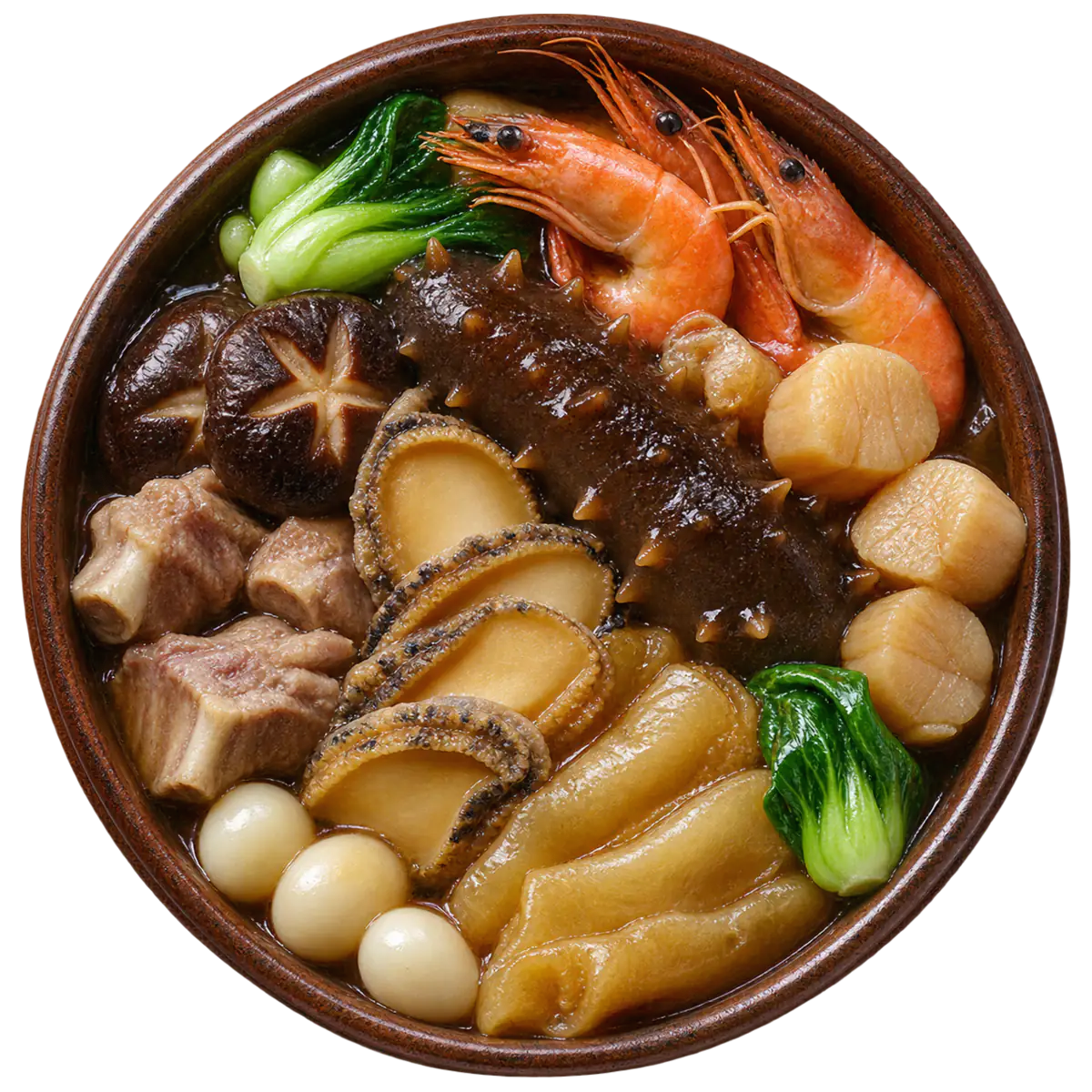
Origin and history
Buddha Jumps Over the Wall comes from Fuzhou, Fujian. China's national intangible heritage record says the dish took shape in the Daoguang reign of the Qing (1821-1850) and was first called Fushouquan; it was renamed after literati at the Juchunyuan restaurant, founded in 1865, improvised poems about it, one line saying the Buddha smelled it and leapt over the wall. According to tradition, a monk was tempted to break his vows.
Make it at home
- Makes
- 8 small bowls
- Total time
- 3 h
- Hands-on
- 40 min
Ingredients
- 300 g10 1/2 oz chicken feet, chopped, nails trimmed
- 300 g10 1/2 oz pork spare ribs, chopped into short pieces
- 50 g1 3/4 oz dried shrimp, rinsed
- 30 g1 oz Jinhua ham, thinly sliced
- 20 g3/4 oz ginger, sliced
- 3 pieces dried fish maw (hua jiao), soaked in cold water for 2 days until fully soft, changing the water
- 40 g1 1/2 oz dried scallops (yao zhu), soaked overnight, until soft
- 3 dried shiitake mushrooms, soaked until soft, chopped
- 150 g5 1/4 oz sea cucumber, pre-soaked or thawed, cleaned, cut in pieces
- 6 abalone, shelled and cleaned; good canned abalone works
- 100 g3 1/2 oz cooked quail eggs, peeled
- 200 g7 oz fresh prawns, peeled, deveined
- 100 g3 1/2 oz heart of a leafy green (choy sum hearts), added only at the end
- 60 ml1/4 cup Shaoxing wine
- 1.7 L7 cups water or light chicken stock
Method
-
1. Two days ahead, soak the fish maw in cold water, changing it daily, until it is soft all through. Soak the scallops and the mushrooms the day before. Clean the sea cucumber and abalone and keep them cold.
-
2. Blanch the chicken feet and ribs in boiling water for 3 minutes, then rinse them clean. Roast or pan-fry them until browned in places, which gives the broth depth.
-
3. Dry-fry the dried shrimp and the sliced ginger in a little oil in a heavy pot until fragrant. Add the browned chicken feet and ribs, the ham, the wine and the water or stock.
-
4. Bring to a boil, skim off the foam, then cover and cook at the gentlest simmer for about 1 hour 30 minutes, until the bones give up their flavor and the liquid is amber.
-
5. Prepare each remaining ingredient on its own: blanch the fish maw and sea cucumber in ginger water for a few minutes, and briefly steam or fry the scallops and mushrooms.
-
6. Lay the ribs and the broth's solids in the bottom of a clay pot or a deep, lidded casserole, then add the mushrooms, fish maw, scallops and sea cucumber in layers, with the quail eggs on top. Pour in the strained broth to cover.
-
7. Cover tightly and cook at the lowest heat, or in an oven at 120 °C / 250 °F, for 1 hour. Add the abalone and cook 20 minutes more so it stays tender.
-
8. Add the prawns and the greens for the last 3 minutes, until the prawns are pink and the greens are bright. Taste, season with salt, and serve in small bowls with all the layers in each portion.
Notes
- This is a scaled-down home version of a banquet dish. The Fuzhou original uses more than thirty ingredients (shark fin, dried abalone, sea cucumber, scallops, fish maw, tendon, old duck and more), each prepared separately by steaming, frying, blanching or sauteing, then layered in a jar and simmered over low heat for several hours until the broth turns amber but stays mellow.
- Substitutions: this home version leaves out shark fin and bird's nest, which the banquet dish uses. Canned abalone replaces dried; add it late because long cooking toughens it. Pork tendon, bamboo shoots, taro and a duck leg are common additions in other versions; the Fuzhou record lists tendon, bamboo tips and old duck.
- The simpler Taiwanese home versions roast the ribs, chicken wings, taro and quail eggs first, pile them in a bowl with cabbage, mushrooms, dried scallops, lotus seeds and red dates, add hot stock, seal the bowl with foil and steam it in an electric rice cooker for about 1 hour (the source says the traditional way takes 2 to 3 hours or more).
- Make-ahead: the broth and the soaked ingredients can be ready a day early; the assembled pot reheats gently and is better the next day.
Adapted from Cookidoo, Buddha Jumps Over the Wall (ingredient list and weights), China News Service, feature on Buddha Jumps Over the Wall (technique), National intangible heritage record (ihchina.cn), and KT Xie Kai-ting, Early Health (edh.tw), home version.
At the festivals
No festival we list has printed it on a menu yet.