
🇨🇳 China · Guangdong, Hong Kong and Chaoshan especially; eaten across East and Southeast Asia
CongeeChinese rice porridge
Also called zhou
What is congee?
Rice simmered in a large amount of water until the grains burst and soften into a thick, creamy porridge, eaten plain (baizhou) or with toppings such as pork, fish, century egg, ginger, spring onion and fried dough sticks. Breakfast food and late-night food across southern China.
- Total time
- 1 h 15 min
- Hands-on
- 30 min
- Makes
- 4 servings
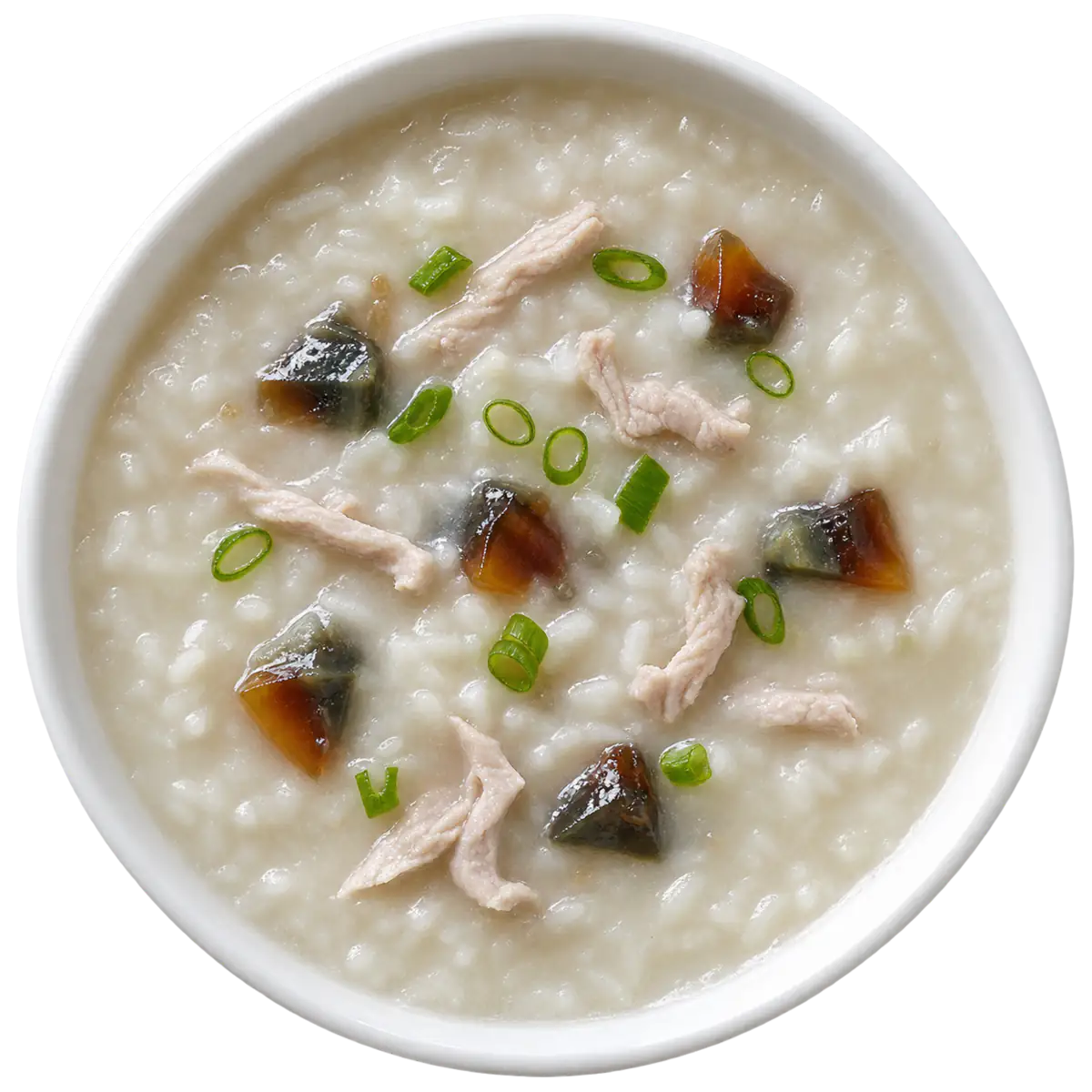
Congee recipe
- Total time
- 1 h 15 min
- Hands-on
- 30 min
- Makes
- 4 servings
Congee ingredients
- 150 g3/4 cup jasmine or long-grain white rice, rinsed until the water runs nearly clear
- 2 L8 1/2 cups water
- 4 slices fresh ginger
- 150 g5 oz lean pork, cut into thin shreds
- 2 century eggs, peeled and diced
- salt, to taste
- white pepper, to taste
- spring onions, thinly sliced, to finish
- youtiao (fried dough sticks), pickled mustard greens or salted duck egg, optional, to serve
How to make congee
-
1. Rinse the rice two or three times in cold water and drain it.
-
2. Bring the water to a rolling boil in a tall pot over high heat.
-
3. Add the rice, return to the boil, then lower the heat to a steady simmer and set the lid slightly ajar.
-
4. Cook for about 40 minutes, stirring from time to time and scraping the bottom, until the grains have burst and the porridge is thick and creamy.
-
5. Add the ginger and pork, stirring to separate the shreds, and cook for about 10 minutes, until the pork is cooked through.
-
6. Stir in the diced century eggs and cook for 5 minutes more.
-
7. Season with salt and white pepper to taste.
-
8. Ladle into bowls and top with spring onions and, if you like, youtiao or pickles on the side.
Notes
- HK01 soaks the rice for 30 minutes before cooking (not included in the time here); SBS freezes the washed rice for at least 8 hours, which it says shortens the cooking and gives a silkier texture.
- Water proportions in the sources run from 1:12 to 1:13 (HK01, America's Test Kitchen) to 1:15 (a Hong Kong recipe), by weight; this recipe uses about 1:13 and gives a creamy porridge. Use less water for a thicker bowl.
- Cantonese congee is divided into a soft school with no visible grains (Guangzhou, Zhuhai, Shenzhen) and a firm one where grains stay visible (Chaoshan, Zhanjiang, Maoming); this recipe is closer to the soft style.
- Variations: plain white congee (baizhou) with salted eggs and pickles; fish congee (sliced fish added raw to the boiling congee at the end); sheng-gun congee, in which raw ingredients are cooked by the heat of the base; tingzai congee with fish, squid and pork skin.
- Broken rice breaks down faster and gives a smoother base (Chinese Cooking Demystified). A century egg's alkali speeds the breakdown of the rice, according to a Singapore chef quoted by The Peak.
- Leftover congee thickens as it cools; loosen it with hot water when reheating.
- Quantities scale up a Hong Kong century egg and pork congee (100 g rice, 100 g pork, 1 egg, 3 slices ginger, 1.5 L water) by half and adjust the water to the 1:13 proportion that HK01 and America's Test Kitchen use; the simmer is a little longer than HK01's 21 minutes, closer to the Hong Kong recipe's 40 and America's Test Kitchen's 45.
Adapted from Bowtie (Hong Kong): 白粥 and 皮蛋瘦肉粥, HK01 (Hong Kong): 煲粥貼士 white congee method, America's Test Kitchen: Congee (Chinese Rice Porridge) with Stir-Fried Ground Pork, and SBS Food, ArChan Chan: Quick congee (san gwan juk).
Congee origin and history
Sources place congee in Chinese texts from the Zhou dynasty, about 2,500 to 3,000 years ago, and the Qing scholar Yuan Mei wrote about it in the Suiyuan Shidan. The English name is said to come from Tamil kanji by way of the Portuguese. The Peak says Cantonese cooks treat porridge as an art form, with plain, old-fire and sheng-gun forms, and a firmer style in Chaoshan; it is a breakfast, snack and late-night dish across Guangdong.
Congee at soup festivals
No festival we list has printed it on a menu yet.