
🇬🇭 Ghana · Bono (Brong Ahafo) and Ashanti, Akan
AbunuabunuGhanaian cocoyam leaf soup
An Akan green soup whose name means 'green green': cocoyam leaves (kontomire) cooked with tomatoes, onion, pepper and smoked fish (sometimes mushrooms or snails), eaten with fufu, rice or boiled plantain.
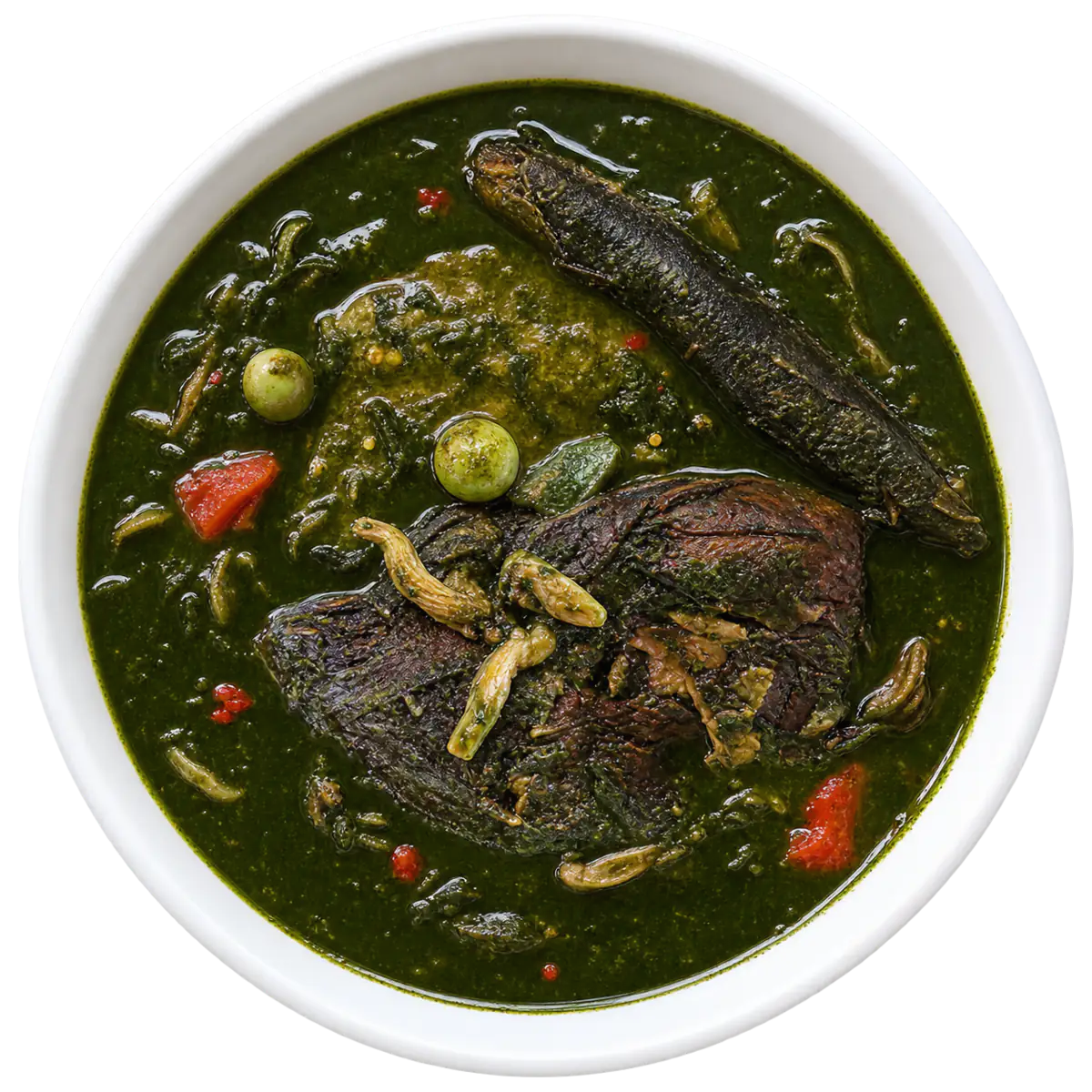
Origin and history
Abunuabunu is an Akan soup associated with the Bono people of the Brong Ahafo region of Ghana and is eaten across Akan areas, where it is also called ebunu ebunu. The name means 'green green' and describes the finely blended cocoyam leaves that colour it. Sources record it as a household soup with little documented history beyond that.
Make it at home
- Makes
- 5 servings
- Total time
- 1 h 15 min
- Hands-on
- 40 min
Ingredients
- 500 g1.1 lb kontomire (cocoyam or taro leaves), stems stripped, washed well
- 8 to 10 turkey berries (kwahu nsusua), small green pea-eggplants; see notes
- 4 large (about 600 g)4 large (1.3 lb) ripe tomatoes, roughly chopped
- 2 onions, chopped
- 1 to 2 hot peppers (kpakpo shito or scotch bonnet), to taste
- 2 cm3/4 in fresh ginger, peeled
- 1 clove garlic
- 400 g14 oz smoked fish (mackerel or herring), bones removed, in chunks
- 250 g9 oz goat meat or mushrooms, optional; traditional cooks also add giant African snails
- 600 ml2.5 cups water, plus more as needed
- 1 tbsp lemon juice, to clean snails or fish, if used
- salt and a bouillon cube, to taste
Method
-
1. Put the washed cocoyam leaves and the turkey berries in a pot with a splash of water, cover, and cook for about 10 minutes until the leaves collapse.
-
2. Blend the cooked leaves and berries with one hot pepper until very smooth. Set this green purée aside.
-
3. Blend the tomatoes, one onion, the ginger and the garlic with a little water into a smooth sauce.
-
4. If using goat, season it with salt and onion and simmer it in the pan with a little water for 30 to 40 minutes until tender. Snails should be boiled, scrubbed with salt and rinsed, then rinsed again with lemon juice.
-
5. Add the tomato sauce to the pot, stir, and add water until the meat is just covered. Simmer for 15 to 20 minutes into a thin, light soup base.
-
6. Add the smoked fish and the bouillon cube, simmer for 5 minutes, then lift the fish out and keep it aside so it does not fall apart.
-
7. Stir the green purée into the base, add water to reach a spoon-coating, soup-like thickness, and the remaining chopped onion if you like, and simmer partly covered for 10 to 15 minutes, stirring now and then.
-
8. Return the fish, season with salt, and warm for 2 minutes. The soup should be thick, deep green and fragrant with smoke and pepper.
Notes
- The usual accompaniment is fufu (cassava and plantain pounded together), eaten by pinching a piece, dipping and swallowing. Rice, banku, boiled plantain and boiled yam also go with it.
- Abunuabunu (also ebunu ebunu or abubunabunu, 'green green') comes from the Bono people of Ghana's Brong Ahafo region and the Akan. Sources disagree on details: some add goat, snails, mushrooms or salted tilapia (koobi); others use only smoked fish. It is cooked on a tomato base like light soup, with the green purée stirred in.
- Do not confuse it with kontomire stew (palaver sauce), a different dish: the cocoyam leaves are fried in palm oil, often with ground melon seeds, and it is eaten as a thick stew. Some Ghanaian writers use ebunu ebunu for both, so recipes vary; this one follows the thinner, bowl-served soup.
- Cocoyam (taro) leaves are sold at African and Asian grocers, often frozen. If you cannot find them, spinach is the usual substitute, but the soup will be less earthy and thinner in body; use about 600 g spinach and simmer a few minutes less. Never eat raw taro leaves: they must be boiled, which the first step does.
- Turkey berries (kwahu nsusua) are a bitter pea-eggplant. Thai pea eggplants from an Asian grocery are the closest substitute; failing that, 1 small aubergine, boiled with the leaves.
- Smoked mackerel or herring, with or without snails, is interchangeable. A mushroom version is also traditional. Keep the heat to taste.
- Reheats well for 2 to 3 days in the refrigerator; add a little water when warming.
Adapted from Abunuabunu Nkwan, Nkenne, Ebunu ebunu soup, Diana Bamoako, and How to make the perfect traditional Ebunuebunu, Pulse Ghana.
At the festivals
No festival we list has printed it on a menu yet.