
🇲🇾 Malaysia · Penang
Asam laksaPenang sour fish noodle soup
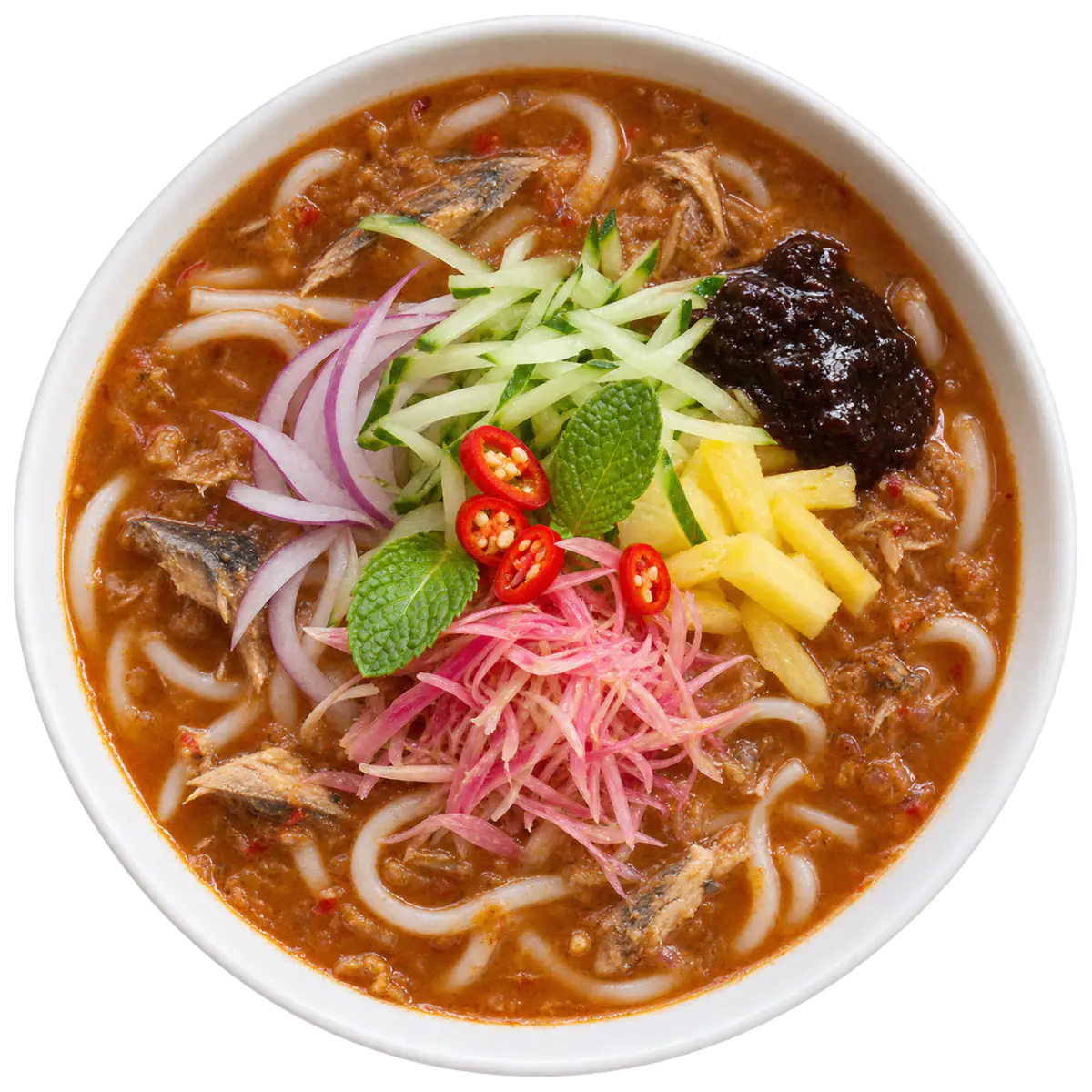
Penang's sour noodle soup: thick rice noodles in a fish broth of mackerel (ikan kembung) cooked with tamarind and asam keping, lemongrass, galangal, chilli and belacan, with no coconut milk, topped with cucumber, pineapple, onion, mint, torch ginger flower and thick prawn paste (hae ko).
Origin and history
Asam laksa is the laksa of Penang in Malaysia, named for the Malay word asam, 'sour', after the tamarind that defines it. It is one of the few laksas made without coconut milk: a mackerel broth soured with tamarind and asam keping, scented with torch ginger flower and laksa leaf. It is a hawker dish, cooked by family stalls across Penang, some of them in the same family for three generations and around fifty years.
Make it at home
- Makes
- 6 servings
- Total time
- 1 h 30 min
- Hands-on
- 50 min
Ingredients
- 1 kg2.2 lb ikan kembung (Indian mackerel), or fresh sardines, whole, gutted and scaled
- 2.5 l10 1/2 cups water
- 6 slices asam keping (dried garcinia slices)
- 15 dried red chillies, for the paste; seeded, soaked in hot water 15 minutes
- 3 fresh red chillies, for the paste; roughly chopped
- 150 g5 oz shallots (about 10), for the paste; peeled
- 20 g3/4 oz fresh turmeric (kunyit), for the paste; peeled
- 30 g1 oz galangal (lengkuas), for the paste; sliced
- 2 stalks lemongrass (serai), for the paste; white part, sliced
- 1 tbsp belacan (shrimp paste), for the paste; toasted in a dry pan until it smells strongly
- 3 tbsp vegetable oil
- 2 stalks lemongrass, for the broth; bruised
- 30 g1 oz galangal, for the broth; thickly sliced
- 1 bunga kantan (torch ginger flower), for the broth; halved lengthwise
- 1 small bunch daun kesum (laksa leaf, Vietnamese coriander), for the broth; on the stalk
- 60 g2 oz tamarind pulp (asam jawa), soaked in 250 ml (1 cup) warm water, squeezed and strained
- 2-3 tbsp sugar, to taste
- salt, to taste
- 800 g1.75 lb fresh thick round rice noodles (laksa noodles, laifun), or 350 g (12 oz) dried, cooked as the packet says
- 1 cucumber, for the topping; seeded, cut in fine matchsticks
- 1/4 pineapple, for the topping; cut in fine matchsticks
- 1 red onion, for the topping; thinly sliced
- 1 bunga kantan (torch ginger flower), for the topping; very finely sliced
- 1 bunch mint, for the topping; leaves picked
- lettuce and sliced red or bird's eye chilli, for the topping; shredded lettuce, to taste
- 4 tbsp hae ko (thick black prawn paste, petis udang), loosened with a little hot water to a pouring syrup
Method
-
1. Bring the 2.5 l (10 1/2 cups) of water to the boil in a large pot, add the mackerel and the asam keping and simmer for 10 minutes, until the fish is cooked through.
-
2. Lift out the fish, leaving the asam keping in the pot, and let it cool until you can handle it.
-
3. Pick all the flesh from the bones in small flakes and set it aside; return the heads and bones to the pot and simmer for 15 minutes more.
-
4. Strain the stock through a fine sieve into a bowl, pressing on the bones, and discard them; keep the asam keping.
-
5. Pound or blend the paste ingredients (dried and fresh chillies, shallots, turmeric, galangal, lemongrass and belacan) to a fine paste, adding a spoonful of water if the blender needs it.
-
6. Heat the oil in the cleaned pot over medium heat and fry the paste for 6 to 8 minutes, stirring, until it darkens, smells sweet and the oil separates from it.
-
7. Pour in the fish stock, then add the tamarind water, the asam keping, the bruised lemongrass, sliced galangal, halved torch ginger flower and daun kesum.
-
8. Bring to the boil, lower the heat and simmer uncovered for 30 to 40 minutes, until the broth is fragrant and slightly reduced; add hot water if it drops by more than a quarter.
-
9. Fish out the lemongrass, galangal, torch ginger and daun kesum, then return the flaked fish to the pot; the fish breaks down and gives the broth body.
-
10. Season with sugar and salt and simmer 5 minutes more; the broth should taste clearly sour first, then hot, salty and slightly sweet.
-
11. Just before serving, dip the noodles into boiling water for 20 to 30 seconds in a strainer to heat them, shake dry and divide among deep bowls.
-
12. Ladle the boiling broth and fish over the noodles, pile cucumber, pineapple, onion, lettuce, chilli, mint and sliced torch ginger on top, and drizzle a spoonful of hae ko over each bowl or serve it on the side.
Notes
- Asam laksa is not made from the coconut curry laksa recipe: its broth is fish, tamarind and asam keping with no coconut milk. In Penang 'laksa' means this soup, and the coconut version goes by curry mee; the site's laksa page covers that branch.
- Fish: ikan kembung (Indian mackerel) is the usual choice for its rich, oily flesh; sardines are common too, and some hawkers use wolf herring (ikan parang) or Spanish mackerel. Penang hawkers flake the fish by hand, and some boil the heads and bones separately for a deeper stock.
- Some cooks do not fry the paste and simply boil it in the stock with the aromatics; the result is lighter and sharper. Frying gives a rounder, slightly sweeter broth.
- Hae ko is a thick, sweet, black fermented prawn paste, not belacan. Add it to taste, a little at a time: it changes the soup's flavour completely.
- Substitutions: without torch ginger flower, the broth loses its floral note; a little extra lemongrass and a few lime leaves come closest. Without daun kesum, use mint and coriander, which are milder. Tamarind concentrate can replace the pulp (start with half the amount).
- Make-ahead: the broth tastes better the next day. Keep it in the fridge, bring it back to a full boil and assemble the bowls only when serving.
- In Penang it is eaten at any hour from hawker stalls, often with spring rolls dipped in the broth.
Adapted from Aim Aris and Ahmad Salim, Penang Local (Smith Street Books), Penang asam laksa, via SBS Food, Margarita Lee, Ipoh Echo, Recipe: Penang asam laksa, and Michelin Guide Malaysia, How to make the perfect assam laksa.
At the festivals
No festival we list has printed it on a menu yet.