
🇺🇸 United States · Upper Midwest (northeast Wisconsin, Minnesota, Michigan Upper Peninsula)
BooyahWisconsin meat and vegetable stew
A thick stew-soup of mixed meats (chicken, beef, sometimes pork) and vegetables simmered in a bone broth in very large kettles, made for crowds at church, fire-department and club gatherings.
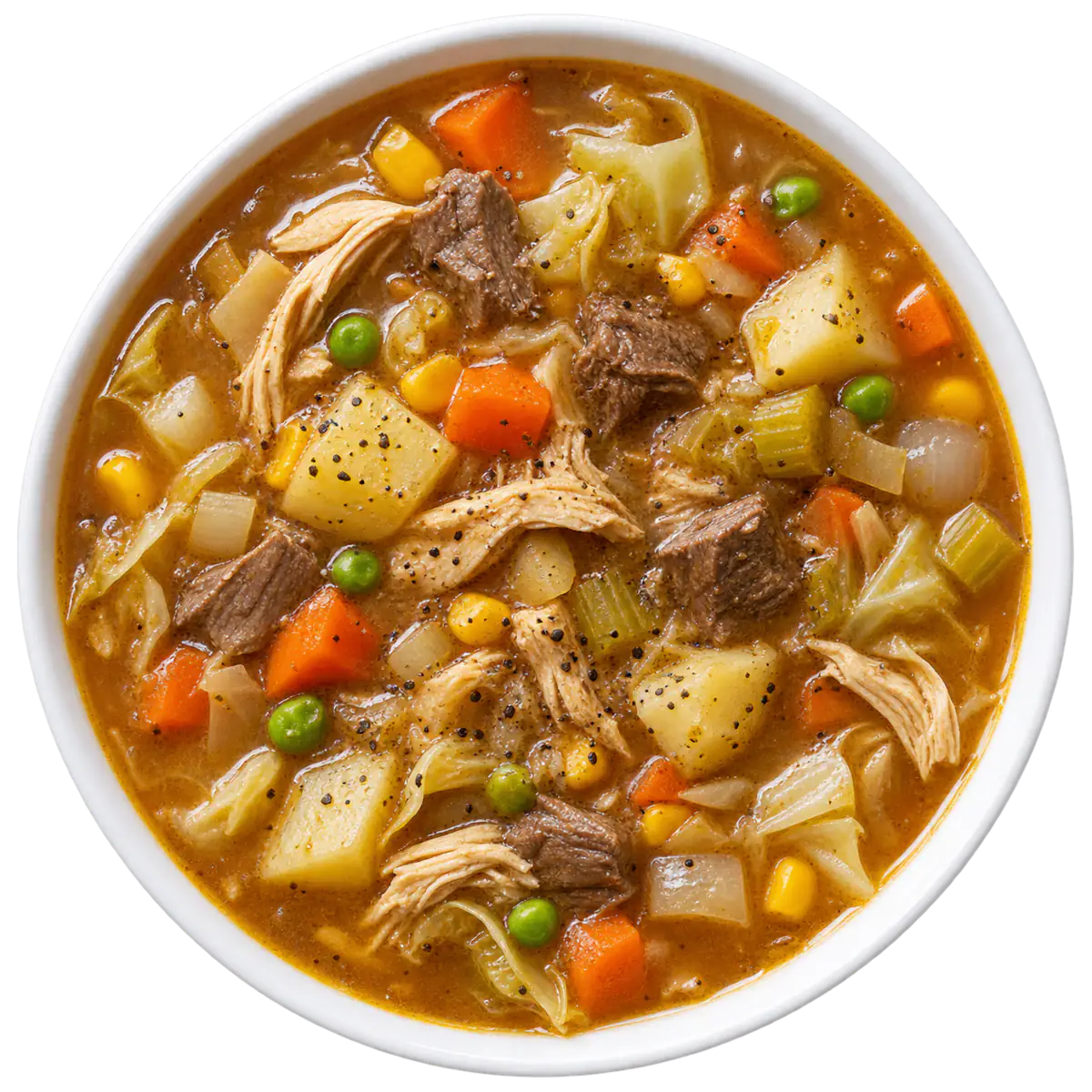
Origin and history
Booyah came to north-eastern Wisconsin with Walloon (French-speaking Belgian) settlers who arrived from 1853 around Green Bay, Brussels and the Door peninsula. The name is usually traced to bouillon or the Walloon bouyon (broth). According to a 1976 Green Bay Press-Gazette story, a newspaper misprinted 'bouillon' as 'booyah' at a school picnic; other families claim the invention too. Cooked in huge kettles, it feeds church picnics, fire-department fundraisers and fairs across Wisconsin, Minnesota and Michigan's Upper Peninsula.
Make it at home
- Makes
- 8 servings (about 5 l / 5 qt)
- Total time
- 4 h 30 min
- Hands-on
- 1 h
Ingredients
- 1 (1.8 kg)1 (4 lb) whole chicken, or a stewing hen, quartered; roast it first for a deeper flavour if you like
- 500 g1.1 lb beef shank or oxtail, on the bone
- 450 g1 lb bone-in pork (country ribs or shoulder), optional
- 4 l4 qt cold water
- 2 large onions, finely chopped; half for the broth
- 1 bay leaf
- 4 carrots, diced
- 4 stalks celery, diced
- 1 small (300 g)1 small (10 oz) rutabaga, peeled and diced; optional
- 800 g1.75 lb potatoes, peeled and diced
- 1/4 head (300 g)1/4 head (10 oz) green cabbage, shredded; optional
- 150 g1 cup green beans, cut short
- 1 can (400 g)1 can (14.5 oz) whole tomatoes, chopped, with juice; optional
- 150 g1 cup peas, fresh or frozen
- salt and black pepper, to taste
Method
-
1. Put the chicken, beef and pork in a large heavy pot or cast-iron Dutch oven with the cold water, half the onion and the bay leaf. Bring slowly to a boil and skim off the foam.
-
2. Lower the heat and simmer gently. After 45 minutes, when the chicken is tender, lift it out to cool.
-
3. Keep simmering the beef and pork for another 1 1/2 hours, until the meat comes away from the bone. Lift them out to cool.
-
4. Strain the broth and skim off most of the fat. Pull all the meat from the bones, discard skin and bones, and cut the meat into small pieces.
-
5. Return the broth to the pot with the rest of the onion, the carrots, celery, rutabaga and potatoes. Simmer for 20 minutes.
-
6. Add the cabbage, green beans and tomatoes and simmer for 20 minutes more.
-
7. Add the meat and the peas and keep the pot at a bare simmer for 30 to 45 minutes more, stirring from the bottom, until the potatoes have started to break down and the booyah is thick and stew-like. Season well with salt and pepper.
-
8. Serve in big bowls, with bread or crackers.
Notes
- There is no single recipe: every kettle crew has its own. Chicken is the constant; beef (often oxtail or shank) and pork are common additions, and the vegetables change with what is at hand.
- The traditional way is a crowd-sized batch in a cast-iron or steel kettle over a wood fire, stirred with a paddle for 12 hours or more; some crews cook for two days. At home a long, gentle simmer gives the same thick result.
- A rapid boil dries out the chicken, so keep the pot just trembling once the meat is in.
- Like most stews it is better the next day; it also freezes well, which is why church and fire-department booyahs sell it by the quart or gallon to take home.
- Minnesota 'booya' and Michigan versions are the same dish under other spellings.
Adapted from Chicken Booyah History and Recipe, What's Cooking America and A Belgian Beauty – Booyah, Great Lakes Cuisine.
At the festivals
Served at 1 festival in United States.
Earlier editions
-
September 20, 2025
🇺🇸 Cadott, Wisconsin, United States
Cadott Booya Days
On the menu as Booya Soup
By Booya soup crew (coordinator Krystal Thom)