
🇩🇪 Germany, 🇦🇹 Austria, and 🇨🇭 Switzerland · Swabia, Baden, Vorarlberg (Flädle); Austria (Frittaten)
FlädlesuppeGerman pancake soup
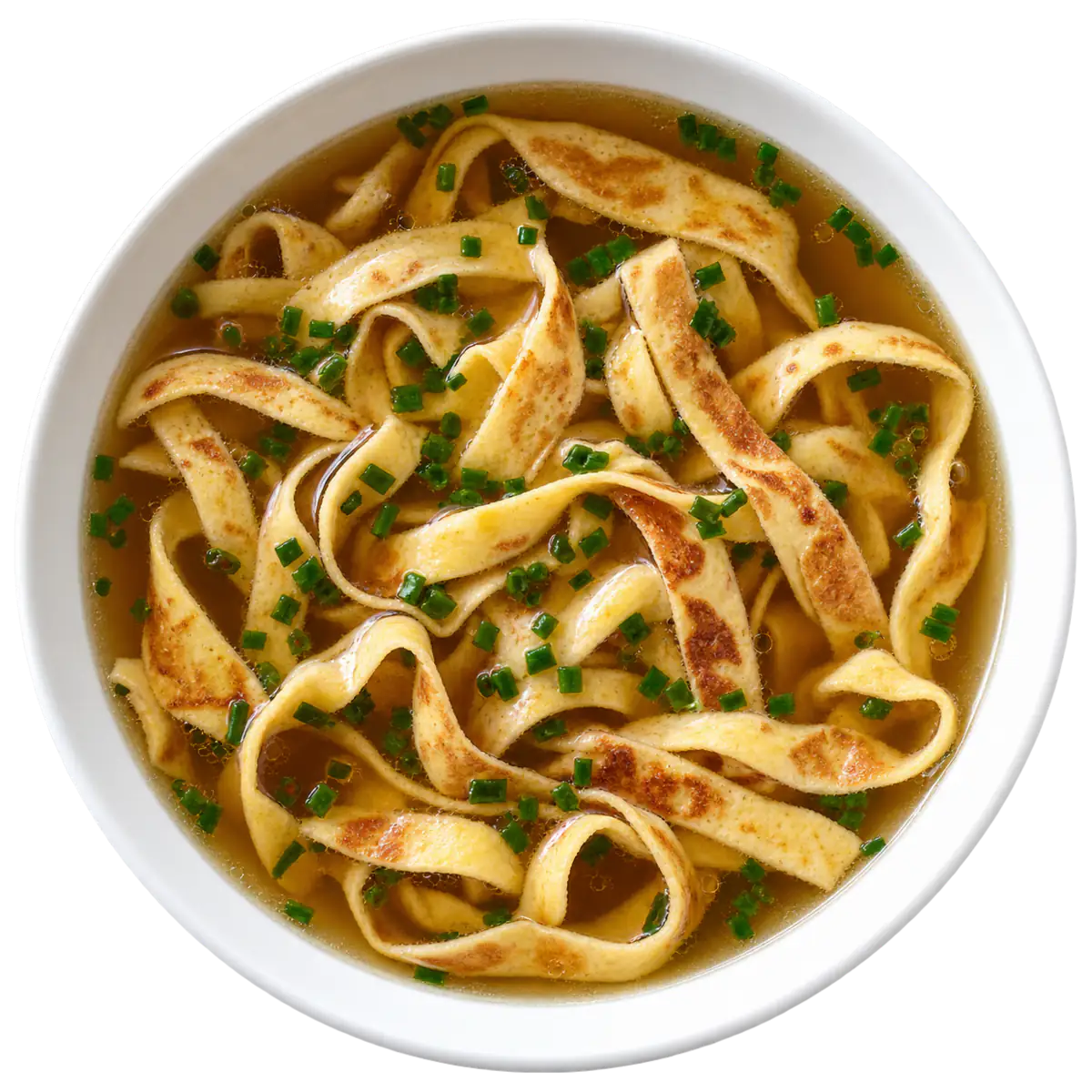
Clear beef broth garnished with thin pancake strips and chives.
Origin and history
Pancake strips in clear beef broth are a staple first course across the southern German-speaking lands. Swabians and Badeners call the strips Flädle, a diminutive of Fladen (a flat cake); Austrians call them Frittaten, a name taken from Italian frittata. The pancakes themselves are the Palatschinken that reached Vienna from Hungary, and the Viennese soup tradition kept such garnishes alive in old cookbooks and inn kitchens.
Make it at home
- Makes
- 4 servings
- Total time
- 3 h
- Hands-on
- 40 min
Ingredients
- 1 kg2.2 lb beef for boiling (Suppenfleisch: short rib, brisket or shank), in one or two pieces
- 1–2 beef marrow or soup bones, optional, for a fuller broth
- 3 L3 qt cold water
- 1 onion, unpeeled, halved
- 1 bunch soup greens (Suppengrün): carrot, a piece of celeriac, leek, parsley root or parsley, washed and cut in large pieces
- 1 tsp black peppercorns
- 1 bay leaf
- 2 tsp salt, plus more to taste
- 125 g1 cup plain wheat flour, for the Flädle
- 250 ml1 cup + 1 tbsp milk
- 2 eggs
- 1 pinch salt, for the batter
- 20 g1 1/2 tbsp butter or clarified butter, for frying
- 1 bunch chives (Schnittlauch), finely snipped
Method
-
1. Put the beef and bones in a large pot with the 3 L (3 qt) of cold water and bring it slowly to a simmer.
-
2. Skim off the grey foam as it rises, then keep the pot at a bare simmer, uncovered, for 1 hour 30 minutes; a rolling boil makes the broth cloudy.
-
3. Meanwhile, set the onion halves cut side down in a dry frying pan and let them blacken over medium-high heat; this gives the broth its golden colour.
-
4. Add the browned onion, soup greens, peppercorns, bay leaf and salt to the pot and simmer for about 1 hour more, until the meat is tender when pierced.
-
5. While the broth cooks, whisk the flour with half of the milk until smooth, then whisk in the rest of the milk, the eggs and a pinch of salt; let the batter rest for 20 minutes.
-
6. Heat a little butter in a 24–26 cm (10 in) frying pan and pour in just enough batter to coat the base thinly, tilting the pan.
-
7. Fry until the edge lifts and the underside has light brown spots, turn and cook the other side briefly; repeat to make 4–5 thin pancakes.
-
8. Let the pancakes cool, roll each one up tightly and cut it across into thin strips, about 3–5 mm (1/8–1/4 in) wide.
-
9. Lift out the meat and strain the broth through a fine sieve (lined with a cloth for a very clear soup); skim off excess fat and season with salt.
-
10. Divide the pancake strips among warmed soup plates, pour the boiling-hot broth over them and scatter generously with chives; serve at once, before the strips go soft.
Notes
- The same soup goes by several regional names: Flädlesuppe in Swabia, Baden and Vorarlberg, Flädlisuppe in German-speaking Switzerland, Frittatensuppe in Vienna and most of Austria, Pfannkuchensuppe in Bavaria, Eierkuchensuppe elsewhere in Germany, Fanzelsuppe in Jewish cookery. French cuisine knows it as consommé Célestine.
- Many cooks stir finely chopped parsley or chives into the batter. Viennese cooks traditionally clarify the beef broth with egg white for a crystal-clear Rindsuppe.
- The boiled beef is not wasted: a little is diced into the soup, or it is served afterwards as a main course (Tafelspitz-style, with horseradish).
- A good stock cube or vegetable broth is a common shortcut at home; the soup is then lighter and less golden, and it no longer has the depth of a beef broth.
- Make-ahead: the broth keeps 3 days in the refrigerator or months frozen; the pancakes can be made a day ahead and kept wrapped so they do not dry out. Cut them only shortly before serving and never let them stand in the hot broth.
Adapted from Das Sacher Kochbuch (Frittaten, via Wien Tourismus) and für Sie: Klassische Flädlesuppe.
At the festivals
Served at 1 festival in Germany.
Earlier editions
-
November 15, 2025
🇩🇪 Lahr, Germany
17. Internationales Lahrer Suppenfest
By Kinderkochstudio der städtischen Kinder- und Jugendarbeit
-
November 23, 2024
🇩🇪 Lahr, Germany
16th Internationales Lahrer Suppenfest
By Kinderkochstudio of the municipal child and youth work