
🇨🇳 China and 🇭🇰 Hong Kong · Guangdong (Lingnan) and Hong Kong
Hong dou shaChinese red bean soup
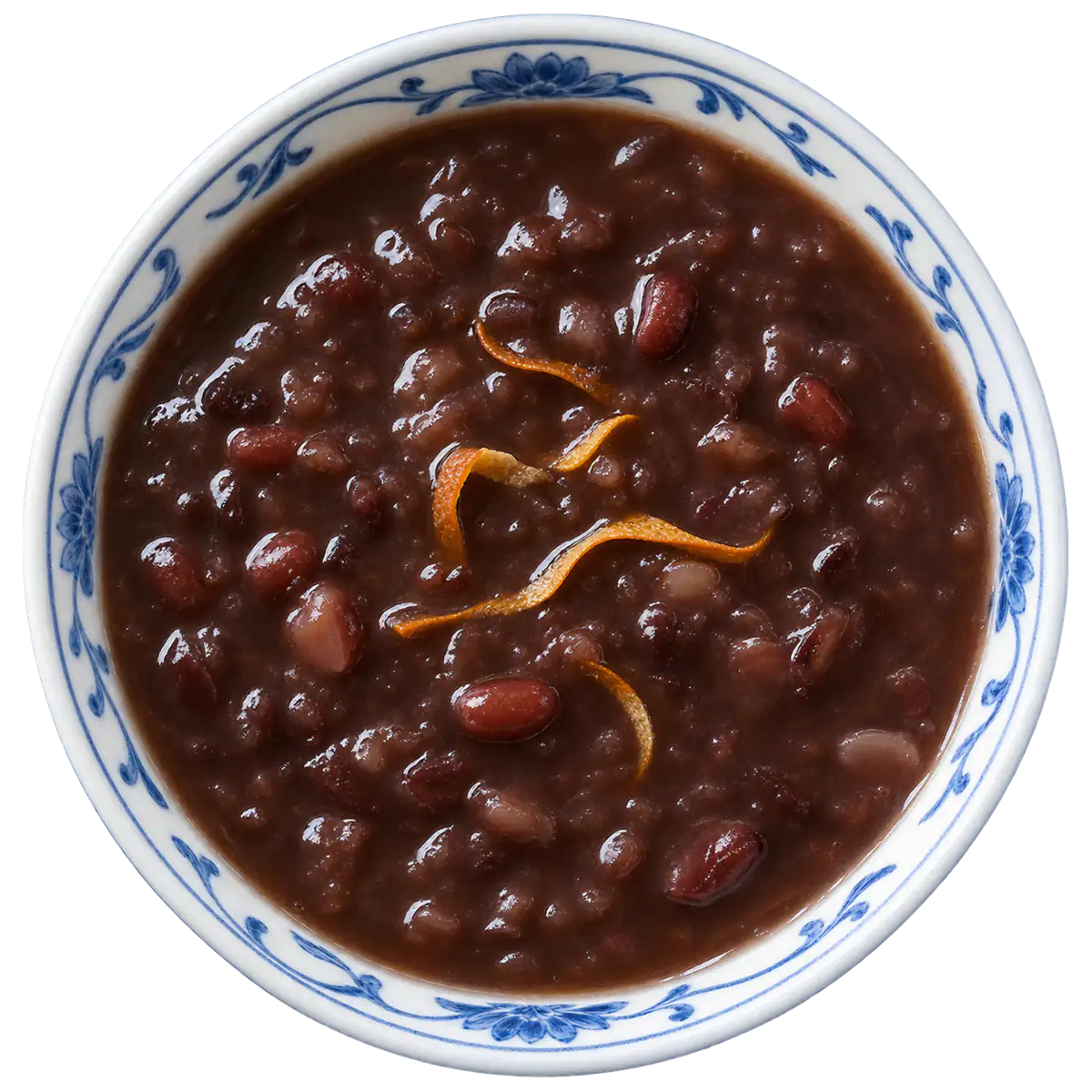
A sweet soup of red (adzuki) beans boiled with dried tangerine peel until they collapse into a soft, grainy 'sand', sweetened with rock sugar. Served hot as a dessert, often at the end of a banquet.
Origin and history
Red bean sand with chenpi is a classic Cantonese sweet soup (tong sui), also loved in Hong Kong. The sources say nothing firm about its origin, but chenpi is tied to Guangdong: Xinhui chenpi has a history reaching back to the Southern Song, large-scale planting of Xinhui citrus began in the Yuan, and from the Ming and Qing periods medical circles considered Guangdong chenpi the best.
Make it at home
- Makes
- 4 servings
- Total time
- 2 h 15 min
- Hands-on
- 25 min
Ingredients
- 200 g1 cup small red (adzuki) beans, rinsed; the small round kind, soaked overnight in plenty of water
- 2 pieces dried tangerine peel (chenpi, 陳皮), soaked in water until soft; scrape off any thick white pith if it is bitter
- 1.2 liters5 cups water, plus a little more to top up
- 80 gscant 1/2 cup rock sugar (冰糖), to taste
- 1/4 tsp salt, just a pinch to lift the sweetness
Method
-
1. Drain the soaked beans. Put them in a pot with the softened chenpi and the water and bring to a boil.
-
2. Reduce the heat to medium-low and simmer for about 1 hour, topping up with hot water if the level drops, until the beans are very soft and break easily when pressed.
-
3. Scoop out the beans with a little liquid and press them through a fine sieve (or mash firmly), to make a grainy, sand-like purée. Discard the skins for a smoother soup, or stir a few back in for bite.
-
4. Return the purée to the pot with the cooking liquid and the peel. Simmer for 30 to 45 minutes on low heat, stirring from time to time, until the soup is thick and grainy like wet sand. Add hot water if it gets too thick.
-
5. Add the rock sugar and the salt and stir until the sugar has completely dissolved. Taste and add a little more sugar if you like.
-
6. Serve hot in small bowls. Remove or leave the peel strips in, as you prefer.
Notes
- 'Sha' means sand: the soup is cooked until the beans fall apart into a soft, grainy texture, not a smooth paste. Chef Lee Ka-ding of Hong Kong advises pressing the cooked beans through a sieve and then simmering further, because simmering alone may not give a good sand texture. Another method freezes the soaked beans for about 5 hours; the freeze and thaw helps them break down.
- Use small round adzuki beans, which are the usual choice for this soup.
- Sugar varies by taste. One source uses 20 to 30 g for 100 g of beans; this recipe uses 80 g for 200 g. Use only a small amount of salt.
- The soup can be served hot or cold. Some cooks add glutinous rice balls and a splash of coconut milk, but the classic version is beans, chenpi and sugar only.
- Chenpi (aged tangerine peel) adds a citrus and slightly bitter fragrance; Xinhui chenpi from Guangdong is the best known. Soak it and scrape away thick white pith to avoid bitterness.
- Make ahead: it keeps in the fridge for 3 to 5 days and thickens as it cools; loosen with a little hot water when reheating.
Adapted from HK01 (Hong Kong), Red bean sand recipe with Chef Lee Ka-ding (鼎爺), Bowtie Hong Kong, 紅豆沙 recipe, and Chinese Cooking Demystified, Cantonese Tong Sui.
At the festivals
No festival we list has printed it on a menu yet.