
🇦🇲 Armenia, 🇬🇪 Georgia, and 🇦🇿 Azerbaijan · and Azerbaijan
KhashCaucasian trotter soup
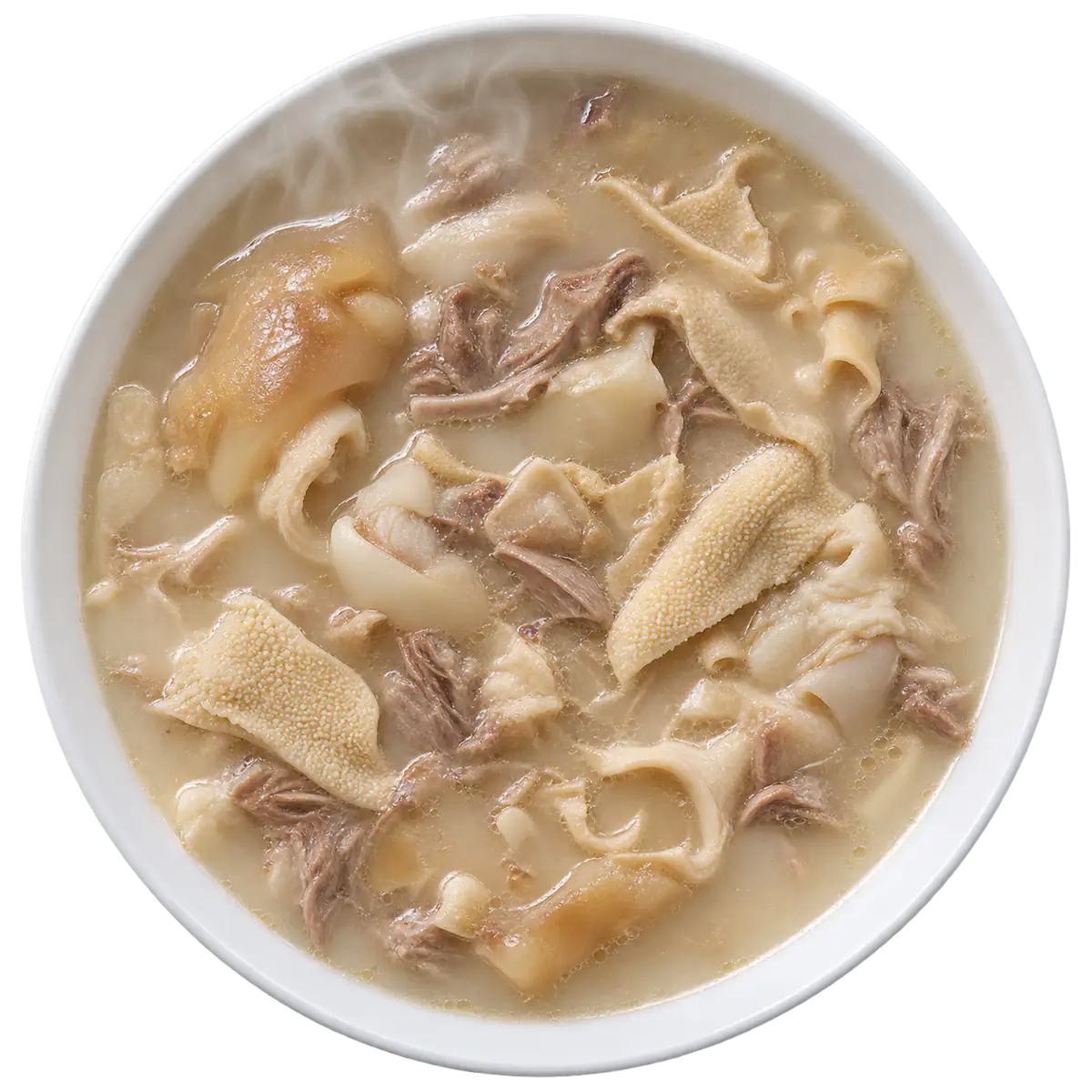
A plainly seasoned soup of cow's or sheep's trotters, shanks and tripe boiled for many hours to a gelatinous milky broth, eaten at dawn in winter with raw garlic, dried lavash and a shot of vodka or chacha.
Origin and history
Khash is cooked in Armenia, Georgia, Azerbaijan, Iran and Turkey, and its origin is disputed: some say Armenia's rural poor in Shirak invented it, others call it Georgian or Azeri. Georgia's tourism board says the name probably comes from Turkish, that the dish was valued for taste, nutrition and low cost, and that in villages it was often boiled the day after a well-attended wedding. An Armenian account links the name to khashel, to boil, and says the bones and joints were what the rich left to poorer households.
Make it at home
- Makes
- 5 servings
- Total time
- 10 h
- Hands-on
- 45 min
Ingredients
- 1.2 kg2.6 lb beef feet (trotters) and shin pieces, cleaned and chopped through the joints by the butcher
- 500 g1.1 lb beef tripe, well cleaned and cut in strips
- 4 l4 quarts water, plus boiling water to top up
- 2 tbsp white vinegar, for the soaking water
- 3 tbsp coarse salt, for rubbing the meat before cooking
- 2 heads garlic, peeled and crushed, to serve
- salt, at the table, to taste
- 250 ml1 cup milk, optional, stirred in at the table (Georgian style)
- 4 sheets of lavash, dried until crisp, broken in pieces
- lemon wedges, radishes, pickles, vodka, to serve
Method
-
1. Rinse the feet, shin and tripe, then soak them in cold water with the vinegar for several hours.
-
2. Rub the pieces with the coarse salt until they look clean and white, then rinse well.
-
3. Put them in a large pot, cover with cold water, bring to a boil and boil for 10 minutes, then drain and discard this first water, rinsing off any scum.
-
4. Return the meat to the pot, add the 4 l (4 quarts) of fresh water and bring to a gentle simmer over low heat; do not add salt.
-
5. Cook half covered overnight, about 8 hours, topping up with boiling water so the pieces stay covered.
-
6. In the morning the hooves should feel soft and glossy, the meat should fall from the bones, and the broth should be pale and milky.
-
7. Lift out the pieces, pull the meat from the bones and discard the bones, then return the meat and tripe to the broth and reheat.
-
8. Warm the bowls, then ladle in the hot khash with a good share of meat and tripe.
-
9. At the table each person adds crushed garlic, salt, and lemon or milk as they like, and crumbles dried lavash into the bowl.
Notes
- The broth is cooked unsalted and plain, and everything is added at the table. In Armenia the garlic, lemon and salt go in with dried lavash, with vodka alongside; in Georgia (khashi) crushed garlic, salt and milk are the usual additions, with chacha.
- Quantities follow Georgia's tourism board, which says 5 kg of khashi makes about 15 servings (roughly 330 g per portion), scaled here to about 1.7 kg for 5 servings. For comparison, Marcus Samuelsson's recipe for PBS uses 4 lb (1.8 kg) of calves' feet for 8 servings and a shorter 5-hour simmer. The vinegar and salt amounts for cleaning are our estimate: the Georgian page says only to soak in vinegar water for a few hours and to coat with coarse salt.
- Georgian khashi uses the head, feet and stomach, in Georgia of beef; elsewhere in the Caucasus and in Muslim countries mutton is usual. The Georgian page also says the tripe is first held in lime so that its inner membrane softens and comes away easily; with ready-cleaned tripe from a butcher you can skip this. Many cooks add pieces of old bread wrapped in gauze to the pot.
- It is a shared meal: the Georgian tourism page says never to eat khashi alone, and it is eaten mostly in winter, often at dawn. Armenian diners dip bowls in boiling water first so the soup stays hot, and crumble dried lavash into it.
- Cleaning is the real work. Ask the butcher for split feet and cleaned tripe; the soup cannot be rushed, so start in the evening.
Adapted from Georgia Travel (Georgian National Tourism Administration): Khashi, Marcus Samuelsson, Khash (PBS Food, No Passport Required), Roads & Kingdoms: Bones, garlic and vodka in Armenia, and The Moscow Times: Khash.
At the festivals
No festival we list has printed it on a menu yet.