
🇫🇷 France · classical cuisine
Lobster bisque
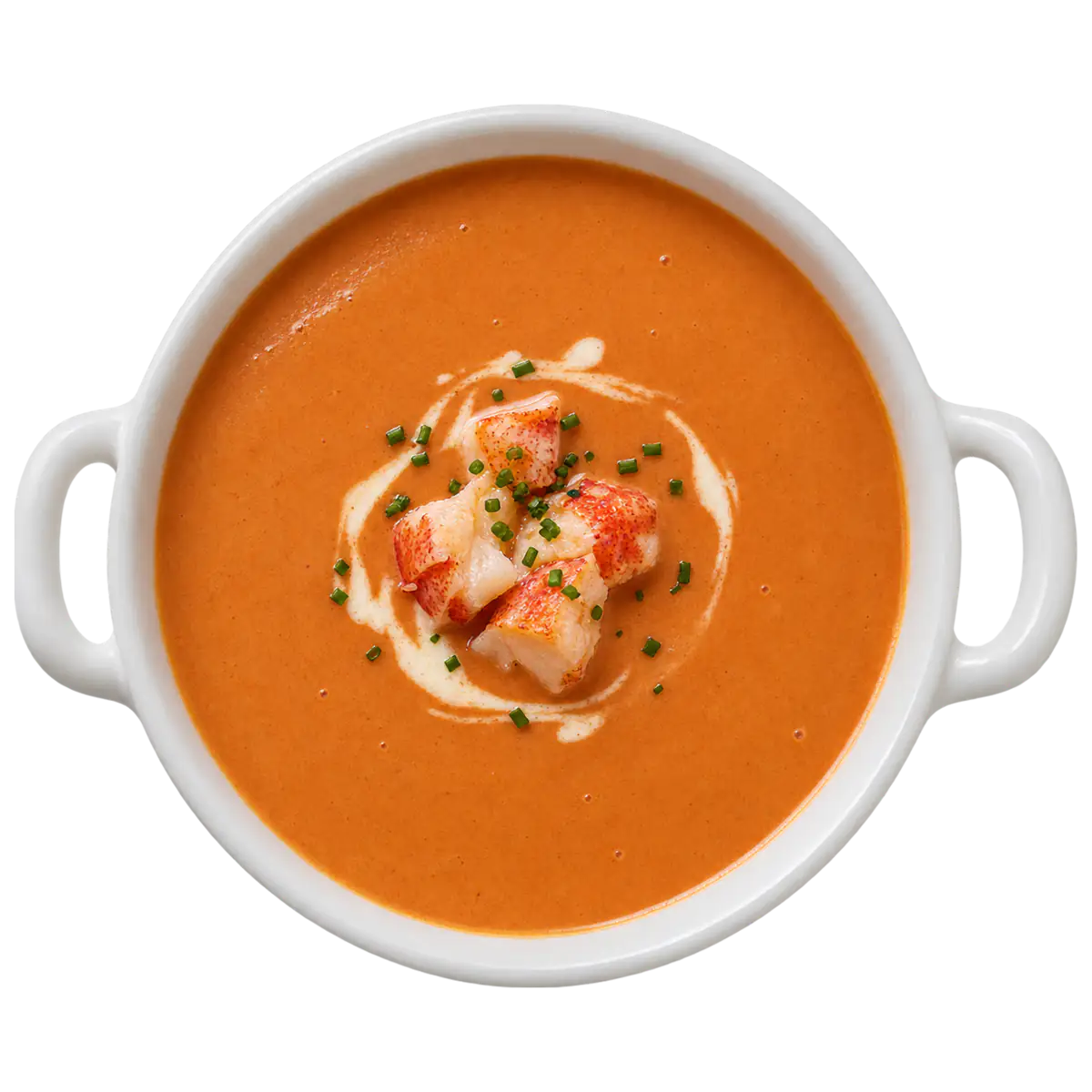
The classical French shellfish soup: lobster shells and mirepoix pounded and simmered in wine or brandy and stock, thickened with rice, rubbed through a fine sieve and finished with butter, cream and a little cayenne, with diced lobster tail.
Origin and history
Bisque is a classical French shellfish soup, made first from crayfish and later from lobster, with the shells ground or pounded and rice as the thickener. Escoffier's Guide to Modern Cookery gives crayfish bisque as recipe 662 and lobster bisque as 663. One source notes that older bisques were spiced game dishes, and that by the 1600s shellfish had become the usual base.
Make it at home
- Makes
- 4 to 6 servings
- Total time
- 1 h 30 min
- Hands-on
- 50 min
Ingredients
- 2 (about 700 g each)2 (about 1.5 lb each) live lobsters, or 2 cooked lobsters plus extra shells
- 3 tbsp butter, plus 70 g (5 tbsp) cold, to finish
- 1 carrot, finely diced
- 1 onion, finely diced
- 1 celery stalk, finely diced
- 30 ml2 tbsp cognac or brandy
- 150 ml2/3 cup dry white wine
- 1.2 litres5 cups fish or light chicken stock
- 85 g1/2 cup long-grain rice
- 1 bouquet garni, thyme, bay, parsley
- 45 ml3 tbsp heavy cream, thick; more makes a richer modern bisque
- cayenne pepper and salt, to taste
Method
-
1. Cut the lobsters into small sections with a heavy knife, shells included, and keep the pieces raw for now.
-
2. Brown the carrot, onion and celery with the bouquet garni and 3 tablespoons of butter in a wide pot, then add the lobster pieces and toss over high heat until bright red, about 5 minutes.
-
3. Add the cognac, light it if you wish, and let the flames die; add the wine and reduce by about half.
-
4. Add 250 ml (1 cup) of the stock and simmer for 10 minutes. Lift out the tail meat, cool it and dice it for the garnish.
-
5. Meanwhile cook the rice in 400 ml (1 2/3 cups) of the stock until very soft, about 25 minutes.
-
6. Pound or finely chop the shells and body with the vegetables, rice and all their cooking liquid. Rub through a coarse sieve, then through a fine one, pressing hard.
-
7. Return the purée to the pot with the remaining stock, bring to a boil while whisking, then strain again.
-
8. Off the heat, stir in the cream and a pinch of cayenne, then swirl in the 70 g of cold butter a piece at a time. Season, add the diced lobster meat and serve hot.
Notes
- Rice is the thickener in the classical method: Escoffier uses about 85 g (3 oz) per 450 g (1 lb) of shellfish, and no flour.
- Escoffier's recipe 662 is crayfish bisque, and lobster bisque (663) is made by substituting lobster; shrimp bisque (664) follows the same procedure. Here the quantities scale his: 3 lb of lobster in all, 2 tablespoons of brandy, 1/4 pint of white wine, 3 oz of rice and 2 1/2 oz of butter, with much less cream than most modern recipes.
- Tomato paste is not in Escoffier's or Larousse's versions; some cooks add a spoonful before the brandy.
- Frozen lobster shells and tails work if live lobster is hard to find.
- Make the strained base ahead; add the cream and butter when reheating, and do not boil it afterwards.
- Icelandic humarsúpa is a related lobster soup with a different character (see its own page).
Adapted from Auguste Escoffier, A Guide to Modern Cookery (recipes 662 and 663), Great British Chefs, Five soups and sauces every cook should know, and Nosey Chef, Larousse-based bisque de homard.
At the festivals
No festival we list has printed it on a menu yet.