
🇰🇷 South Korea · Korea; freshwater river forms are best known inland
MaeuntangKorean spicy fish soup
Fish cut into pieces, with the head and innards, simmered with radish, tofu and scallion in a broth made hot with gochugaru or gochujang, ginger and garlic.
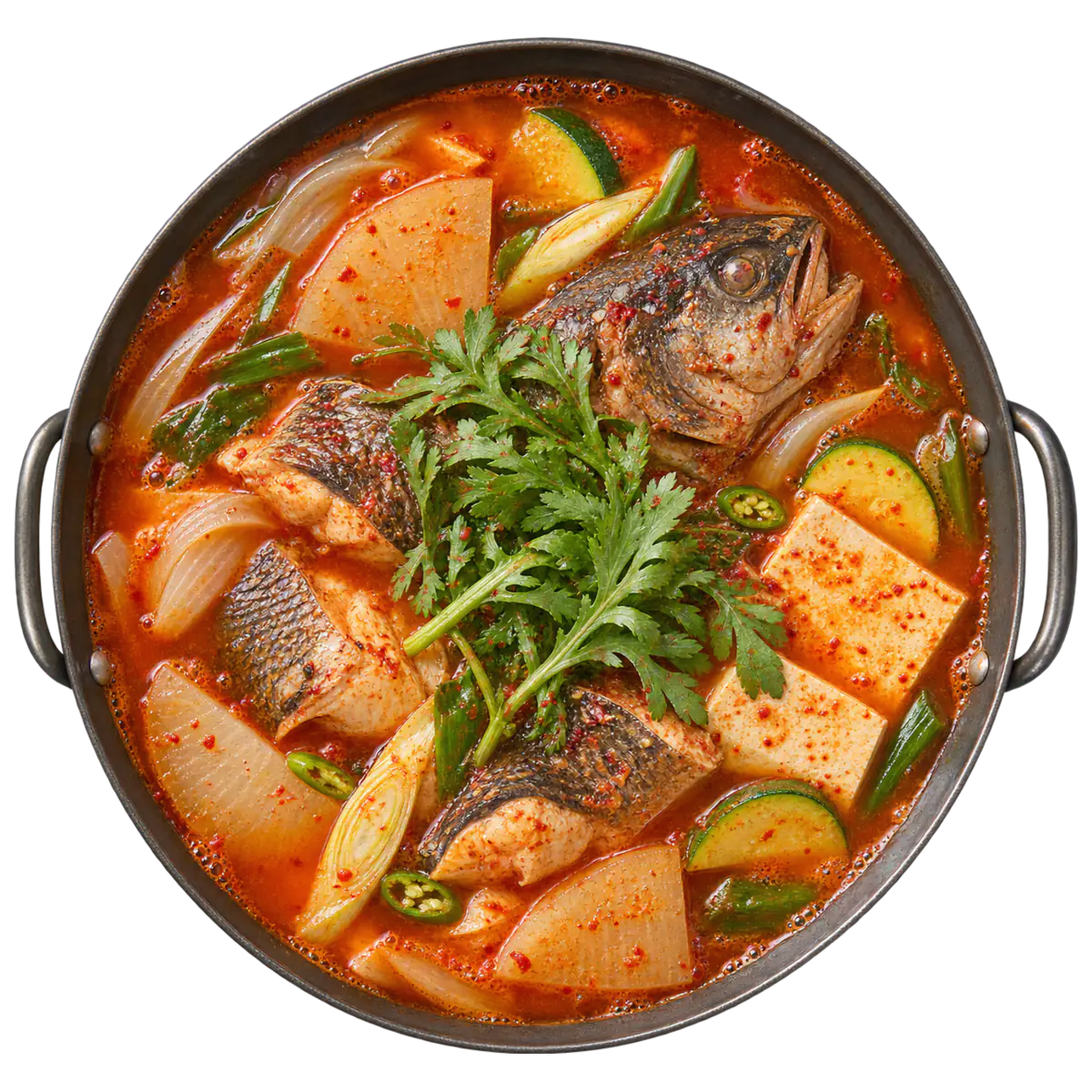
Origin and history
The Encyclopedia of Korean Culture defines maeuntang as a fish stew seasoned with red pepper flakes or gochujang, made with fish cut in pieces with the head and edible innards, radish, tofu and scallion; its entry gives no historical account. Freshwater stews are a speciality of the upper Han River, around Paldang and Cheongpyeong, and Yeoncheon on the Hantan River, where only licensed fishermen may fish the river and supply the restaurants, and stews include catfish, freshwater shrimp and mitten crabs. A Korea Tourism Organization article notes that freshwater stew is cooked long, the opposite of seawater stew.
Make it at home
- Makes
- 4 servings
- Total time
- 50 min
- Hands-on
- 25 min
Ingredients
- about 800 g1.75 lb whole fish with head, such as catfish, pomfret, croaker or pollock, gutted, scaled, cut in thick pieces; keep the head and any edible innards or roe; freshwater fish, like catfish, are prized
- 1.4 L6 cups anchovy stock (myeolchi dashimul), or water for freshwater fish; stock made with anchovies and kelp
- 200 g7 oz Korean radish (mu), sliced thin, about 1 cm thick squares
- 1/2 block (about 150 g)5 oz firm tofu, cut in slabs
- 1/2 zucchini, sliced
- 1 small onion, sliced
- 1 green chili (cheongyang), sliced
- 1 stalk scallion, cut in 4 cm pieces
- 1 handful garland chrysanthemum (ssukgat), optional, added at the end
- 5 tbsp gochugaru (Korean chili flakes), the main heat; 3 to 7 tbsp are used in different recipes
- 1 tbsp gochujang, flavouring
- 1/2 tbsp doenjang, softens the fish smell
- 2 tbsp minced garlic
- 1 piece (thumb-sized)1 piece fresh ginger, half minced, half sliced
- 1/3 tbsp sugar
- salt and black pepper, to taste; pepper helps against fishy smell, and salt rather than soy sauce keeps the broth clean
Method
-
1. Rinse the fish well, scale it and cut it into thick pieces with the head. For freshwater fish, rub it with a little salt and rinse again to lose the muddy smell.
-
2. Stir the gochugaru, gochujang, doenjang, garlic, minced ginger, sugar and a pinch of black pepper into a paste.
-
3. Bring the stock to a boil with the radish. When it boils, stir in the paste.
-
4. When the radish is about half cooked, about 8 minutes, lay in the fish, tofu, onion, zucchini and ginger slices. Simmer about 15 minutes for sea fish, or longer for freshwater fish, until the fish is cooked through and the broth has deepened.
-
5. Season with salt and more pepper. Add the chili and scallion and simmer 30 seconds.
-
6. Add the garland chrysanthemum just before serving and bring the pot to the table, serving it with rice.
Notes
- The Encyclopedia of Korean Culture classes maeuntang as a fish stew seasoned with gochugaru or gochujang, with the proportions not fixed, and fish cut in pieces with the head and edible innards, plus radish, tofu and scallion.
- Freshwater fish need black pepper and minced ginger, because chili alone does not remove their smell; the broth gets richer and thicker the longer it cooks. Freshwater stew is simmered thoroughly, where a sea-fish stew cooks briefly.
- Catfish (meegi), Korean perch (ssogari) and yellow perch (hwang-ssogari) are considered the best freshwater fish; people travel to Paldang, Cheongpyeong, Yeoju, Dongducheon and the Hantan River for it. In Yeoncheon on the Hantan, restaurants cook the stew in the kitchen first, then reheat it at the table with vegetables, and add dried cabbage greens (ugeoji), which soak up the broth.
- A home version with clams, mussels, sea squirt, crab and a handful of soybean sprouts is a seafood style of the same dish.
- If you cannot find a whole fish, use thick fillets plus fish heads for the stock.
Adapted from Encyclopedia of Korean Culture (Academy of Korean Studies): Maeuntang, Korea Tourism Organization (VisitKorea): maeuntang in Yeoncheon, 10000recipe: maeuntang (seasoning paste, 4 servings), and 10000recipe: byeongeo maeuntang (stock proportions, 4 servings).
At the festivals
No festival we list has printed it on a menu yet.