
🇮🇹 Italy · Romagna (Emilia-Romagna) and the Marche
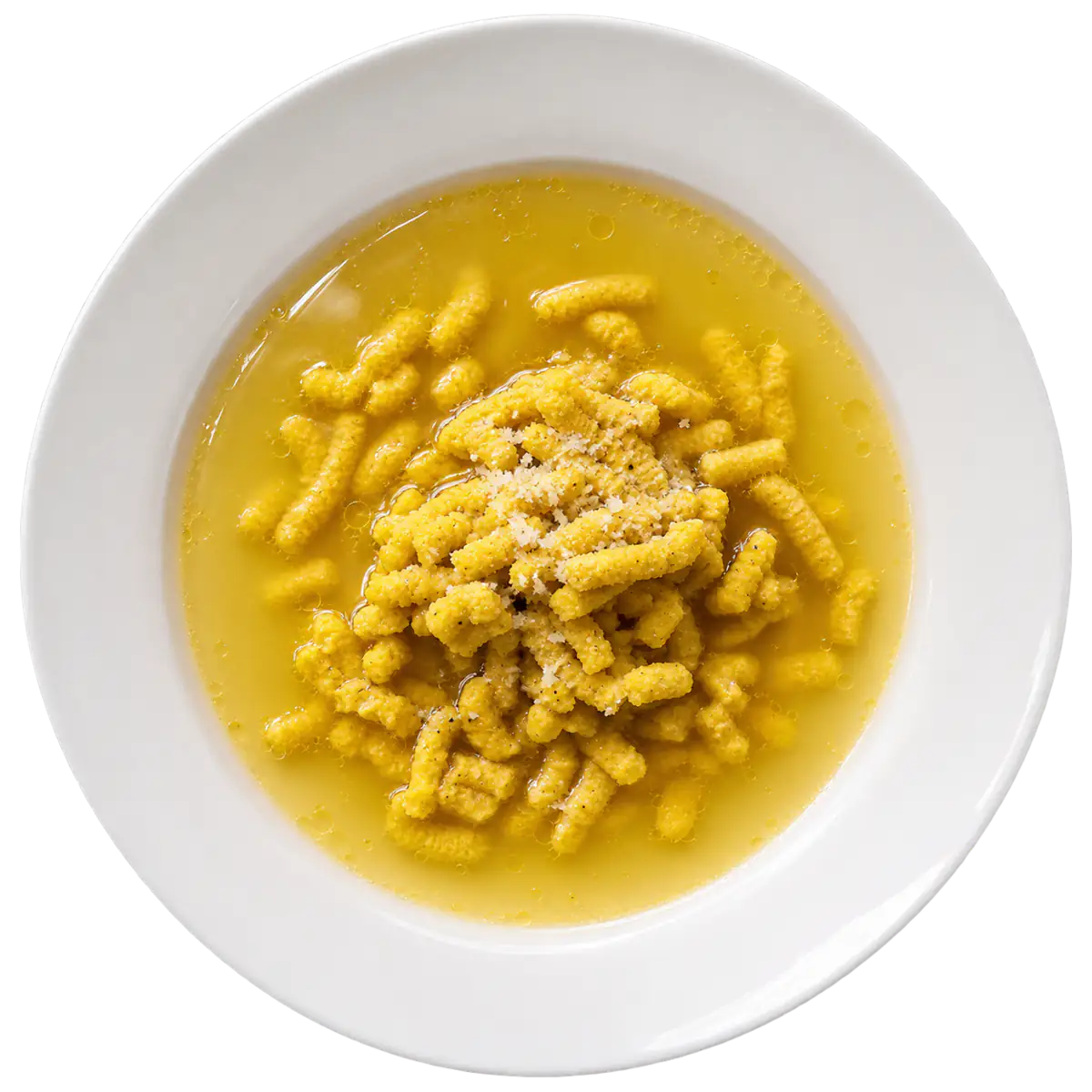
Passatelli in brodoItalian breadcrumb noodle soup
An Italian broth soup of short strands of a dough of breadcrumbs, grated Parmigiano, eggs and nutmeg or lemon zest, pressed through the holes of a special iron and cooked in meat broth.
Origin and history
Scatti di Gusto describes passatelli as coming from peasant households in Emilia-Romagna, made from stale bread, hardened cheese and eggs, and likely descending from an older egg-and-cheese soup. Pellegrino Artusi prints the minestra di passatelli in La scienza in cucina (1891), saying it is highly valued in Romagna and that almost every family there owns the special iron used to shape it.
Make it at home
- Makes
- 6 servings
- Total time
- 4 h 30 min
- Hands-on
- 1 h
Ingredients
- 1/4 hen (gallina), for the broth
- 500 g1.1 lb beef (polpa di manzo), for the broth
- 300 g10.5 oz ox bones, for the broth
- 300 g10.5 oz beef short rib (biancostato), for the broth
- 1 onion
- 1 rib celery
- 1 carrot
- 4 liters4 quarts cold water
- 200 g2 cups fine dry breadcrumbs, from good plain bread
- 200 g2 cups grated Parmigiano Reggiano or Grana Padano, plus more to serve
- 4 whole eggs
- nutmeg, freshly grated, a generous grating
- 1 lemon, zest only
- salt, a pinch
Method
-
1. Put all the broth ingredients in a large pot with the cold water. Bring to a gentle simmer and skim off the foam from time to time.
-
2. After about 3 hours, remove the meat and vegetables, strain the broth through a fine sieve, let it cool and lift off the fat from the surface.
-
3. Mound the breadcrumbs and cheese on a board, make a well, break the eggs into it and add the lemon zest, the nutmeg and a pinch of salt.
-
4. Work everything into a firm ball of dough, adding a little more breadcrumb if it is too soft, and rest it for at least 1 hour so it holds together.
-
5. Press the dough a little at a time through a passatelli iron (ferro) or a large-holed potato ricer, cutting the strands at about 5 cm (2 in).
-
6. Bring the broth to a rolling boil, drop in the passatelli and cook for 3 to 4 minutes, until they rise to the surface. Do not stir, so they do not break.
-
7. Serve very hot with more grated cheese.
Notes
- Artusi's 1891 recipe in La scienza in cucina uses much less cheese than the modern quantities used here: for about 4 servings, 100 g of breadcrumbs, 40 g of Parmesan, 2 eggs and 20 g of beef marrow, with nutmeg or lemon zest or both; his larger version (7 to 8 servings) takes 170 g of breadcrumbs, 70 g of Parmesan, 3 eggs plus a yolk and 30 g of marrow. He says the marrow makes the passatelli more tender and need not be melted, only mashed with a knife blade. The recipe here follows Scatti di Gusto's ratio of equal weights of breadcrumbs and cheese, with no marrow.
- The traditional tool is the ferro, a perforated iron found in many Romagna homes; a large-holed potato ricer is the usual home substitute.
- Only the broth with passatelli is covered here: Scatti di Gusto says that in the Marche they are often served dry, with a mushroom or fish ragù. It also says modern versions sometimes use flour in the dough, which it considers a departure from the original.
- Commercial breadcrumbs vary; the dough should be firm but pressable. A weak or over-wet dough falls apart in the pot.
- Make the broth a day ahead and keep it cold; the dough can be made and rested in the morning.
Adapted from Pellegrino Artusi, La scienza in cucina e l'arte di mangiar bene (1891), Minestra di passatelli and Scatti di Gusto, Passatelli in brodo.
At the festivals
No festival we list has printed it on a menu yet.