
🇮🇹 Italy · Emilia-Romagna, Marche, Umbria
Cappelletti in brodoItalian stuffed pasta soup
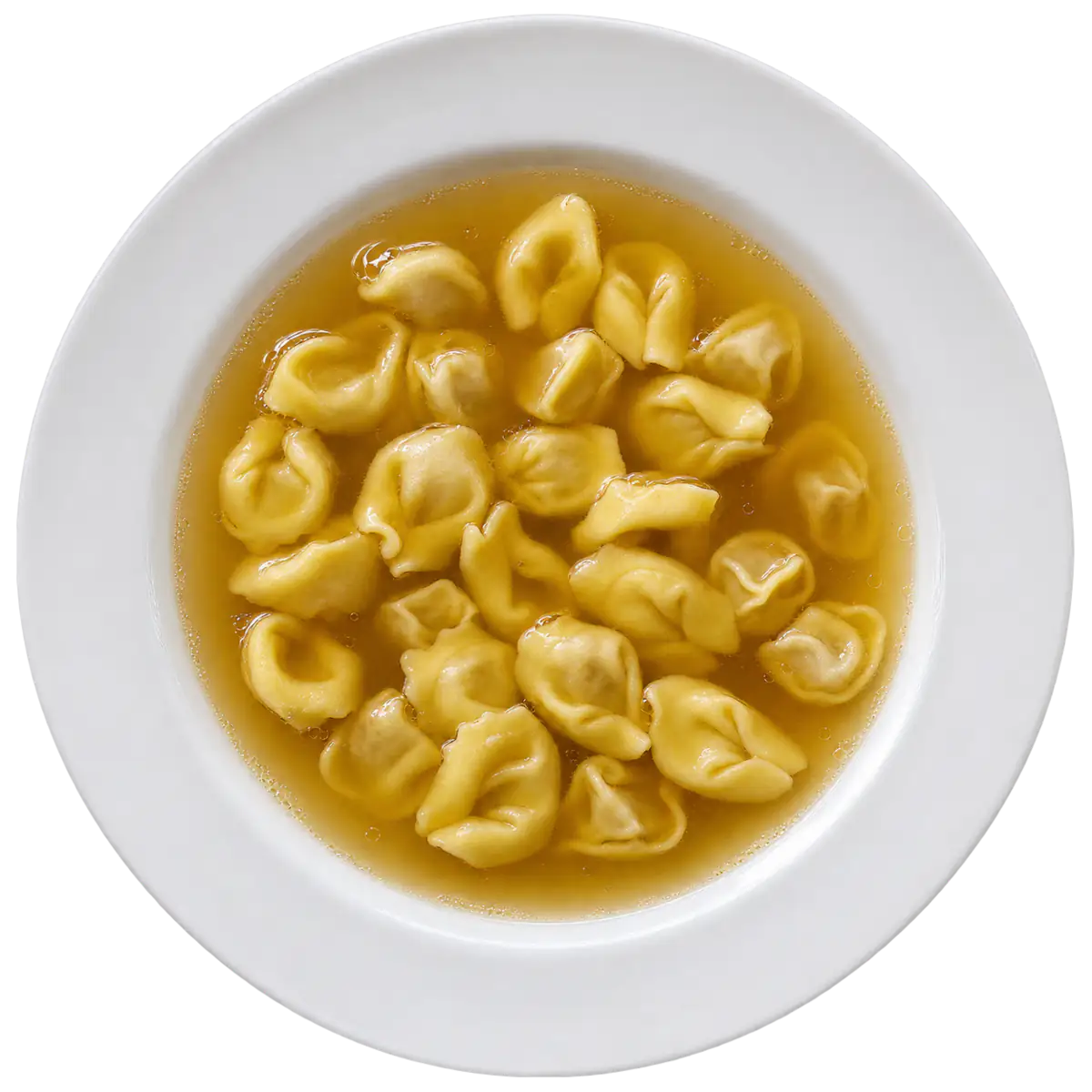
Hat-shaped filled pasta served in a clear meat or capon broth, traditional at Christmas and New Year across Romagna, Marche and Umbria.
Origin and history
Named for their hat shape, cappelletti in capon broth are the Christmas first course of Romagna and much of Emilia, the Marche and Umbria. Romagna sources cite mentions at the 16th-century Este court of Ferrara and in a Napoleonic survey of 1811 that records them as the Christmas dish. Artusi's La scienza in cucina (1891) gives 'cappelletti all'uso di Romagna' and insists they be cooked in capon broth, as in Romagna on Christmas Day.
Make it at home
- Makes
- 6 servings (about 130 cappelletti)
- Total time
- 5 h
- Hands-on
- 2 h
Ingredients
- 1/2 (about 1.5 kg)1/2 (about 3.3 lb) capon, or a large boiling hen, for the broth
- 500 g1.1 lb beef brisket or shin (punta di petto), for the broth; optional but traditional
- 1 beef marrow bone, optional
- 1 carrot, for the broth
- 1 celery rib, for the broth
- 1/2 onion, unpeeled, for colour
- 4 l4 1/4 quarts cold water, for the broth
- 300 g2 1/3 cups Italian 00 flour, for the pasta
- 100 g2/3 cup fine durum-wheat semolina (semola rimacinata), for the pasta; or use 400 g / 3 cups 00 flour in all
- 4 large eggs, for the pasta
- 150 g2/3 cup ricotta, drained well in a sieve, for the filling
- 150 g5 oz squacquerone or raviggiolo (soft fresh Romagna cheese), for the filling; or more ricotta, or a soft young caciotta
- 100 g1 cup Parmigiano Reggiano, finely grated, for the filling
- 1 + 1 yolk egg, for the filling
- nutmeg, freshly grated, a generous pinch
- lemon zest, finely grated, a little; optional
- salt and pepper, to taste
- grated Parmigiano Reggiano, to serve
Method
-
1. Put the capon, beef and marrow bone in a tall pot with the cold water and bring slowly to the boil over medium heat.
-
2. Skim off the grey foam as it rises, for the first 10 minutes, so the broth stays clear.
-
3. Add the carrot, celery and unpeeled onion and a little salt, then lower the heat until the surface barely trembles.
-
4. Simmer for 3 hours without boiling hard; lift out the capon when it is tender, after about 1 1/2 hours, and keep it for another meal.
-
5. Strain the broth through a fine sieve. If you have time, chill it overnight and lift off the fat that sets on top; you need about 2.5 l (2 1/2 quarts).
-
6. For the filling, mash the drained ricotta and the soft cheese together, then beat in the Parmigiano, the egg and yolk, nutmeg, a little lemon zest if you like, salt and pepper. It should be soft but hold its shape on a spoon; chill it while you make the pasta.
-
7. For the pasta, mix the flour and semolina into a mound on a board, make a well, break in the eggs and beat them with a fork, drawing in the flour little by little.
-
8. Knead for 10 to 15 minutes, pushing with the heel of your hand and folding, until the dough is smooth and springs back when pressed. Wrap it and rest it for 30 minutes.
-
9. Roll out a quarter of the dough at a time (keep the rest covered) into a thin sheet, about 0.7 mm, thin enough to see your hand through it.
-
10. Cut the sheet into squares of 4 cm (1 1/2 in) and put a hazelnut-sized dot of filling in the middle of each.
-
11. Fold each square into a triangle, pressing the edges together to seal and squeeze out the air; if the pasta has dried, dab the edges with a wet fingertip.
-
12. Wrap the triangle around your fingertip, bring the two side corners together and pinch them firmly, so the top point turns outward like the brim of a hat.
-
13. Lay the cappelletti on a floured tray in one layer, not touching, and leave them to dry a little while you finish the rest.
-
14. Bring the broth to the boil, taste it for salt, and drop in the cappelletti, about 20 per person.
-
15. Cook at a gentle boil for 4 to 6 minutes, until they float and the folded edge is tender when bitten.
-
16. Ladle into warm bowls with plenty of broth and pass grated Parmigiano at the table.
Notes
- The filling changes from town to town. This recipe follows the cheese-only filling of the Ravenna area, which Ravenna sources call the oldest tradition around Forlì as well. Artusi added the breast of a capon cooked in butter to ricotta or raviggiolo, or pork loin when there was no capon. Imola's recipe, filed with the Bologna Chamber of Commerce in 2019, uses pork loin, capon breast, mortadella and Parmigiano. Rimini, San Marino and Pesaro also use meat. Reggio Emilia's cappelletti are filled with beef, pork, veal and prosciutto browned in butter and bound with breadcrumbs and Parmigiano.
- Broth: capon broth is the Christmas standard. A boiling hen is the usual everyday substitute. Do not use a pressure cooker, cheese rinds or tomato, which make the broth cloudy or sour. Some cooks also add beef.
- Cheese: squacquerone is a soft, spreadable fresh cheese from Romagna. Where it is hard to find, use all ricotta, well drained, plus a little more Parmigiano. The filling will be firmer and a little less tangy.
- In the Reggio lowlands some people pour a splash of sweet Lambrusco into the hot bowl of cappelletti.
- Make ahead: the broth can be made 2 days ahead. Shaped cappelletti can be frozen raw on a tray, then bagged; cook them from frozen, adding a minute.
- Portions: Romagna cooks count 18 to 24 cappelletti per person; Artusi joked about people who claimed to eat a hundred on Christmas Day.
Adapted from Pellegrino Artusi, La scienza in cucina e l'arte di mangiar bene (1891), recipe 7, Cappelletti all'uso di Romagna, Turismo Ravenna, Cappelletti, and Visitare Imola, Cappelletti (recipe filed with the Bologna Chamber of Commerce, 2019).
At the festivals
Served at 8 festivals in Brazil.
Earlier editions
-
August 07, 2026
🇧🇷 Caxias do Sul, Brazil
Noite das Sopas
On the menu as capeletti in brodo
By Cozinha Andreazza/Quanta, do Di Paolo
-
July 18, 2026
🇧🇷 São Paulo, Brazil
Festival de Sopas e Caldos do Memorial da América Latina
On the menu as Capelete in Brodo
- June 27, 2026
- May 13, 2026 – August 30, 2026
-
August 23, 2024
🇧🇷 Cocal do Sul, Brazil
Noite das Sopas da APAE de Cocal do Sul
On the menu as Sopa de capeletti
By Chefs: Andreia e Sinara; sponsor: Sicredi
-
June 29, 2024
🇧🇷 Curitiba, Brazil
Noite da Sopa da Paróquia Nossa Senhora do Rocio
On the menu as Capelletti
By Parish community volunteers
- May 29, 2024 – September 01, 2024
- May 04, 2022 – September 04, 2022
-
August 17, 2019
🇧🇷 Parobé, Brazil
7º Buffet de Sopas
On the menu as Sopa de Capeletti
By Paulo César Mosmann and his sons Gabriel Vinícius Mosmann and Samuel Ruiz Mosmann
-
August 03, 2019
🇧🇷 Porto União, Brazil
Noite das Sopas da Comunidade Luterana de Porto União
On the menu as Capeletti