
🇦🇿 Azerbaijan · Sheki, northern Azerbaijan
PitiAzerbaijani lamb and chickpea soup
Lamb, chickpeas, onion and saffron slow-cooked in an individual clay pot (dopu), with chestnuts and dried plums in the Sheki form and potato, tomato or quince in other versions; the broth is poured over torn dry bread (lavash) and eaten first, then the meat and chickpeas are mashed and eaten.
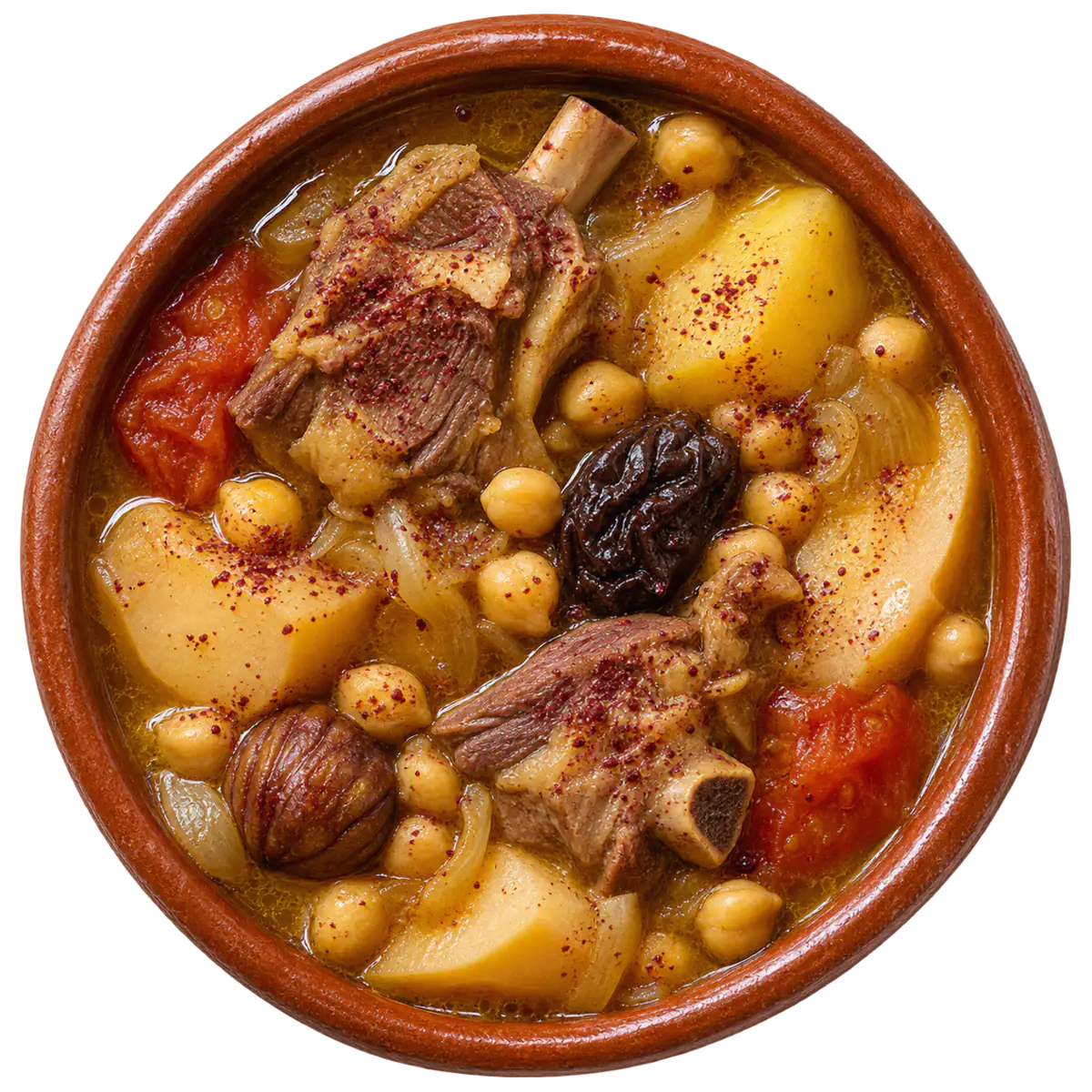
Origin and history
Piti is the signature dish of Sheki, an old Silk Road city in northwestern Azerbaijan, cooked in small clay pots called dopu. A Sheki restaurant owner quoted by Euronews calls it one of the town's oldest specialties and says peasants made it so they could eat their fill; AzerNews calls it a worker's dish, one portion enough to carry a person through the day. The page does not date it.
Make it at home
- Makes
- 4 servings
- Total time
- 1 h 30 min
- Hands-on
- 25 min
Ingredients
- 100 g1/2 cup dried chickpeas, soaked 4 to 5 hours (overnight is also common) and drained
- 700 g1.5 lb mutton or lamb, bone-in, cut in pieces of about 55 to 60 g, so 2 to 3 per portion
- 2 medium onions, sliced; plus extra raw onion to serve
- 1 quince, cut in pieces
- 2 small potatoes, peeled, halved
- 1 tomato, cut in pieces
- 6 boiled chestnuts, peeled
- 4 dried plums (alycha, cherry plum)
- 100 g3.5 oz sheep tail fat, finely chopped; lamb fat or suet if unavailable
- 1 pinch saffron, steeped in a little hot water
- salt and black pepper, to taste
- dried lavash or flat bread, sumac, to serve
Method
-
1. Heat the oven to 190 °C (375 °F).
-
2. Divide the onion, meat, quince and chickpeas in layers between four small clay pots (or one lidded casserole), filling each about halfway and adding the tail fat.
-
3. Add 1 cup (240 ml) of boiling water to each pot, cover, and bake for 30 minutes.
-
4. Take the pots out, add the potato, tomato, chestnuts, plums and the saffron water, and season with salt and pepper.
-
5. Return to the oven for another 40 minutes, until the meat is tender and the chickpeas are soft.
-
6. Serve in the pot. Break dried lavash into a bowl, pour the broth over it, sprinkle with sumac and eat this first.
-
7. Mash the meat, chickpeas and vegetables together, and eat them as the second course with sumac and raw onion.
Notes
- Piti is two courses from one pot: the broth over torn bread, then the mashed solids.
- Traditional clay pots (dopu) and slow cooking in a wall oven are the proper method; AzerNews says it is cooked slowly, and a Turkish version of the Sheki recipe bakes it at 180 C (350 F) for 4 hours. A covered casserole in a low oven is the home stand-in, and the shorter bake here follows the small meat pieces in the AzerNews recipe. A clear broth is prized, so skim and cook gently.
- Cooks differ: Sheki piti uses chestnuts and dried plum (alycha), while AzeriFood's home version has potato, cherry plum and a little tomato puree and no chestnuts, noting that the original had no potatoes. Saffron is common (turmeric in the AzeriFood version), and crushed sumac or barberry goes on the broth.
- Quantities: AzerNews gives 2 to 3 pieces of 55 to 60 g of meat per portion, AzeriFood about 25 g of chickpeas per portion, and a Turkish recipe for the Sheki form uses 50 g of tail fat and 50 g of chickpeas for two large pots (about 25 g each per portion, scaled here to 4). The sources give no weights for the quince, potato and tomato, so those are a modest guide to adjust to taste; the chestnuts and plums are scaled from the Turkish recipe and the count of about 4 plums from a Sheki recipe that says 'a couple'.
- Soak the chickpeas well ahead; AzerNews gives 4 to 5 hours, noting overnight is traditional.
Adapted from AZERNEWS: Piti, Sheki's lamb and chickpea soup, Euronews: Piti, a rich taste of Azerbaijan, AzeriFood: Piti, and Yemek.com: Seki pitisi.
At the festivals
No festival we list has printed it on a menu yet.