
🇲🇽 Mexico · Widespread; often Guerrero and Jalisco
Pozole blancoWhite pozole
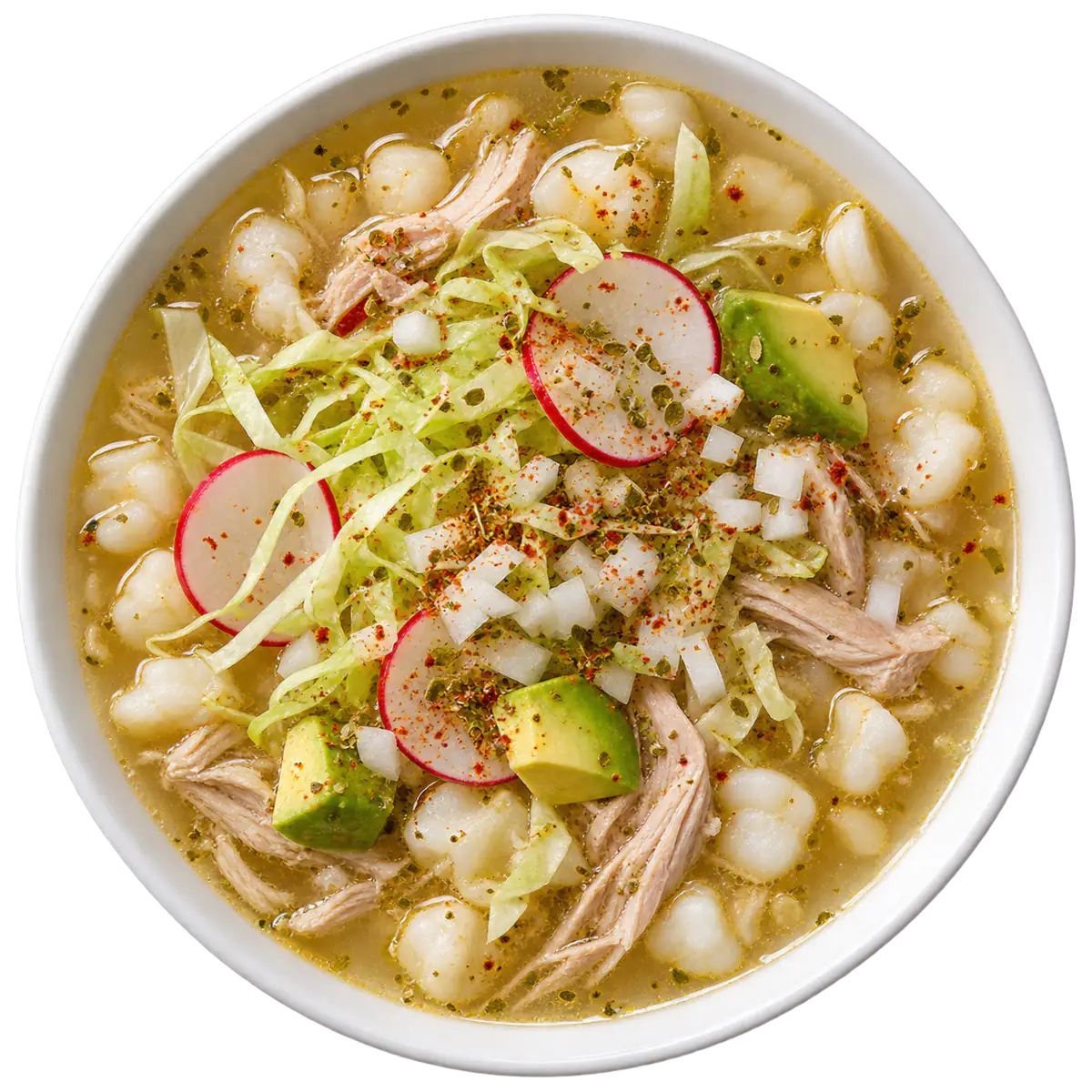
Pozole served without red or green sauce: a plain hominy and meat broth to which each diner adds salsas and garnishes.
Origin and history
White pozole is regarded as the original and most traditional form of the dish: cacahuazintle maize and pork in a broth with nothing added to change its colour, every diner seasoning their own bowl. It is the typical pozole of central Mexico and of Guerrero, where eating pozole on Thursdays is a custom some trace to 19th-century Iguala.
Make it at home
- Makes
- 8 servings
- Total time
- 5 h
- Hands-on
- 50 min
Ingredients
- 500 g1.1 lb dried nixtamalized cacahuazintle corn (maíz pozolero), or 1.2 kg / 2.6 lb cooked hominy, rinsed; see notes
- 1 head garlic, halved crosswise
- 5 l5 1/4 quarts water for the corn, plus more as needed
- 1 kg2.2 lb bone-in pork shoulder, in large pieces
- 700 g1.5 lb pork head meat, or pork shanks, in pieces; head is traditional in Guerrero and Jalisco
- 2 pig's trotters, split lengthwise
- 3.5 l15 cups water for the meat
- 1 white onion, halved
- 2 tbsp coarse salt, divided, plus more to taste
- 1/4 head green cabbage or romaine lettuce, finely shredded, to serve
- 12 radishes, thinly sliced, to serve
- 1 white onion, finely chopped and rinsed, to serve
- 3 tbsp dried Mexican oregano, to serve
- 3 tbsp ground chile piquín or chile de árbol, to serve
- 5 limes, in wedges, to serve
- 16 tostadas, to serve
- chicharrón (pork crackling) and diced avocado, optional, to serve, Guerrero style
Method
-
1. The night before, rinse the dried corn well, cover it with plenty of cold water and leave it to soak.
-
2. Drain the corn, put it in a large pot with the garlic and the 5 litres of water and bring to a boil. Do not salt it. Lower the heat and simmer, partly covered, for 3 to 4 hours, topping up with hot water, until most of the kernels have burst open like flowers and are tender.
-
3. While the corn cooks, put the shoulder, head meat and trotters in another large pot with the 3.5 litres of water and 1 tablespoon of salt. Bring to a boil and skim off all the foam for the first 10 minutes.
-
4. Add the halved onion, lower the heat and simmer for 2 1/2 to 3 hours, until the shoulder falls apart and the trotters are soft. Let the meat cool in its broth for 30 minutes if you have time; it stays juicier.
-
5. Lift out the meat. Strain the broth and skim off most of the fat.
-
6. Shred the shoulder and head meat; take the bones out of the trotters and chop what is left into small pieces.
-
7. When the corn has opened, pour the broth into the corn pot with the remaining tablespoon of salt and simmer for 20 minutes. The broth should stay pale and clear-tasting, with no chile or spice.
-
8. Add the meat, heat through for 10 minutes and taste for salt.
-
9. Serve in deep bowls with the garnishes on the table, so each person adds onion, cabbage, radish, oregano rubbed between the palms, chile, lime and, in Guerrero style, chicharrón and avocado.
Notes
- Total time: 5 h (plus overnight soaking).
- How it differs from the parent: pozole blanco is the pozole left white, its broth seasoned only with salt, onion and garlic, so all the colour and heat come from the table. This version follows the slow traditional method from dried corn with the gelatinous cuts.
- Shortcut: with 1.2 kg (2.6 lb) of cooked hominy, skip the soaking and the long simmer; add the hominy to the strained broth and simmer 30 minutes.
- Corn: in Guerrero cooks favour a local broad-kernelled maize; cacahuazintle is the general choice elsewhere. Either way, salt only after the kernels have opened.
- Regional ways: in Guerrero the white pozole is eaten on Thursdays, often with chicharrón and avocado, and depending on the region with eggs or sardines. In central Mexico it is the everyday white pozole of fondas and parties.
- Make-ahead: it keeps 3 to 4 days in the fridge and improves; cool it quickly in shallow containers and reheat gently.
- The other colours, rojo (dried red chiles) and verde (pumpkin seeds and tomatillo), have their own pages and recipes.
Adapted from Rick Bayless, Classic White Pozole with All the Trimmings (Mexico: One Plate at a Time) and Pozole blanco: receta fácil, Milenio.
At the festivals
Served at 2 festivals in Mexico.
Earlier editions
-
October 17, 2025 – October 19, 2025
🇲🇽 Xochitepec, Mexico
XVII Feria del Pozole
- November 17, 2023 – November 19, 2023
-
May 07, 2017 – May 14, 2017
🇲🇽 Chilpancingo, Mexico
12º Festival Nacional del Pozole y el Mezcal