
🇯🇵 Japan · Tokyo (Kanto)
Shoyu ramenSoy sauce ramen
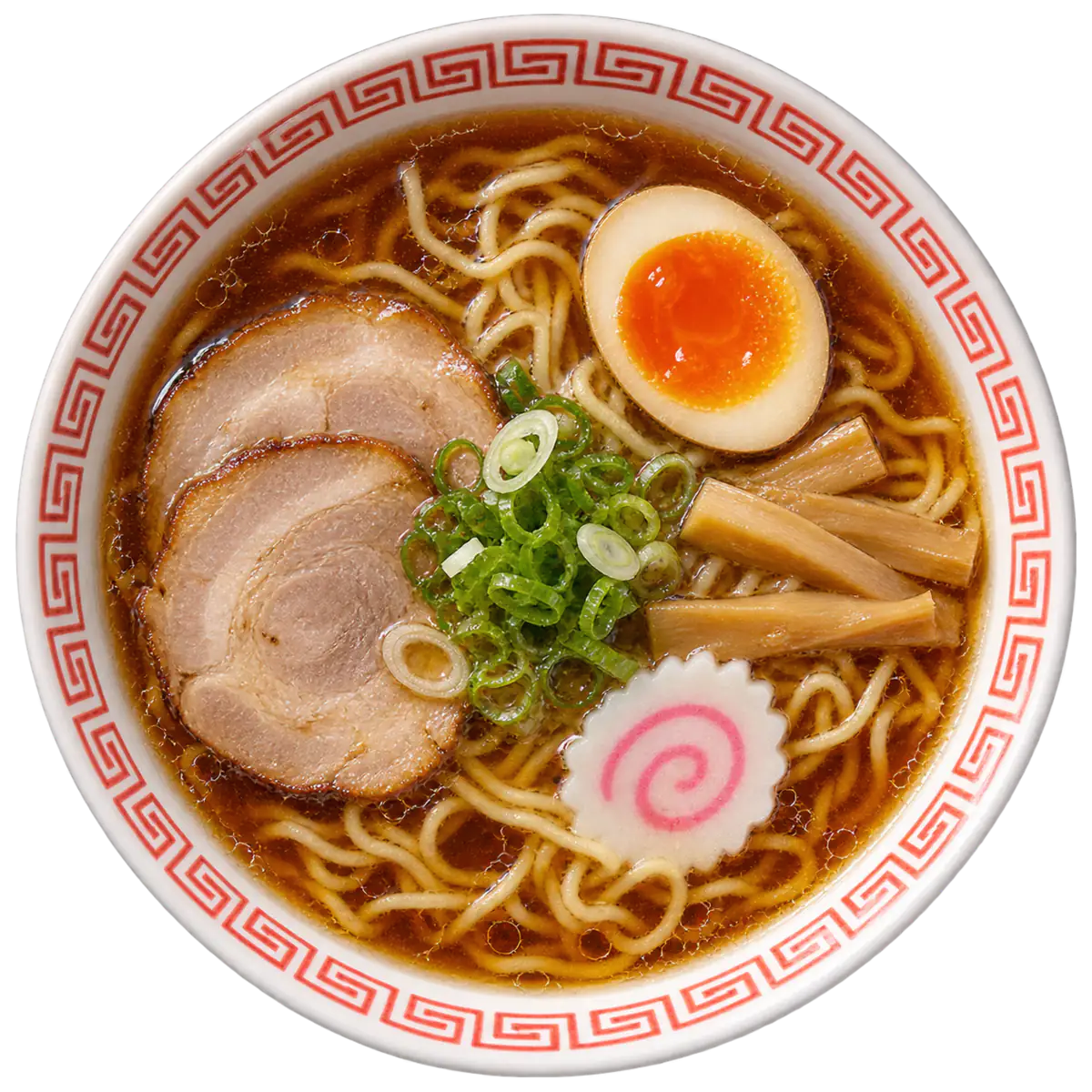
Ramen seasoned with a soy-sauce tare, giving a clear brown, tangy-salty broth, typically of chicken and/or pork with dried fish.
Origin and history
Soy sauce seasoned the first ramen boom: Tokyo's Rairaiken, opened in Asakusa in 1910, served shina soba with dark soy, and the clear brown chicken-and-pork chūka soba that spread from Tokyo and Yokohama after the 1923 earthquake is the style still called Tokyo ramen. In Hokkaido, Asahikawa's shoyu ramen counts among the island's three great styles, with Sapporo miso and Hakodate shio.
Make it at home
- Makes
- 4 servings
- Total time
- 6 h 30 min
- Hands-on
- 1 h
Ingredients
- 6 l6.3 qt cold water, added in stages as the pot allows
- 600 g1.3 lb pork leg bones (genkotsu), cracked
- 500 g1.1 lb chicken carcass or backs (tori-gara), rinsed of blood
- 1/2 onion, skin on, root trimmed
- 3 garlic cloves, skin on
- 15 g1/2 oz fresh ginger, sliced, skin on
- 900 g2 lb pork belly, in one block, skin off, tied tightly with kitchen string
- 50 g1.75 oz (about 1/4 cup) rendered chicken fat (chī-yu)
- 1 naga negi (Japanese long onion) or 3 thick scallions, green part for the broth, white part for the bowls
- 240 ml1 cup koikuchi (regular Japanese) soy sauce, for the chashu sauce, which becomes the tare
- 30 ml2 tbsp sake
- 30 ml2 tbsp mirin
- 10 g2 tsp fine salt
- 4 portions (about 520 g)4 portions (about 18 oz) fresh ramen noodles, medium-thin, wavy (Tokyo style)
- 80 gabout 1/2 cup menma (seasoned bamboo shoots)
- 2 scallions, green tops only, cut in long thin strips
- 1 sheet nori, cut in quarters
Method
-
1. Put about 5 litres (5.3 qt) of the water in a large stockpot with the pork bones, chicken, onion, garlic and ginger and bring it to a boil over high heat, uncovered.
-
2. Skim off all the grey foam as the water comes to the boil; a clean skim now is what keeps the finished broth clear.
-
3. Lower the tied pork belly into the pot and cook at a steady boil, uncovered, for 2 hours, skimming every so often and adding the rest of the water as the level drops.
-
4. Ten minutes before the 2 hours are up, ladle out 240 ml (1 cup) of stock into a separate saucepan for the chashu sauce.
-
5. Add the soy sauce, sake, mirin and salt to that saucepan, bring just to a simmer and turn off the heat.
-
6. At the 2-hour mark, add the chicken fat and the green part of the negi to the stockpot and boil for 1 hour more.
-
7. Lift the pork belly out carefully (it is very tender now) and lay it in the chashu sauce; cover it with a drop lid or a disc of baking paper and simmer on low heat for 2 hours, spooning the sauce over it now and then.
-
8. Meanwhile turn the stockpot down to low and let it simmer gently, uncovered, for 3 hours more.
-
9. Take the chashu out of its sauce, cut away the string, cool it and chill until firm. Skim the fat off the sauce: this salty liquid is your shoyu tare.
-
10. Strain the broth through a fine sieve and discard the bones and vegetables; keep it very hot.
-
11. Finely slice the white part of the negi, slice the cold chashu about 3 mm (1/8 in) thick, and bring a large pot of unsalted water to a boil for the noodles.
-
12. Put 1 to 1 1/2 tablespoons of tare and a spoonful of sliced negi in each warmed bowl and pour in about 360 ml (1 1/2 cups) of the hot broth; taste and add tare if needed.
-
13. Boil the noodles for the time on the packet, usually 60 to 90 seconds, drain them very well and fold them into the soup.
-
14. Top with the chashu, menma, scallion strips and nori and serve at once.
Notes
- Shoyu ramen differs from the other variants only in its tare: soy sauce gives a clear, brown, salty-tangy soup over a chicken and pork broth. Here the tare is the soy liquid the chashu was braised in, as many Tokyo shops do it.
- Older Tokyo-style broths add dried sardines (niboshi) to the pork and chicken, as Rairaiken did from the early Shōwa era; simmer about 20 g of cleaned niboshi in the broth for its last 45 minutes if you want that note. Asahikawa (Hokkaido), Sano, and Toyama Black ramen are other regional shoyu styles.
- The tare is very salty; always start with less and add to taste, since bowl sizes vary.
- Make ahead: broth, chashu and tare keep 3 days in the fridge or a month frozen; freeze the broth in single portions. Slice the chashu only when it is cold, or it falls apart.
- The other variants on this site: shio (salt tare), miso and tonkotsu (milky pork-bone broth).
Adapted from Just One Cookbook (Namiko Hirasawa Chen), Shoyu Ramen from Bizentei, Tokyo and Shin-Yokohama Raumen Museum, history of ramen in Japan.
At the festivals
Served at 4 festivals in Canada, Japan, and United States.
Earlier editions
- October 12, 2026 – October 25, 2026
- December 01, 2023
-
January 28, 2023
🇺🇸 Schenectady, New York, United States
7th Annual Soup Stroll
On the menu as Tokyo Style Shoyu Ramen
By SUNY Schenectady Food Truck
-
October 27, 2022
🇯🇵 Tokyo, Japan
Tokyo Ramen Festa 2022
On the menu as 佐野ラーメン~UMAMI and 氷見イワシの富山ブラック「氷見ツの黒2022スペシャル」
By 佐野ラーメン 麺屋ようすけ and 魚王国!富山氷見 麺屋 いく蔵
-
December 06, 2019
🇯🇵 Suita, Japan
Ramen EXPO 2019
On the menu as トリュフ香る黄金(KOGANE)鴨中華そば
By 麺や 齋とう and 麺や 齋とう (Osaka, number 3 on the shop board)
-
October 24, 2014
🇯🇵 Tokyo, Japan
Tokyo Ramen Show 2014
On the menu as 醤油ラーメン (来々軒 recreation)
By せたが屋 owner 前島司 (legend ramen)