
🇯🇵 Japan · Fukuoka prefecture (Hakata, Kurume), Kyushu
Tonkotsu ramenPork bone ramen
Ramen built on a milky, creamy broth from pork bones boiled hard for hours, typically with thin straight noodles; seasoning is usually salt or soy-based.
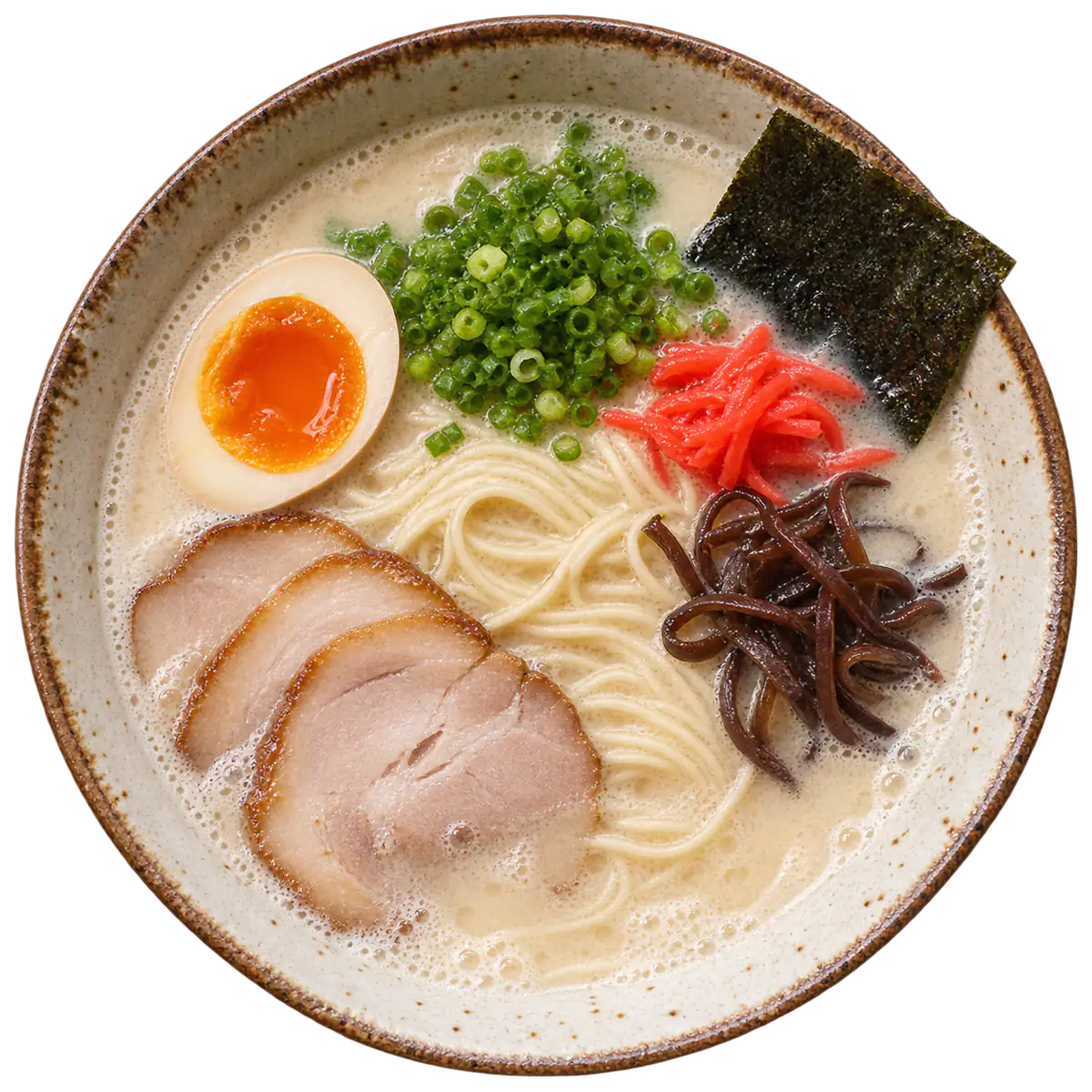
Origin and history
Tonkotsu ramen belongs to Fukuoka prefecture in Kyushu. Kyushu's first ramen stall, Nankin Senryō, opened in Kurume in 1937 using pork bones, and in 1947 the Kurume stall Sankyū served a pork-bone broth boiled until cloudy, which Japan's agriculture ministry calls the start of Kyushu ramen. Hakata ramen grew from it, with very thin noodles, and the fish-market stalls of Nagahama gave it kaedama, the refill of noodles. It boomed in Tokyo from 1989.
Make it at home
- Makes
- 4 servings
- Total time
- 13 h
- Hands-on
- 1 h 15 min
Ingredients
- 2 kg4.4 lb pork leg bones (genkotsu), cracked or sawn open by the butcher so the marrow shows
- 1 kg2.2 lb pig's trotters, split; they give the collagen that makes the broth creamy
- 5 l5.3 qt water, plus hot water for topping up
- 1 head of garlic, halved crosswise, optional
- 30 g1 oz fresh ginger, sliced, optional
- 100 ml1/3 cup + 1 tbsp usukuchi (light-coloured) soy sauce, for the tare
- 30 ml2 tbsp sake
- 30 ml2 tbsp mirin
- 5 ga 2 1/2 in square kombu (dried kelp)
- 15 g1 tbsp fine salt
- 4–8 portions (100 g each)4–8 portions (3.5 oz each) very thin straight ramen noodles (Hakata-style), one per bowl, the rest for kaedama refills
- 8–12 slices chashu (braised pork belly or shoulder), thinly sliced
- 4 scallions or thin green onions (banno negi), finely sliced
- 10 g1/3 oz dried kikurage (wood-ear mushrooms), soaked, thinly sliced
- 2 tbsp beni shōga (red pickled ginger)
- 2 tbsp toasted white sesame seeds
- 4 tbsp karashi takana (spicy pickled mustard greens), optional, for the table
Method
-
1. Soak the bones and trotters in cold water for 1 hour, changing the water twice, to draw out the blood.
-
2. Put them in your largest pot, cover with cold water, bring to a boil and boil hard for 10 minutes.
-
3. Drain, then rinse each piece under the tap, scrubbing off the dark scum and any clots; wash the pot too.
-
4. Return the bones to the clean pot with the 5 litres (5.3 qt) of water and bring to a full, rolling boil over high heat.
-
5. Keep it at a vigorous boil, lid ajar, for 10 to 12 hours; the hard boil is what breaks down the marrow and collagen and emulsifies the fat into the water. Stir from the bottom every hour and top up with boiling water whenever the bones start to show.
-
6. Add the garlic and ginger, if using, for the last hour.
-
7. The broth is ready when it is opaque and milky white, coats a spoon and feels sticky between your fingers; you should have about 2 litres (8 cups).
-
8. Strain it through a fine sieve, pressing on the solids, and keep it at a simmer.
-
9. For the tare, warm the soy sauce, sake, mirin and kombu to just below a simmer for 3 minutes, take off the heat, stir in the salt until dissolved and remove the kombu.
-
10. Bring a large pot of unsalted water to a hard boil and warm the bowls.
-
11. Put 1 1/2 to 2 tablespoons of tare in each bowl and pour in about 350 ml (1 1/2 cups) of the boiling-hot broth; taste and adjust.
-
12. Boil one portion of noodles per bowl very briefly, 30 seconds to 1 minute depending on how firm you want them; Hakata eaters often ask for them hard (katamen) or very hard (barikata).
-
13. Drain the noodles well, slide them into the bowls and top with chashu, scallions and kikurage.
-
14. Put beni shōga, sesame and karashi takana on the table for each person to add, and boil the remaining noodles to order as kaedama when someone finishes theirs.
Notes
- Tonkotsu differs from the other variants in its broth, not its tare: pork bones boiled hard for many hours until the soup turns milky and creamy. The other variants are clear broths seasoned with soy (shoyu), salt (shio) or miso.
- Hakata (Fukuoka city) style uses very thin noodles in a small portion of about 100 g so they can be eaten before they soften, with a light soy or salt tare; extra noodles (kaedama) are ordered into the same soup. Kurume style is the older one; some Hakata shops serve a lighter, creamier broth than Kurume's.
- Many shops in Tokyo and abroad mix tonkotsu with soy tare as 'tonkotsu shoyu'; on this site that counts as tonkotsu. Some home cooks add chicken bones or a dashi of kombu, niboshi and katsuobushi in the last hour.
- A pressure cooker shortens the work: about 1 hour at high pressure, then an hour of hard boiling with the lid off to emulsify. The colour and body come only from boiling, never from simmering.
- The broth keeps 3 days in the fridge or a month frozen; it sets to a firm jelly when cold, which is a good sign.
Adapted from Ministry of Agriculture, Forestry and Fisheries of Japan, aff magazine feature on Hakata and Kurume ramen and Just One Cookbook (Namiko Hirasawa Chen), Tonkotsu Ramen.
At the festivals
Served at 3 festivals in Canada, United States, and Japan.
Earlier editions
-
October 12, 2026 – October 25, 2026
🇨🇦 Montreal, Canada
Ramen Ramen Fes
On the menu as Hakata Kaisoku, Tonkotsu Black, and Chashu Tonkotsu Ramen
By Neotokyo, Sansotei Ramen (Mackay), Sansotei Ramen (Mont-Royal), Sansotei Ramen (Sainte-Catherine), Tsukuyomi Ramen (Bishop), Tsukuyomi Ramen (Bois-Franc), and Tsukuyomi Ramen (Mile End)
-
February 01, 2025
🇺🇸 Port Washington, New York, United States
18th annual SOUPer Bowl
-
October 27, 2022
🇯🇵 Tokyo, Japan
Tokyo Ramen Festa 2022
On the menu as 無化調「極旨トロ肉豚骨」2022ver. and 溢れチャーシュー麺SP東京Ver.
By 秋田 錦 本店 and 世紀末ラーメン伝説 モヒカンらーめん