
🇵🇱 Poland · Masovia
Rosół dworski z kapłonaManor-house capon broth
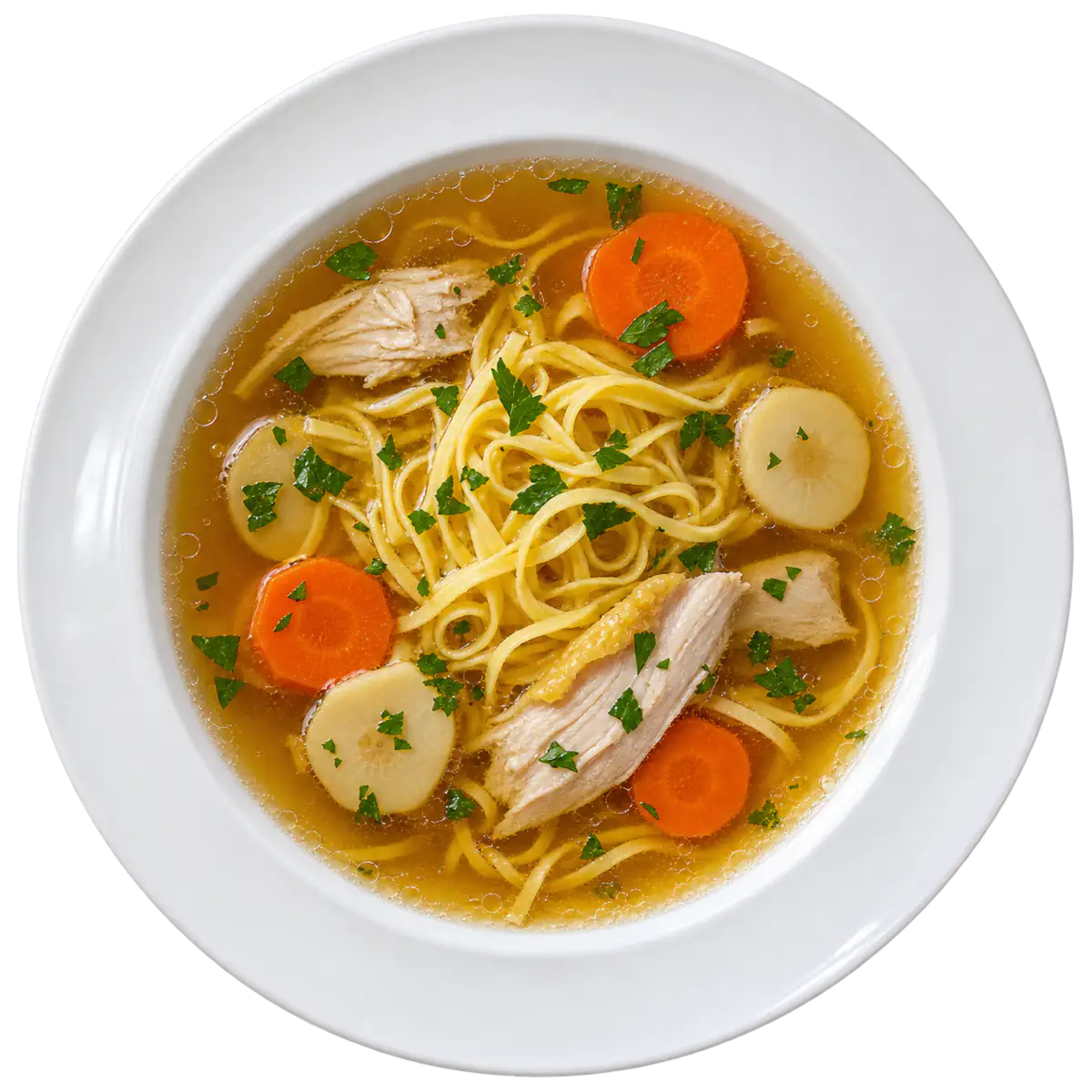
A manor-house rosół of capon and hens of the native green-legged partridge breed with local vegetables, clear with small eyes of fat and setting to a jelly when cold, served with home-made egg noodles, semolina or poured dumplings at weddings and holidays.
Origin and history
Capons have been raised in Poland since the 16th century, and their roasts and broths were a delicacy of magnate and noble tables. This manor-house broth follows 19th- and 20th-century recipes, chiefly from the kitchen of the Radziwiłł manor at Nieborów, where capons were raised apart for the household. Cooked for weddings, holidays and guests, it won a Pearl in the Our Culinary Heritage competition in 2011 and joined Poland's List of Traditional Products for Masovia on 10 July 2012.
Make it at home
- Makes
- 8 servings
- Total time
- 4 h 45 min
- Hands-on
- 1 h 10 min
Ingredients
- 1 (2.5-3 kg)1 (5.5-6.5 lb) capon (kapłon), ideally of the Polish green-legged partridge breed (zielononóżka kuropatwiana), cut in 6-8 pieces
- 300 g10 oz poultry giblets: hearts, gizzards and the neck, gizzards cleaned
- 4 l4 1/4 qt cold water, plus a little extra
- 3 carrots, peeled
- 3 parsley roots (pietruszka) or small parsnips, peeled
- 150 g5 oz celeriac (celery root), peeled, in one piece
- 2 small leeks, white and pale green part, washed
- 100 g3.5 oz white cabbage, one wedge
- 100 g3.5 oz cauliflower, a few florets
- 5-6 dried porcini or other boletes, rinsed
- 1 onion, unpeeled, halved
- 1 tsp black peppercorns
- 4 allspice berries (ziele angielskie)
- 2 bay leaves
- 1 tbsp salt, adjust at the end
- 2 tbsp chopped parsley, to serve
- 250 g2 cups plain flour, for the noodles, plus extra for dusting
- 2 + 1 yolk eggs, for the noodles; farm eggs with deep yellow yolks
- 1 pinch salt, for the noodles
Method
-
1. Rinse the capon pieces and the giblets briefly under cold water; do not soak them. Put them in a large pot and cover with the cold water.
-
2. Bring slowly to a simmer over medium heat, skimming off the foam each time it gathers, until no more forms.
-
3. Take the pot off the heat and pour in a small glass of cold water. Leave it for 5 minutes, so the fine particles settle to the bottom.
-
4. Lift out the meat and giblets and rinse them in lukewarm water. Ladle the broth through a sieve lined with muslin or a clean cloth into a clean pot, leaving the sediment behind.
-
5. Return the meat and giblets to the strained broth, add the salt and keep it at the barest simmer, partly covered, for 1 1/2 hours.
-
6. Add the carrots, parsley roots, celeriac, leeks, peppercorns, allspice and bay leaves, and simmer gently for 1 1/2 hours more.
-
7. Meanwhile, blanch the cabbage wedge in boiling water for 3 minutes and drain it; this keeps the broth from tasting of cabbage. Char the cut sides of the onion over a gas flame or in a dry heavy pan.
-
8. Add the blanched cabbage, the cauliflower, the dried mushrooms and the charred onion and simmer for the last 30 minutes.
-
9. For the noodles, heap the flour on a board, make a well, add the eggs, yolk and salt and knead for 8-10 minutes to a smooth, firm dough. Wrap it and let it rest (see notes).
-
10. Roll the dough out very thinly on a floured board, let the sheet dry for 15 minutes, dust it with flour, roll it up loosely and cut it into thin strips. Shake them loose.
-
11. Lift the meat and vegetables out of the broth. Skim off the surplus fat, leaving the small golden eyes of fat on the surface that mark this broth, then strain it through cloth and taste for salt.
-
12. Cook the noodles in salted boiling water for 2-3 minutes, until they float and are tender, and drain.
-
13. Put noodles, a few pieces of giblets and some carrot in each bowl, pour the hot broth over and sprinkle with parsley. Serve the capon as a second course.
Notes
- Resting: the noodle dough needs 30 minutes to rest before rolling; make it while the broth simmers.
- How it differs from the parent rosół: the everyday rosół is a hen broth. Rosół dworski z kapłona is made from a capon, a castrated, slowly fattened cockerel whose meat is tender and marbled, with the giblets cooked in the pot, cabbage, cauliflower and dried mushrooms from the old manor recipe, and home-made egg noodles. The parent recipe on this site is the hen broth.
- The marks of the real thing: a pale straw-coloured, clear broth with small eyes of fat on top that sets to a jelly when cold, with soft noodles and brown giblets in the bowl.
- Capons are sold by specialist poultry farms and some butchers, mostly before Christmas. If you cannot find one, a large free-range hen (kura rosołowa) is the closest substitute; the broth will be leaner and set less firmly.
- Garnish: in Masovia this broth is served with egg noodles, with semolina, or with poured dumplings (lane kluseczki). Ready-made thin egg noodles work too.
- The first blanching and the cold-water trick come from the 1923 Warsaw recipe that the traditional-product entry follows. Some cooks simply discard the first water after 20 minutes and start again with fresh water.
- Make-ahead: the broth keeps 4 days in the fridge, where it sets to a jelly, and freezes for months. Keep the noodles separate. Fresh noodles can be dried and stored for a week.
- Other named forms on this site: rosół królewski (three meats) and rosół myśliwski (game).
Adapted from Ministry of Agriculture and Rural Development (Poland), List of Traditional Products: "Rosół dworski z kapłona", Praktyczny Kucharz Warszawski (Warsaw, 1923), and Moje Gotowanie, "Rosół dworski z kapłona".
At the festivals
No festival we list has printed it on a menu yet.