
🇵🇱 Poland
Rosół królewskiPolish royal broth
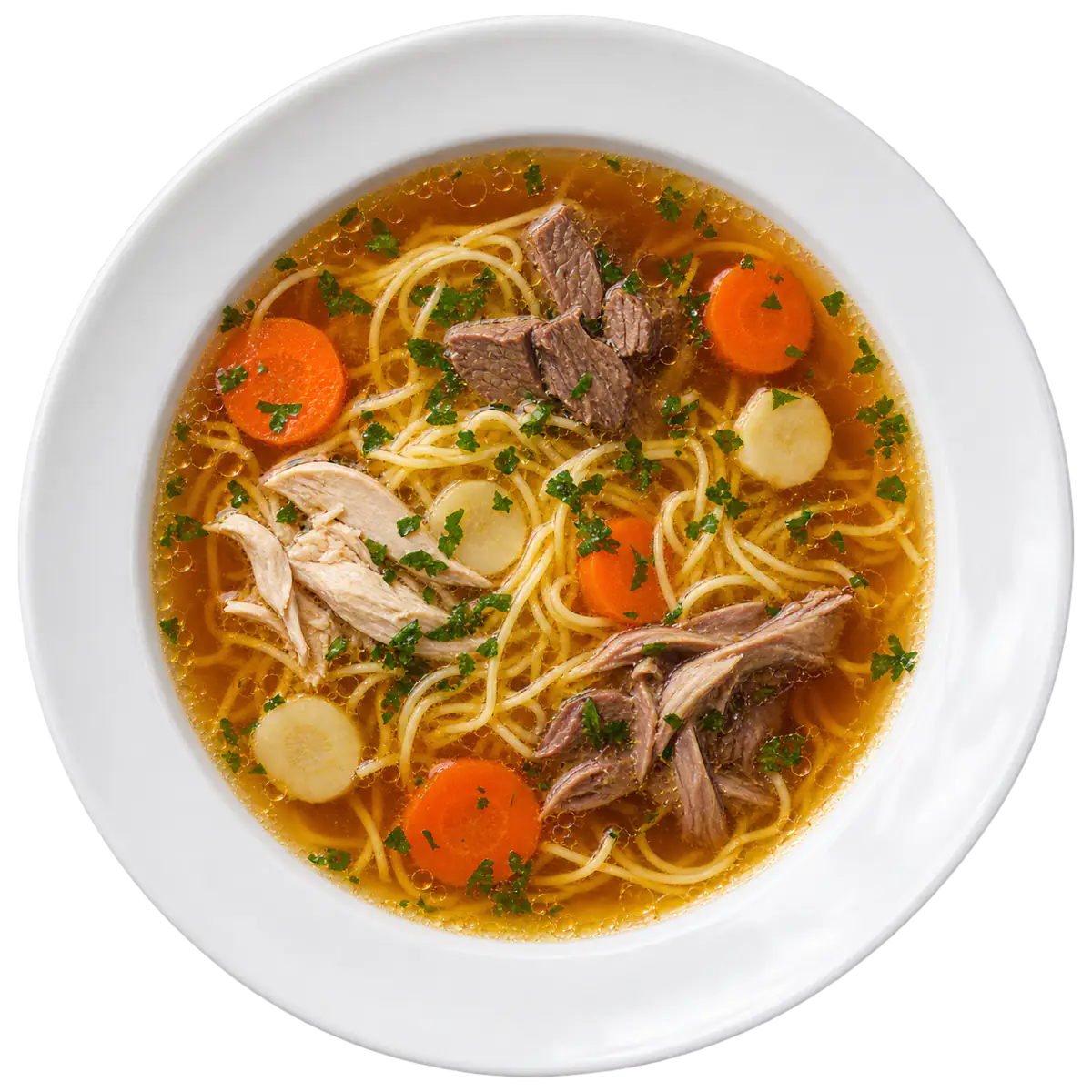
'Royal' rosół: a clear broth made from three kinds of meat, usually beef or veal, a white bird (hen, turkey or chicken) and a dark bird such as duck or goose, with root vegetables, served with fine noodles.
Origin and history
Broths of several meats were the pride of old Polish tables. The rosół in Stanisław Czerniecki's Compendium Ferculorum (1682), the first Polish cookbook, already combined beef, veal and birds such as partridges and pigeons, and Polish cooks still prize mixed-meat broths above all. A rosół cooked from several kinds of meat came to be called królewski, 'royal'; today the name means a broth of three meats: beef or veal, a white bird and a dark bird.
Make it at home
- Makes
- 8 servings
- Total time
- 5 h 30 min
- Hands-on
- 45 min
Ingredients
- 600 g1.3 lb beef brisket (szponder) or shank, or veal shank, on the bone, the 'red' meat
- 1 kg2.2 lb boiling hen (kura rosołowa) or turkey pieces: wings, neck, thighs, the white bird
- 800 g1.75 lb duck or goose: carcass, neck, wings and a leg, the dark bird; trim off loose skin and fat
- 4 l4 1/4 qt cold water
- 3 carrots, peeled
- 2 parsley roots (pietruszka) or small parsnips, peeled
- 150 g5 oz celeriac (celery root), peeled, in one piece
- 1 leek, white and pale green part, washed
- 1 savoy cabbage leaf (kapusta włoska), just one
- 2-3 dried porcini (borowiki), rinsed
- 1 onion, unpeeled, halved
- 5 allspice berries (ziele angielskie)
- 2 bay leaves
- 1 tsp black peppercorns
- 1 small bunch flat-leaf parsley and lovage (lubczyk), or 1 tsp dried lovage
- 1 tbsp salt, adjust at the end
- 300 g10 oz thin egg noodles (makaron nitki)
- 2 tbsp chopped parsley, to serve
Method
-
1. Rinse the beef or veal, put it in your largest pot with the cold water and bring it slowly to the boil over medium heat.
-
2. Skim off all the grey foam as it rises, then lower the heat until the surface barely trembles and simmer, partly covered, for 1 hour. The red meat goes in first because it needs the longest.
-
3. Rinse the hen or turkey pieces and the duck or goose pieces and add them to the pot. Let it come back to a bare simmer and skim again.
-
4. Simmer for 1 hour more without stirring and without letting it boil, or the broth will cloud.
-
5. Add the carrots, parsley roots, celeriac, leek, cabbage leaf, dried porcini, allspice, bay leaves and peppercorns.
-
6. Keep the pot at the barest simmer for 2 1/2 hours. Every half hour, tilt a ladle into the surface to lift off the yellow duck or goose fat.
-
7. Meanwhile, char the cut sides of the onion directly over a gas flame or in a dry heavy pan until black.
-
8. For the last 30 minutes, add the charred onion, the parsley and lovage and the salt.
-
9. Lift out the meats and vegetables gently. Strain the broth through a sieve lined with muslin or a clean cloth, skim off the remaining fat, leaving only small golden eyes on the surface, and taste for salt.
-
10. Cook the noodles separately in salted boiling water and drain them; cooked in the broth they would cloud it.
-
11. Put noodles and a few slices of carrot in each bowl, ladle the very hot broth over and scatter with parsley. Serve the meats separately, as a second course.
Notes
- How it differs from the parent rosół: the everyday rosół is a hen broth, sometimes with a little beef. Rosół królewski ('royal') is built on three meats at once, a red meat, a white bird and a dark bird, and simmered for longer, so it is deeper in colour and richer in body. The parent recipe on this site is the hen broth.
- The three meats: beef or veal for depth, hen, turkey or chicken for sweetness and a dark bird, duck or goose, for richness. Of the dark bird only the carcass and wings or a leg are needed; a whole duck makes the broth fatty and dominates it.
- Veal instead of beef gives a paler, lighter broth. A beef bone with marrow adds body.
- Only a few dried mushrooms and a single cabbage leaf: they add depth, but more would turn the broth into a mushroom or cabbage soup.
- Fat: duck and goose release a lot of it. Skim it as it rises and keep it in a jar for frying potatoes.
- Some old-style cooks add a few leaves of ground ivy (bluszczyk kurdybanek), a slightly bitter wild herb, in place of some of the parsley.
- Garnish: thin noodles are the classic. Poured dumplings (lane kluski) or semolina dumplings are also served.
- The cooked meats are excellent the same day with horseradish or the next day minced into pierogi or croquette filling.
- Make-ahead: the broth keeps 4 days in the fridge and sets to a jelly; lift off the solid fat before reheating. It freezes for months. Keep the noodles separate.
- Other named forms on this site: rosół myśliwski (game) and rosół dworski z kapłona (capon).
Adapted from Stanisław Czerniecki, Compendium Ferculorum, albo Zebranie Potraw (1682), Piotr Bikont, "Skąpany w rosole" (Zintegrowana Platforma Edukacyjna), Kwestia Smaku, "Rosół", and Super Express, "Królewski rosół".
At the festivals
No festival we list has printed it on a menu yet.