
🇮🇹 Italy · Aquilea, Morianese area, Lucca (Tuscany)
Zuppa di AquileaTuscan red bean soup
A meatless frantoiana of Aquilea in the Moriano hills north of Lucca: a broth of Lucca red beans with braschetta (black kale) and wild greens, made without meat or soffritto, layered with unsalted bread and dressed with raw olive oil.
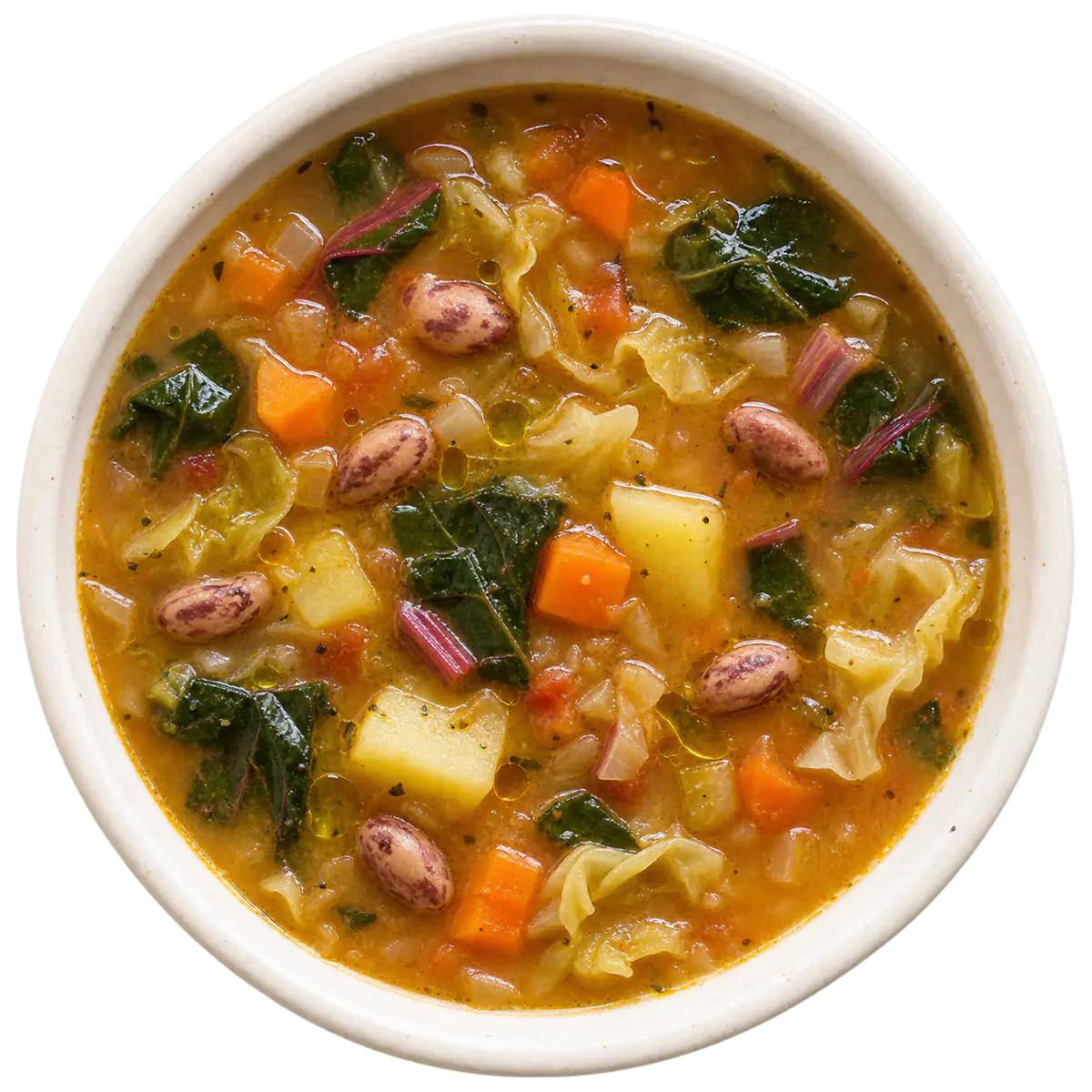
Origin and history
Aquilea is a hill village in the Morianese, north of Lucca, whose committee has held a soup festival every August since 1978 (the first festival, in 1977, was for marinated anchovies). Its meatless frantoiana was entered in Tuscany's list of traditional food products (PAT) in 2019, the village was named 'Paese della Zuppa' the same year, and the soup gained its own mark in 2024. According to local tradition, it goes back to a medieval hilltop settlement.
Make it at home
- Makes
- 6 servings
- Total time
- 4 h
- Hands-on
- 1 h
Ingredients
- 400 g14 oz (2 cups) dried red beans, ideally fagiolo rosso di Lucca (or borlotti), soaked overnight; keep the soaking water
- 2 cloves garlic, peeled
- 1 sprig sage
- 2 large handfuls (about 200 g)2 large handfuls (about 7 oz) wild greens ('erbi di campo'): whatever the season offers, such as young nettle tips, borage and wild fennel, washed, chopped
- 1 red onion, chopped
- 2 celery stalks, chopped
- 2 carrots, chopped
- 1 potato, peeled, diced
- 1/4 head (about 300 g)1/4 head (about 10 oz) white cabbage (cavolo cappuccio), shredded
- 1/4 head (about 300 g)1/4 head (about 10 oz) savoy cabbage (verza), shredded
- 2 bunches (about 400 g)2 bunches (about 14 oz) braschetta lucchese (Lucca black kale) or cavolo nero, central ribs removed, leaves shredded
- 1 bunch chard, chopped
- 1 large handful aromatic herbs for the 'mazzetta': parsley, basil, nepitella (lesser calamint) or mint, a little oregano and thyme
- 150 ml2/3 cup extra-virgin olive oil from the latest harvest, plus more for the bread and to serve
- 400 g14 oz stale unsalted Tuscan bread (pane sciapo), in thin slices
- salt and freshly ground black pepper, to taste
Method
-
1. Put the beans in a large pot with their soaking water, topped up to cover them by about 5 cm (2 in), add the garlic and sage and simmer gently, covered, for about 1 hour 30 minutes, until very tender. Salt only at the end.
-
2. Take out about a third of the whole beans and set them aside. Pass the rest through a food mill with their cooking liquid, back into the pot; you should have about 3 L (3 qt) of bean broth. Add hot water if needed.
-
3. Bring the bean broth to a gentle simmer. Without any soffritto, add the vegetables in order from the toughest to the most tender: first the wild greens, then the onion, celery, carrot and potato, then the white cabbage, savoy and black kale, and the chard last, letting each batch wilt before adding the next.
-
4. Pour in half of the olive oil, season with salt and pepper, and cook slowly over moderate heat, half covered, for about 1 hour 30 minutes, stirring now and then, until all the vegetables are very soft.
-
5. Meanwhile, chop the herbs for the mazzetta very finely together (or pound them in a mortar) with a pinch of salt and the remaining olive oil to make a loose, green paste.
-
6. Stir the reserved whole beans and the mazzetta into the soup for the last 10 minutes of cooking, so the herbs keep their scent. Taste for salt and pepper.
-
7. Brush or drizzle the bread slices with olive oil. In a deep tureen, lay a layer of bread, ladle soup over it, and continue in layers, finishing with soup.
-
8. Cover the tureen and leave the soup to rest for 15–20 minutes, until the bread has soaked up the broth.
-
9. Serve in bowls with a thread of raw new olive oil poured over each portion.
Notes
- Total time: 4 h, plus overnight soaking.
- The zuppa di Aquilea is a 'frantoiana di magro': a Lucchese olive-mill soup with no meat or animal fat at all, no soffritto, beans cooked in their soaking water and as many wild and garden greens as the season gives. The Aquilea committee's rules require local produce: the Lucca red bean, the braschetta lucchese black kale and the wild 'erbi', with oil from the latest harvest and unsalted bread baked in the Morianese.
- Its best season is from the first frosts to early spring, when the wild greens and the braschetta have been touched by frost. For the August sagra, when wild greens are scarce, the cooks use what summer gives: borage, nettle tips, wild fennel, wild strawberry leaves, oregano, mint, basil, parsley, nepitella and courgette flowers.
- In the village a ground spice blend called 'la saporita', prepared by the local grocer, goes in with the mazzetta; at home, freshly ground black pepper is the usual seasoning.
- Close relatives are the other Lucchese soups: the zuppa frantoiana, which many families make with a little rolled pancetta, a rind or a ham bone, and the zuppa lucchese di magro. They differ in small details, and each village considers its own the true one.
- Outside Tuscany, use borlotti beans, cavolo nero and whatever tender wild or bitter greens you can find (dandelion, rocket, young spinach, chicory). Use unsalted or low-salt country bread; salted bread makes the soup too salty.
- Like all Tuscan bread soups it is good reheated the next day, and it is also eaten lukewarm.
Adapted from Cristina Sorbi, La zuppa: sapori, culture, specchio del territorio. Il caso di Lucca (Master in Storia e Cultura dell'Alimentazione, Università di Bologna) and Visit Tuscany: Frantoiana soup.
At the festivals
Served at 1 festival in Italy.
Earlier editions
-
August 01, 2025
🇮🇹 Lucca, Italy
Sagra della Zuppa di Aquilea
By Comitato Paesano di Aquilea / housewives of the village