
🇨🇲 Cameroon · North-West Region, Cameroon (Bamenda and Bafut area)
Achu soup (yellow soup)Cameroonian yellow soup
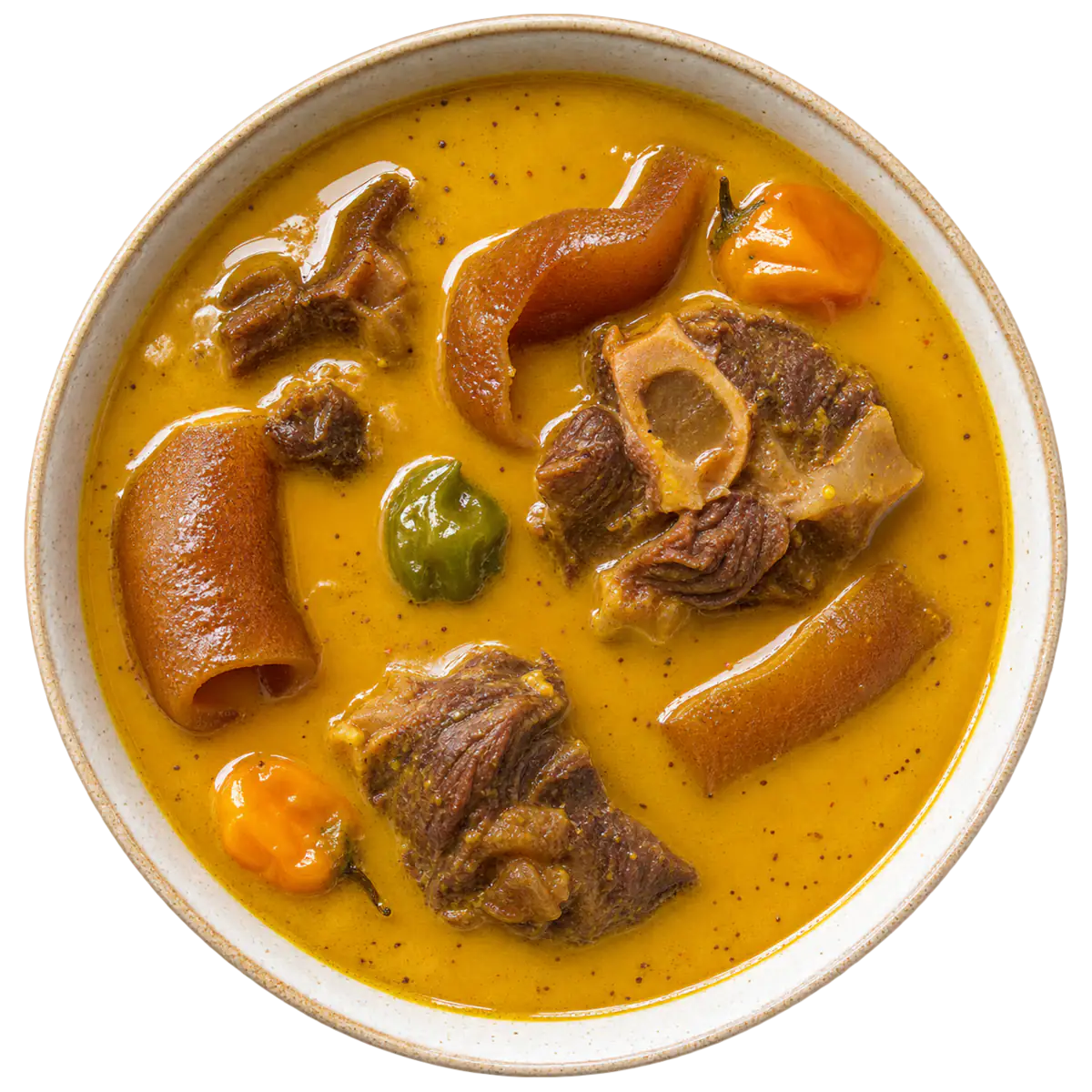
A Cameroonian soup of palm oil emulsified with limestone (kanwa) into a yellow broth with meat or fish and spices, eaten with achu, pounded cocoyam (taro).
Origin and history
Achu soup, also called yellow soup, belongs to the grassfields of North-West Cameroon (the Bamenda and Bafut area) and is also cooked in the West and South-West regions. Its yellow colour comes from palm oil emulsified with kanwa limestone. It is traditionally served with pounded cocoyam and eaten by hand.
Make it at home
- Makes
- 5 servings
- Total time
- 2 h 15 min
- Hands-on
- 50 min
Ingredients
- 500 g1.1 lb beef shank or stewing beef, cut in large chunks
- 300 g10.5 oz beef tripe, well cleaned, cut in strips; optional but traditional
- 1 small onion, sliced
- 1 whole habanero or scotch bonnet pepper, left intact so the heat stays gentle
- 1.2 kg2.6 lb taro (cocoyam, macabo), the starchy corms, not the small eddoes
- 120 ml1/2 cup red palm oil, unrefined, gently warmed
- 5 g1 tsp kanwa (food-grade edible limestone potash), ground to a powder
- 120 ml1/2 cup warm water, to dissolve the kanwa
- 2 tbsp achu or yellow-soup spice mix, ground; the Cameroonian blend usually built on njansang and country pepper
- 2 cubes bouillon cubes, optional
- salt, to taste
Method
-
1. Put the beef, tripe, sliced onion, whole pepper and a good pinch of salt in a large pot, cover with about 1.5 litres (6 cups) of water and bring to a boil.
-
2. Reduce to a steady simmer and cook for 1 hour to 1 hour 30 minutes, until the tripe is tender when pinched, skimming any foam. Lift out the meat and tripe and keep the stock, you need about 750 ml (3 cups).
-
3. Meanwhile, peel the taro, cut it in large chunks and boil it in plenty of water for 40 to 50 minutes, until a knife slides in with no resistance. Drain and keep it hot.
-
4. Stir the ground kanwa into the warm water, leave it for a few minutes to settle, then pour off the cloudy liquid and discard the grit at the bottom.
-
5. Warm the palm oil in a wide bowl or pan over very low heat until it is just liquid and no more than lukewarm, 40 to 50 °C (105 to 120 °F). Hot oil will break the emulsion.
-
6. Pour the kanwa water into the oil a spoonful at a time, whisking or stirring steadily in one direction. The mixture turns pale yellow and thickens into a creamy paste.
-
7. Stir the spice mix into 100 ml of warm stock, then fold it into the yellow paste with the crumbled bouillon cubes.
-
8. Gradually whisk in the rest of the warm stock until you have a smooth, loose yellow soup. Add the meat and tripe, warm through without boiling, and adjust the salt.
-
9. Pound the hot taro in a mortar, or mash it with a heavy wooden spoon or a stand-mixer paddle, for 5 to 10 minutes, until it is completely smooth, stretchy and free of lumps. Sprinkle in a few drops of hot water only if it is stiff.
-
10. Shape the pounded taro into a mound on each plate, press a well into the centre, and ladle in the soup and meat. Eat with the fingers, pinching off bites of achu and dipping them in the soup.
Notes
- The usual accompaniment is the achu itself: pounded cocoyam (taro, macabo). The soup is not really eaten without it, and the taro must be pounded while hot, because it stiffens and goes lumpy as it cools.
- Kanwa (also called kaun or potash) is the limestone-type salt that turns palm oil into a yellow emulsion. Some cooks prefer nikki, a lye made from burnt plantain peels, instead. If you cannot find either, a pinch (about 1/4 tsp) of baking soda stirred into the warm water gives a similar yellow emulsion; it is a shortcut, and the soup will taste a little less earthy and mineral.
- Achu spice mix is hard to find outside Cameroon. Cameroonian grocers and online African shops sell it, and njansang (ndjansang) can be bought alone. A rough stand-in for 2 tbsp is 1 tsp ground white pepper, 1/2 tsp ground nutmeg, 1/2 tsp ground ginger and 1/2 tsp ground dried chilli with 1 tbsp ground toasted sesame seeds; the flavour will be different but in the right direction.
- If you cannot find taro, yam or green plantain boiled and pounded the same way is the nearest texture, but the result is not achu. Ordinary potatoes do not pound into a stretchy dough.
- Beef alone also works; tripe and cow skin (ponmo) are the classic additions. Smoked or fresh fish is another traditional protein for yellow soup.
- Make the stock and boil the meat a day ahead. Mix the yellow emulsion just before serving and reheat it very gently; boiling can split it.
Adapted from Achu Soup (Yellow Soup) & Achu, African Bites, Achu Soup (Yellow Soup), Afrifood Network, and Le taro pilé et sa sauce jaune, camer.be (La recette du dimanche).
At the festivals
No festival we list has printed it on a menu yet.