
🇮🇹 Italy · Marche (Fano)
Brodetto di FanoFano fish stew
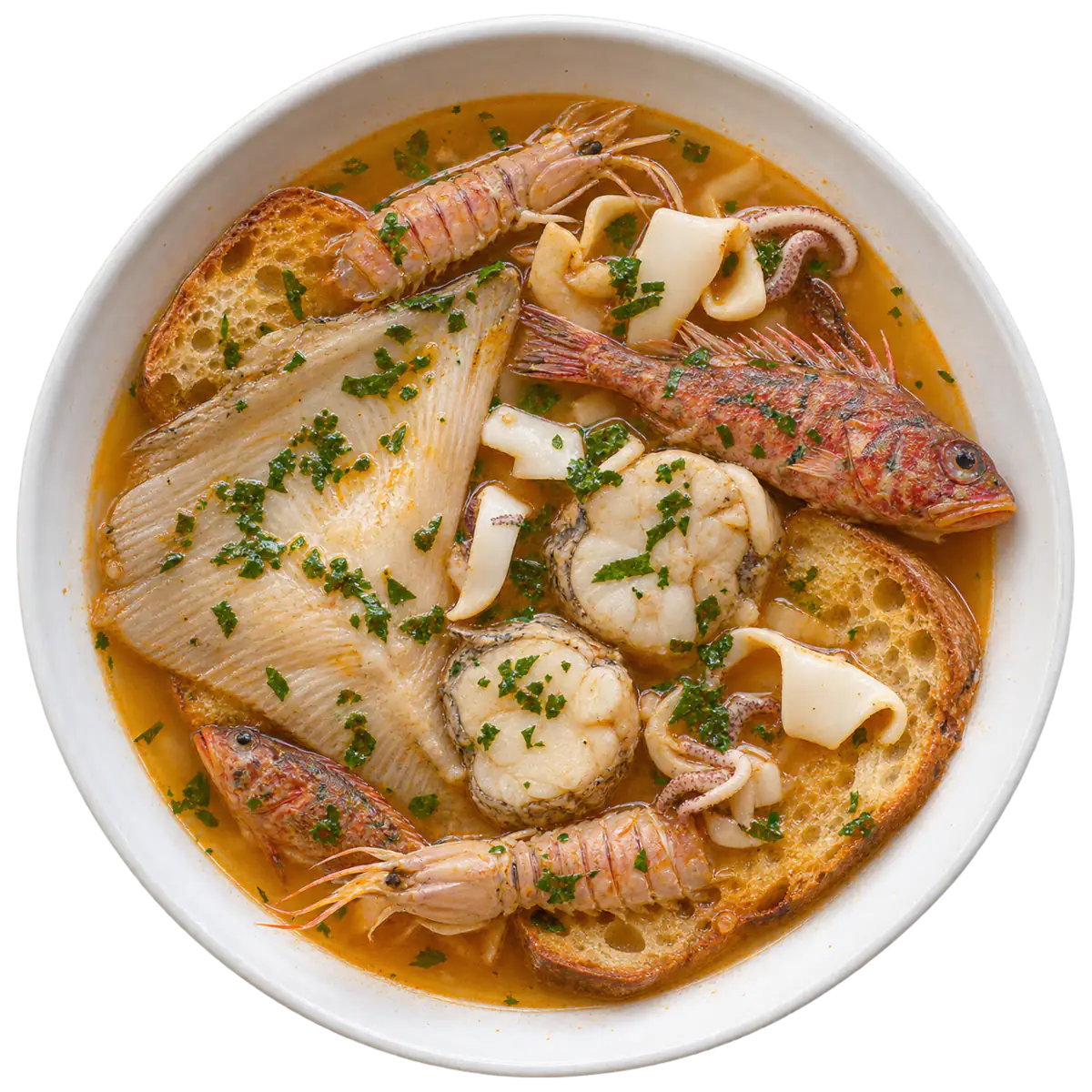
Fano's brodetto: tomato concentrate dissolved in vinegar gives a red-to-amber broth; vinegar is essential, there are no peppers, and skate/ray is a key fish.
Origin and history
Fano, on the Marche coast, makes one of the best-known brodetti of the Adriatic. Like its neighbours, it began as a fishermen's meal cooked from the part of the catch that would not sell. Fishermen carried tomato concentrate aboard as a staple. According to local tradition, vinegar came into the pot when the wine they cooked with turned sour (the 'acetella'). The Confraternita del Brodetto deposited its 'Brodetto tradizionale di Fano' with a notary, and the town has held an international brodetto and fish-soup festival since the early 2000s.
Make it at home
- Makes
- 6 servings
- Total time
- 1 h 20 min
- Hands-on
- 45 min
Ingredients
- 400 g14 oz cuttlefish (seppia), cleaned, cut into thick strips; squid can stand in
- 400 g14 oz skate wing (razza), cut into 5 cm (2 in) pieces
- 400 g14 oz monkfish tail (rana pescatrice), cut into thick slices on the bone
- 300 g10 oz dogfish or smooth-hound (gattuccio, palombo), cut into thick slices
- 600 g1.3 lb small whole fish: scorpionfish (scorfano), gurnard (mazzola), weever (tracina), John Dory (pesce San Pietro), gutted and scaled, left whole; use at least two kinds
- 6-8 mantis shrimp (pannocchie, canocchie), sides of the shell snipped with scissors; or large shell-on prawns
- 150 ml2/3 cup extra virgin olive oil
- 1 small white onion, finely chopped
- 2 garlic cloves, finely chopped
- 80 g5 tbsp tomato concentrate (concentrato di pomodoro, double-concentrated tomato paste)
- 75 ml5 tbsp white wine vinegar
- 500 ml2 cups water, hot, plus more as needed
- salt and black pepper, to taste
- 1 small bunch flat-leaf parsley, chopped
- 6-12 slices day-old country bread, toasted; a cut garlic clove to rub them, optional
Method
-
1. Clean all the seafood and sort it into three piles by firmness: cuttlefish; skate, monkfish and dogfish; then the small whole fish and the mantis shrimp. Keep each pile cold until it goes into the pan.
-
2. Choose a wide, shallow pan (30-35 cm / 12-14 in) so the fish can lie in a single layer. Warm the olive oil over low to medium heat and cook the onion and garlic gently for about 8 minutes, until soft and translucent but not browned.
-
3. In a bowl, dissolve the tomato concentrate in the vinegar and the hot water.
-
4. Pour the mixture into the pan, raise the heat and bring it to a simmer. Season it well with salt and pepper: the liquid should taste savoury and clearly tart. Simmer for 5 minutes.
-
5. Add the cuttlefish, half-cover the pan and simmer gently for about 20 minutes, until a knife slides into it with little resistance.
-
6. Add the skate, monkfish and dogfish and simmer for 5-7 minutes.
-
7. Lay the small whole fish on top and simmer for 8-10 minutes more. From now on do not stir: hold the handles and shake or swirl the pan now and then so nothing sticks.
-
8. If the broth has reduced so far that the fish is less than half submerged, add a splash of hot water.
-
9. Add the mantis shrimp for the last 3-5 minutes, until their shells turn pale and the flesh of the whole fish lifts easily from the spine.
-
10. Scatter over the parsley, taste the broth for salt (the fish releases its own) and let the pan rest off the heat for 5 minutes.
-
11. Bring the pan to the table. Put toasted bread in each bowl, ladle broth over it and serve the fish on top.
Notes
- Fish: the Confraternita del Brodetto of Fano lists ten species for the traditional version: mantis shrimp, dogfish, gurnard, stargazer, monkfish, skate, John Dory, scorpionfish, cuttlefish and weever, from the central Adriatic and never frozen. Most home cooks use six or seven. Outside Italy, mix firm fish (monkfish, gurnard, John Dory) with a few small whole fish. Prawns in place of mantis shrimp make the broth a little sweeter.
- The Fano style uses tomato concentrate rather than fresh tomatoes, and only a modest amount. It gives a brick-red to amber broth. Some cooks use a little passata instead.
- Vinegar is what gives Fano's brodetto its tang. It softens as it simmers, and the generous oil balances it. Some cooks replace part of it with dry white wine. Fano's version uses no peppers and no saffron.
- Other Adriatic towns differ: San Benedetto del Tronto builds on green tomatoes and green peppers, Vasto on ripe tomatoes and sweet peppers without vinegar, and Porto Recanati colours its brodetto with saffron. The Vasto and San Benedetto styles have their own pages.
- Make-ahead: the tomato and vinegar base can be made a few hours ahead. Cook the fish only just before serving, because brodetto does not reheat well. Leftover broth makes a good sauce for pasta.
Adapted from Dissapore, "Brodetto fanese", Confraternita del Brodetto, "Brodetto tradizionale di Fano" (notarised recipe, as reported by Meer), and Memorie di Angelina, "Brodetto Fanese".
At the festivals
Served at 1 festival in Italy.
Earlier editions
-
May 30, 2026 – June 02, 2026
🇮🇹 Fano, Italy
24th BrodettoFest
On the menu as Brodetto alla fanese
By Fishermen at Spazio Bro; restaurants of Fano
- May 30, 2025 – June 02, 2025
- July 04, 2019 – July 07, 2019