
🇰🇷 South Korea · Gyeonggi Province, around Uijeongbu and the other towns beside US military bases
Budae-jjigaeKorean army base stew
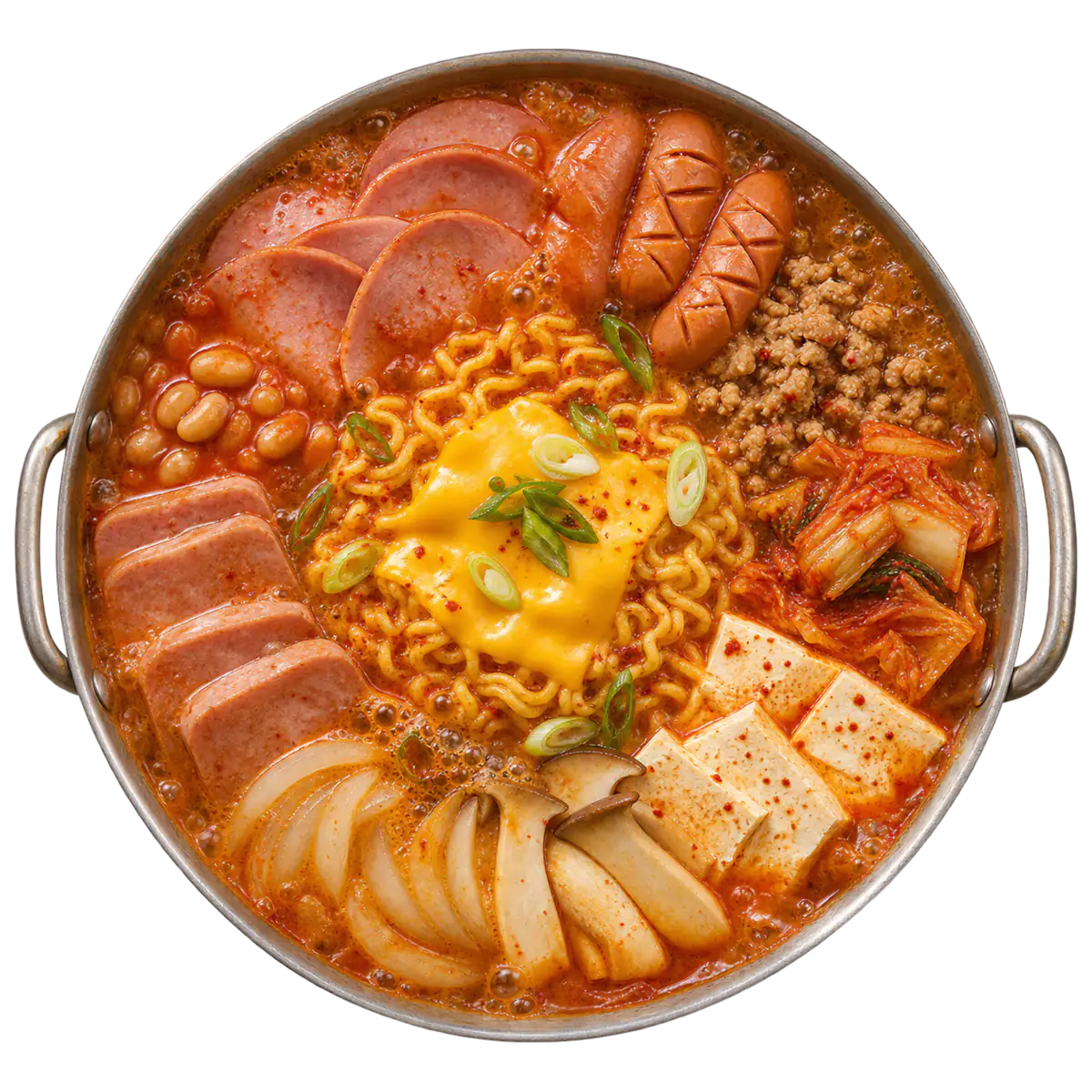
A spicy pot soup of sliced ham, sausage and Spam simmered with kimchi, tofu, bean sprouts, cabbage and onion, often with instant noodles added, which grew up around the US military bases of Gyeonggi Province.
Origin and history
According to the Encyclopedia of Korean Culture, budae-jjigae arose in Uijeongbu, Gyeonggi Province, in the 1960s, after the Korean War, from ham and sausage that came from nearby US bases; it was also nicknamed Johnson-tang. It credits Heo Gi-suk, who sold a stew of sausage, ham and bacon from a stall from 1960 and registered the restaurant Odeng Sikdang in 1968. Instant noodles were not part of the 1960s dish. A Gyeonggi provincial publication says the leftover-food porridge kkulkkuli-juk is often named as its origin but is a different dish, with no fixed recipe.
Make it at home
- Makes
- 4 servings
- Total time
- 35 min
- Hands-on
- 20 min
Ingredients
- 150 g5 oz canned luncheon meat (Spam), sliced about 5 mm thick
- 150 g5 oz smoked ham, cut in squares or slices
- 6 Vienna-style sausages, scored
- 75 g2.5 oz ground pork, marinated in 2 tsp soy sauce, 1 tbsp mirin, 1 tsp minced garlic and a little pepper for 10 minutes
- 1 cup (about 150 g)1 cup well-fermented sour kimchi, cut in bite-size pieces
- 1/4 onion, sliced
- 1/2 stalk scallion or green onion, sliced
- 1 king oyster mushroom, sliced
- a few slices firm tofu, optional; the Kurly recipe lists tofu without an amount
- 3 tbsp canned baked beans
- 500 ml2 cups unsalted beef bone broth (or anchovy broth)
- 300 ml1 1/4 cups water
- 2 tbsp gochugaru (Korean chili flakes), for the seasoning paste
- 1/2 tbsp gochujang, for the paste
- 1 tbsp guk-ganjang (Korean soup soy sauce), for the paste; light soy sauce can stand in
- 1 tsp anchovy fish sauce (myeolchi-aekjeot or chamchi-aek), for the paste; optional
- 1 tbsp minced garlic, for the paste
- 1 tbsp mirin, for the paste
- 1 tsp sugar, for the paste; adjust to the kimchi's sourness
- 2 pinches salt, for the paste, plus a little black pepper
- 1 packet (about 110 g)1 packet (about 4 oz) instant ramyeon noodles, seasoning packet set aside; added last
- 1 slice of cheddar or processed cheese, optional, melted on top
Method
-
1. Marinate the ground pork with the soy sauce, mirin, garlic and pepper for about 10 minutes.
-
2. Pour boiling water over the Spam, ham and sausages and drain them; this removes some of the grease.
-
3. Mix the gochugaru, gochujang, soup soy sauce, fish sauce, garlic, mirin, sugar, salt and pepper into a paste.
-
4. Arrange the ham, Spam, sausages, mushroom, tofu, kimchi, marinated pork, onion and baked beans in a wide shallow pot, keeping each in its own section.
-
5. Put the seasoning paste in the middle, then pour in the broth and water.
-
6. Bring to a boil over high heat, then simmer for 10 to 12 minutes until the kimchi has softened and the broth has turned a deep red.
-
7. Add the ramyeon noodles, pressing them under the broth, and cook 3 to 4 minutes until just tender. Lay the cheese and the scallion on top for the last minute.
-
8. Bring the pot to the table and keep it on a burner; serve with rice.
Notes
- The dish is a jjigae of American base meats (ham, sausage) with Korean kimchi, tofu and bean sprouts. Instant noodles were not part of the 1960s original (they reached Korea in 1963 and were too expensive to add at first), and the Encyclopedia of Korean Culture lists Spam, corn and baked beans as later additions; the Kurly recipe this one follows adds a slice of cheddar and a little rice cake, which you can include if you like.
- Regional styles in Gyeonggi Province: kimchi-forward in Uijeongbu, heavy with scallions in Paju, a mix of processed meats in Dongducheon, and chili beans in Songtan and Osan. This recipe is a general home version with a bone or anchovy broth; a Gyeonggi publication describes one Uijeongbu restaurant that builds its broth by boiling anchovies.
- Store-bought unsalted bone broth is common in Korean shop recipes; an anchovy and kelp broth is the other usual choice.
- Add bean sprouts and cabbage if you like; the Encyclopedia of Korean Culture lists them among the vegetables, and the earliest version was a fried side dish of sausage, ham, cabbage and onion.
- Cook the noodles last; once they are in, the pot does not reheat well.
Adapted from Marketkurly recipe: Kimchi budae-jjigae for 4 (quantities and seasoning paste), SBS Food: Army base stew (budae jjigae), Encyclopedia of Korean Culture (Academy of Korean Studies): Budae-jjigae, and Gyeonggi Province publication, vol. 176: Budae-jjigae.
At the festivals
No festival we list has printed it on a menu yet.