
🇯🇵 Japan · Nagasaki (Chinese quarter)
ChamponNagasaki noodle soup
Thick, chewy noodles in a milky chicken-and-pork bone broth, cooked together with stir-fried seafood, kamaboko and vegetables such as cabbage and bean sprouts.
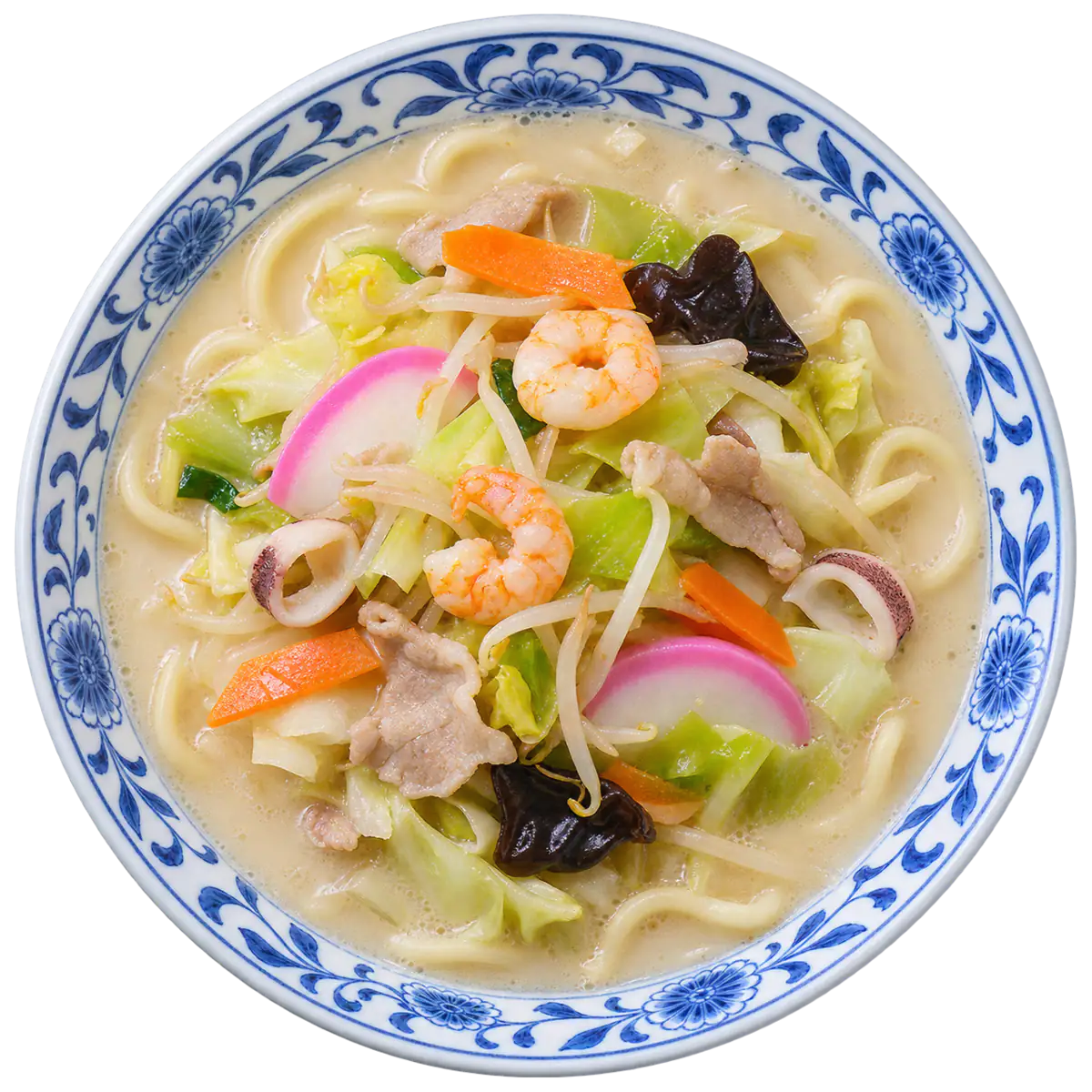
Origin and history
Champon is credited to Chen Heijun, a Fuzhou-born man who came to Nagasaki in 1892 and founded the Chinese restaurant Shikairo in 1899. He wanted an inexpensive, filling meal for poor Chinese students, and based it on a Fujian noodle soup, adding Nagasaki's seafood and vegetables, a milky pork-and-chicken broth and lye noodles. It was first listed as shina udon. The origin of the name champon is uncertain: Shikairo traces it to a Fuzhou phrase meaning to eat a meal, and another theory links it to a word for mixing.
Make it at home
- Makes
- 6 servings
- Total time
- 2 h 15 min
- Hands-on
- 45 min
Ingredients
- 2.6 L11 cups water, for the stock; it reduces to about 1.6 L
- 500 g1 lb 2 oz pork bones, scalded with boiling water
- 400 g14 oz chicken bones or carcasses, washed
- 20 g3/4 oz green part of a leek or scallion, for the stock
- 10 g1/3 oz ginger, peel is fine, for the stock
- 1 tbsp sake, for the stock, added once it boils
- 2 tbsp lard, for stir-frying; neutral oil if you prefer
- 120 g4 1/4 oz thinly sliced pork belly, cut in 2 cm / 3/4 in widths
- 60 g2 oz squid, cut in thin strips
- 60 g2 oz shelled shellfish (clam or oyster meat)
- 100 g3 1/2 oz small shrimp, peeled and deveined
- 60 g2 oz kamaboko or hanpen (fish cake), thinly sliced
- 60 g2 oz chikuwa (fish cake tube), thin rounds
- 60 g2 oz onion, thinly sliced
- 60 g2 oz boiled bamboo shoot, cut in thin strips
- 60 g2 oz carrot, cut in thin strips
- 6 g1/4 oz dried shiitake, soaked, thinly sliced; keep the soaking water
- 400 ml1 2/3 cups shiitake soaking water
- 2 dried wood ear (kikurage), soaked and cut in strips
- 150 g5 1/4 oz cabbage, cut a little coarsely
- 150 g5 1/4 oz bean sprouts, roots left on
- 1 leek (nagaimo negi), white part, sliced on the diagonal
- 18 snow peas, cut in thin diagonal strips
- 6 portions champon noodles (thick, chewy Chinese noodles made with lye), fresh steamed noodles; fresh thick Chinese noodles also work
- 2 tsp salt
- 3 tbsp light soy sauce
- 2 tbsp sake
- pepper, a little
Method
-
1. Put the water, pork bones, chicken bones, leek green and ginger in a deep pot without a lid. Bring to a boil over high heat, add the sake, turn to medium heat and simmer uncovered for 1 hour to 1 hour 30 minutes, skimming. Strain through a cloth-lined sieve and measure 1.6 L (8 Japanese cups); simmer longer if there is more.
-
2. Soak the shiitake and wood ear in water, saving the shiitake liquid, and prepare and cut all the other ingredients.
-
3. Heat a large wok until very hot and melt the lard in it. Stir-fry the pork until it changes color.
-
4. Add the onion, bamboo shoot, carrot, shiitake, wood ear, squid, shellfish, shrimp, kamaboko and chikuwa and stir-fry.
-
5. Last, add the cabbage, bean sprouts, leek and snow peas and stir-fry until the vegetables wilt.
-
6. Pour in the stock and the shiitake liquid. Season with the salt, soy sauce, sake and pepper and taste.
-
7. When it is boiling, push the ingredients aside and add the noodles to the wok, one portion at a time. When a noodle portion is hot, lift it into a deep bowl and add the next.
-
8. Top each bowl with its share of the stir-fried ingredients and pour in the hot soup. Serve immediately.
Notes
- This follows the champon-making material used by Nagasaki for its cooking experiences. The ingredients are stir-fried in lard first and then simmered in the stock, which is the method the Nagasaki material gives; the soup is rich and milky from the pork and chicken bones, not clear.
- The traditional noodle is thick and chewy and made with lye (touaku), which gives it a chewy, udon-like bite; fresh thick Chinese noodles are the closest substitute. The noodle is not a ramen noodle.
- A quick home version (2 servings) uses 150 ml milk and 400 ml water with chicken stock granules, sake, oyster sauce, garlic and sugar, with the same stir-fried pork, shrimp, cabbage, sprouts, kamaboko, carrot, onion and shimeji; it gets close to the milky color without the long stock.
- Sara udon, the same ingredients on crisp fried noodles with a thick sauce, is the stir-fried sibling and is not a soup.
Adapted from Nagasaki, Champon-making experience: ingredients and method for 6 servings (at-nagasaki.jp), Nippon.com, Guide to Japan: Nagasaki champon, and HugKum (Shogakukan), Nagasaki champon with a milk shortcut.
At the festivals
No festival we list has printed it on a menu yet.