
🇬🇧 United Kingdom · London
London particularBritish split pea soup
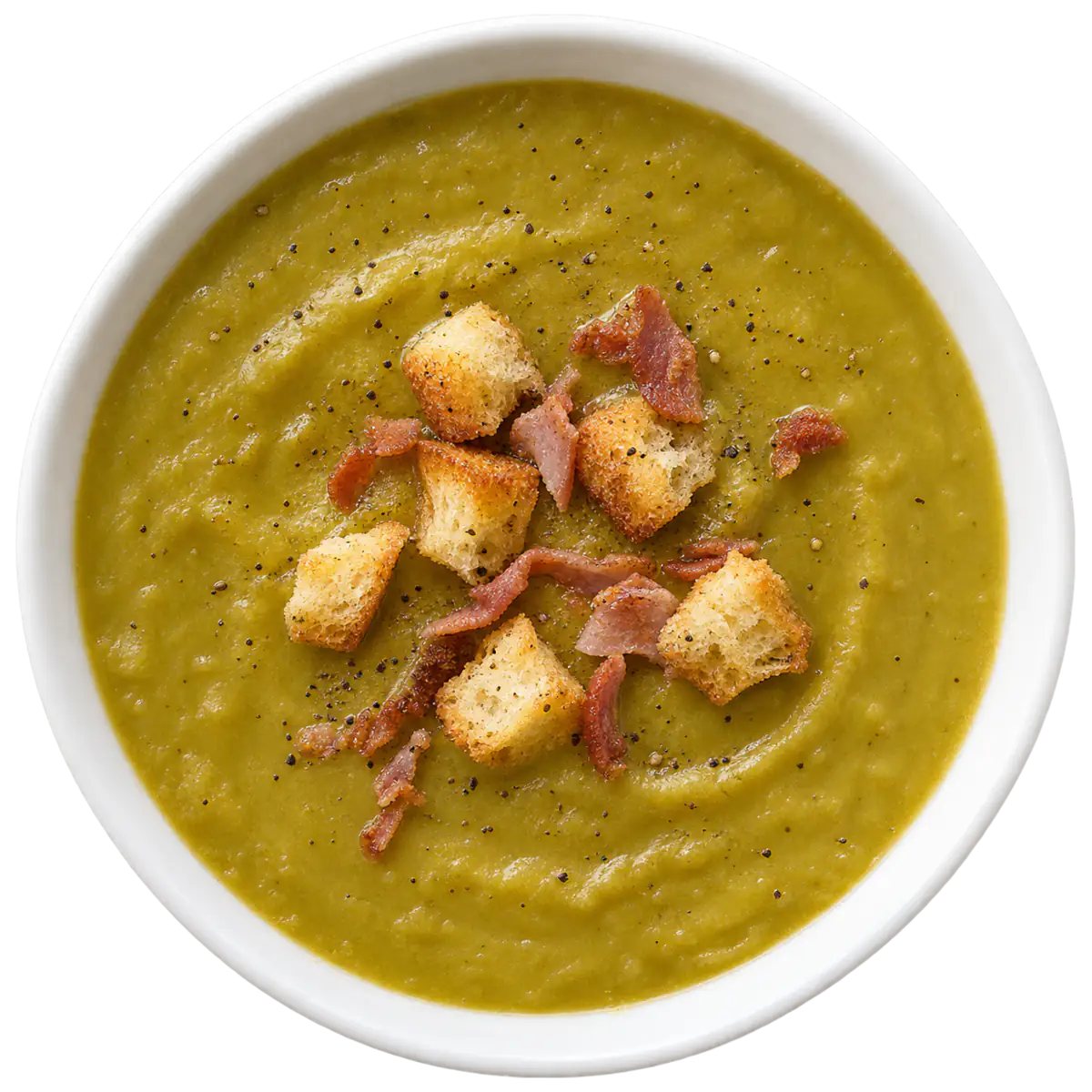
A thick purée of dried split peas simmered with a ham hock or bacon, onion and often carrot or leek, finished with croutons or crisp bacon. It is named after London's yellow pea-soup fog.
Origin and history
London particular is the thick split pea soup named after the sulphurous London fog, known as a pea souper. According to Foods of England it is said to have been devised by the cooks at Simpson's-in-the-Strand. The name comes from the phrase 'London particular', used for things particular to London, which Dickens applied to the fog in Bleak House (1852). Foods of England says the phrase's use for the soup appears to be very modern.
Make it at home
- Makes
- 6 servings
- Total time
- 2 h 30 min
- Hands-on
- 30 min
Ingredients
- 450 g2 1/4 cups dried green split peas, soaked overnight if old or not labelled no-soak
- 60 g4 tbsp butter
- 3 rashers3 slices smoked streaky bacon, chopped; plus 3 extra rashers to garnish
- 1 onion, diced
- 1 carrot, diced
- 1 leek, white and pale green, sliced
- 1 smoked ham hock or knuckle, or 2 pig's trotters
- 2 l2 quarts water, or light chicken stock
- 1 bay leaf, plus a sprig of thyme
- 2 tbsp Worcestershire sauce, optional; British Food History's version uses it
- salt and black pepper, salt only at the end
- croutons, to serve
Method
-
1. Drain the peas if they were soaked. Melt the butter in a large pot, fry the chopped bacon for 5 minutes, then add the onion, carrot and leek and cook until soft.
-
2. Stir in the peas to coat them in the fat, then add the ham hock, bay leaf, thyme, pepper and the water.
-
3. Bring to a boil, skim off the grey scum, cover and simmer gently for 1 h 30 min to 2 h, stirring from time to time since peas catch on the bottom, until they are mushy.
-
4. Lift out the hock and bay leaf and set the meat aside. Blend or mill the soup until smooth, and return it to the pot.
-
5. Shred the meat from the hock, discarding skin and bones, and stir it into the soup.
-
6. Grill the extra bacon until crisp and shred it. Season the soup with salt, pepper and Worcestershire if you like, thin with hot water if needed, and serve with the bacon and croutons.
Notes
- The soup is named for London's yellow-brown pea-soup fog. Foods of England says it is said to have been devised by the cooks at Simpson's-in-the-Strand, either to imitate or to ward off the fog, but gives no date. 'London particular' meant a speciality of London: British Food History says the phrase had been used for London goods such as Madeira for at least a century before Dickens, and Foods of England records it for the fog in Bleak House (1852).
- The base follows British Food History's quantities (450 g peas, butter, bacon, onion, a ham hock, 1 1/2 to 2 hours); the carrot and leek come from Foods of England, which gives no amounts, so those are set to suit the pot. Neither source states the water, which is set here at about 4.5 times the weight of the peas; The English Kitchen uses 1.5 l of ham or chicken stock for 300 g of peas.
- The ham hock supplies the stock, so no further stock is needed. Salt late: the ham and bacon are salty.
- Vegetables vary: Foods of England lists onion, carrot and leek with green or mixed green and yellow split peas and chicken stock; British Food History uses onion only and adds Worcestershire sauce; The English Kitchen uses onion, carrot and celery and purées only half the soup. Pick one or combine.
- It thickens as it sits: thin with water or stock when reheating. It keeps for 3 days, and freezes well.
Adapted from Foods of England: London Particular, British Food History: A pea souper (quantities and method), and The English Kitchen: The London Particular.
At the festivals
No festival we list has printed it on a menu yet.