
🇮🇹 Italy · Campania (Naples, Irpinia, Caserta, Sannio, Cilento)
Minestra maritataNeapolitan greens and meat soup
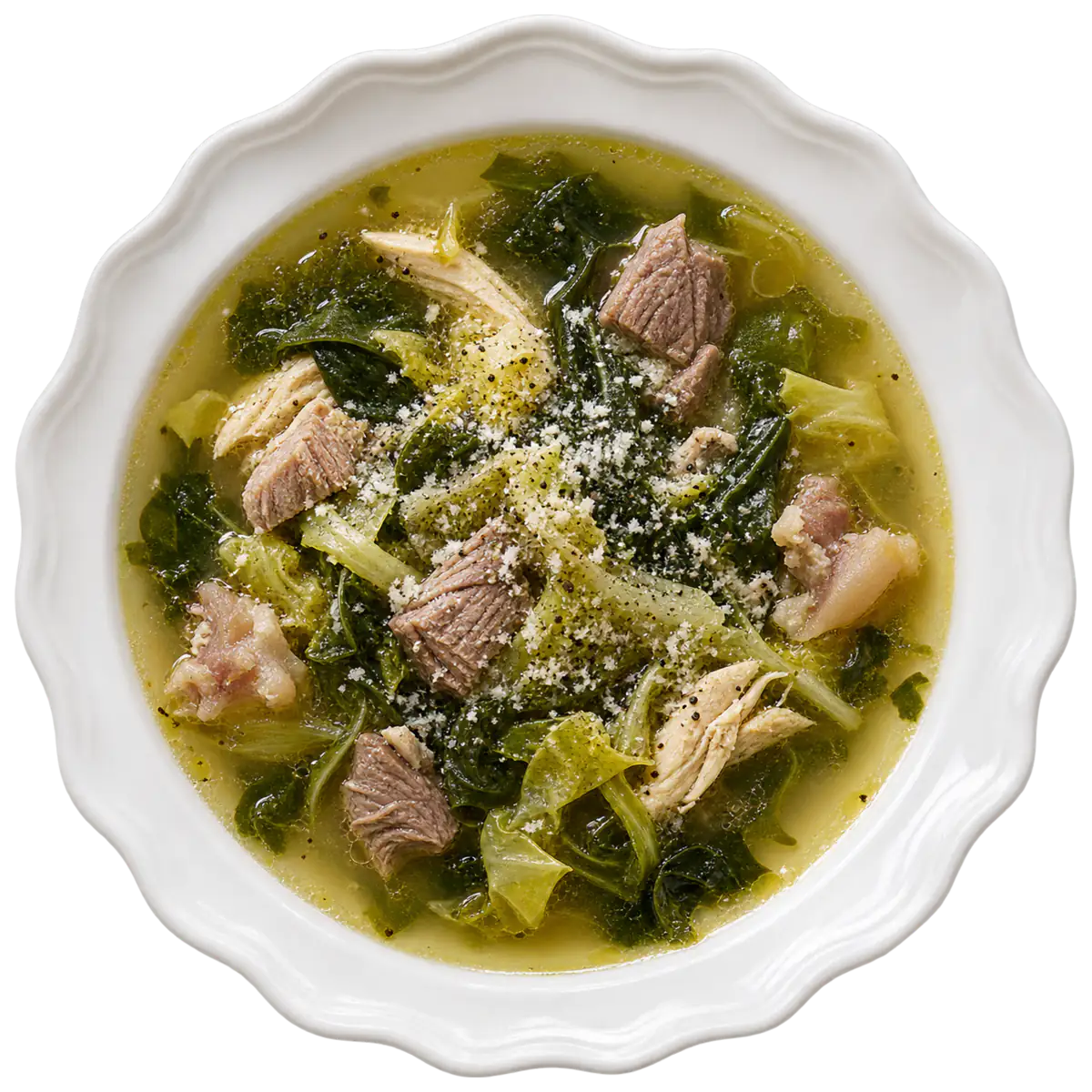
A Campanian soup of wild or garden bitter greens (escarole, chicory, borage, chard, broccoli leaves) simmered with pork, beef or chicken and grated cheese in a meat broth; the 'marriage' is of greens and meat.
Origin and history
Minestra maritata, also called pignato grasso, is a first course of Campania. Discover Campania says it is traditional on the Christmas menu in Naples and on Easter Monday in Sannio, and Ricette dal Mondo adds Santo Stefano (26 December), the day after the main feast. Milk Street's Naples cooks describe it as peasant fare, meat scraps used to flavour plentiful cheap greens. Discover Campania calls its origins very ancient, before macaroni and tomatoes, but Scatti di Gusto says there is no solid proof of where the dish comes from, noting only a similar soup in Apicius and a link to the Spanish olla podrida proposed by Raffaele Bracale.
Make it at home
- Makes
- 6 servings
- Total time
- 4 h 30 min
- Hands-on
- 1 h 15 min
Ingredients
- 1.5 kg3.3 lb beef, secondary cut such as biancostato (short rib) or shoulder, bone-in, for the beef broth
- 1/2 hen, for the hen broth
- 2 pig's feet (trotters), cleaned by the butcher, soaked in cold water for a full day
- 4.5 liters4.5 quarts cold water, about 3 liters for the beef broth and 1.5 liters for the hen broth
- 2 carrots, in large pieces, divided between the two broths
- 2 stalks celery, in large pieces, divided between the two broths
- 2 white onions, in large pieces, divided between the two broths
- 2 tomatoes, whole, one in each broth
- 4 bay leaves, plus a few parsley stems; half in each broth
- about 3.5 kg7.7 lb mixed greens, weighed before trimming, a mix such as escarole (scarola), curly endive, leaf broccoli, chard, borage, spinach, wild chicory, catalogna chicory, cavolo nero and savoy cabbage
- 120 ml1/2 cup extra virgin olive oil
- 1 medium white onion, chopped, for the finish
- 120 g1 1/4 cups grated Parmigiano Reggiano, plus a rind if you have one, and more for serving
- 250 g9 oz caciocavallo cheese, optional, cubed, added just before serving
- salt and black pepper, to taste
Method
-
1. Soak the pig's feet in cold water for a full day, changing the water often. Cover with fresh cold water, bring to a boil, then drain and rinse; repeat. Simmer them in salted water until tender, cool, bone and cut into small pieces.
-
2. Put the beef in a pot with about 3 liters of cold water, half the carrot, celery, onion, tomato, bay and parsley stems. Bring slowly to a gentle simmer, skimming foam, and cook at least 3 hours until the meat is tender.
-
3. In a second pot, cook the hen the same way in about 1.5 liters of water with the rest of the aromatics for about 3 hours.
-
4. Lift out the meats, strain both broths through a fine sieve, skim the fat and cut the meats into bite-size pieces, removing bones and skin.
-
5. Meanwhile, trim and wash the greens. Blanch each kind separately in salted boiling water for a few minutes until just tender, plunge into ice water, then drain and squeeze out the water.
-
6. In a tall pot, soften the chopped onion in the olive oil. Add the meats, then the firmest greens, then the rest.
-
7. Pour in the two broths, about two parts beef to one part hen, using enough to just cover; add the Parmesan rind if using, bring to a boil and simmer 20 minutes so the flavours marry.
-
8. Serve hot with freshly ground pepper and plenty of grated Parmigiano, with cubes of caciocavallo if you like.
Notes
- Quantities follow Scatti di Gusto's Neapolitan recipe for 4 to 6 servings, scaled down (it uses 5 liters each for the beef and hen broths and about 4 kg of greens, including 250 g of caciocavallo, which it calls optional). It makes the two broths separately and combines them two to one; a single pot of beef and hen also works but gives a murkier broth.
- The 'marriage' is that of greens and meat; there are no meatballs and no pasta. Milk Street notes this is the Italian original, not the Italian-American wedding soup, and that the name is partly the marriage of bitter greens and meaty broth and not only about weddings.
- Ricette dal Mondo's version is a pork-heavy one (guanciale, pig's ear, trotter, rind, cotechino, with garlic and chili, about 3 kg of greens for 6) and cooks in about 2 hours; Milk Street says chicken is common for everyday meals and beef and pork for celebrations, with the meat working more as a seasoning than as the centrepiece. Use whatever bitter greens are available; the soup is better with several kinds.
- Croutons and Parmesan top the version served at La Tavernetta Vittozzi in Naples (Milk Street); discovercampania mentions toasted bread alongside.
- Keeps for up to 3 days in the fridge and improves after resting. Be careful with salt if using cured meats.
Adapted from Scatti di Gusto, Minestra maritata napoletana, la ricetta scientifica, Ricette dal Mondo, Minestra maritata, and Discover Campania, La minestra maritata o pignato grasso.
At the festivals
No festival we list has printed it on a menu yet.