
🇨🇴 Colombia · Santander
MuteColombian corn and tripe soup
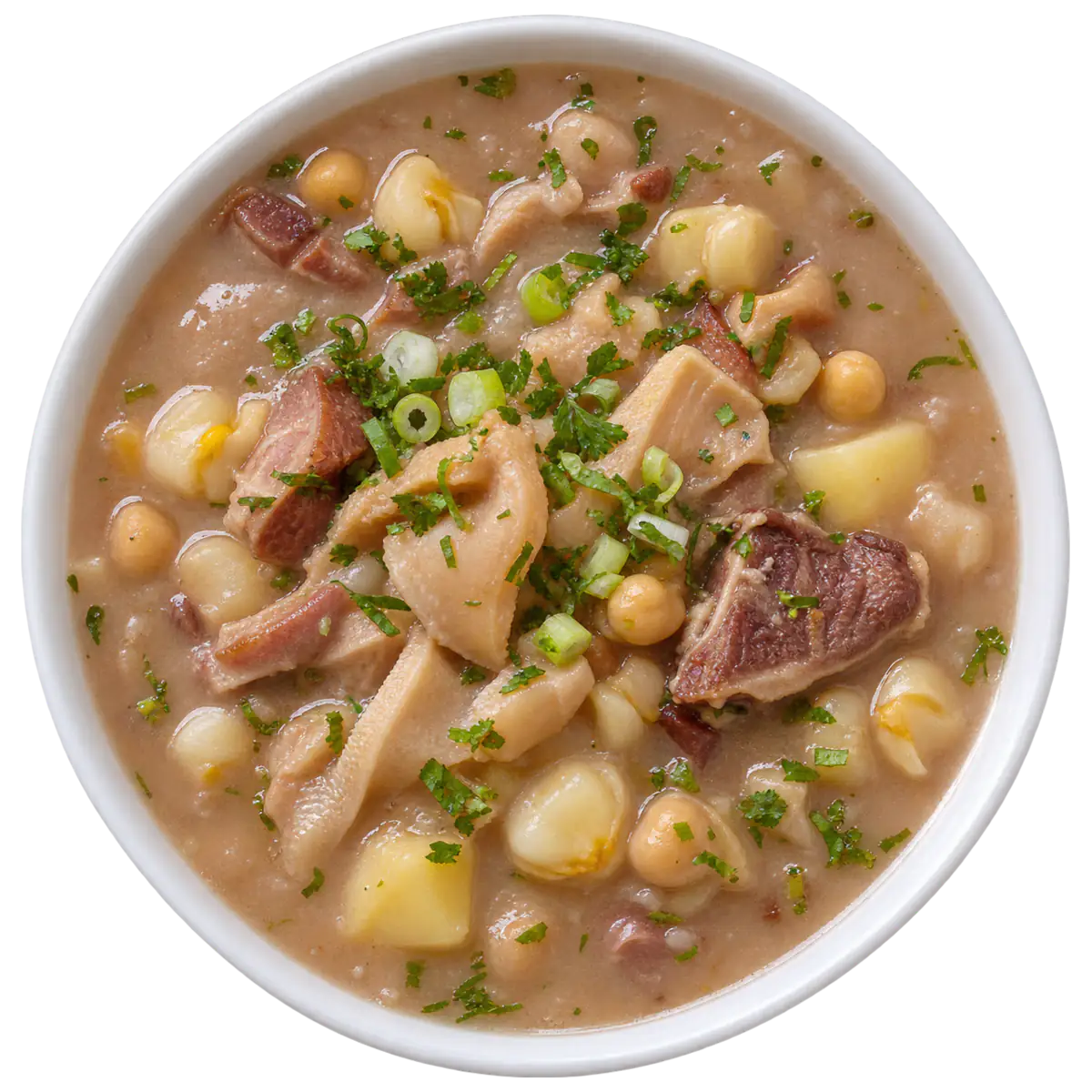
A thick Santander soup of hulled white corn simmered with tripe or other offal, beef and/or pork, potato and chickpeas.
Origin and history
Mute is the signature soup of Santander in north-eastern Colombia, eaten from Boyacá to Norte de Santander, and Bucaramanga holds a festival in its honour. The name comes from a Quechua word for maize, and the dish is built on mute, hulled dried white corn. El Espectador links it to the adafina stew of Iberian Jews, remade with local ingredients; Vanguardia describes it as a hearty Spanish-style stew adapted with corn and native herbs to feed farm workers in rough country such as the Chicamocha canyon.
Make it at home
- Makes
- 6 servings
- Total time
- 6 h 30 min
- Hands-on
- 1 h 15 min
Ingredients
- 375 g13 oz (about 2 cups) maíz para mute (dried hulled white corn, maíz pelado or trillado), soaked overnight; or dried white hominy
- 375 g13 oz (about 2 cups) dried chickpeas (garbanzos), soaked overnight
- 750 g1.65 lb beef tripe (callo or mondongo), ideally mixed cuts
- 1 small cow's foot (mano or pata de res), about 750 g / 1.65 lb, peeled and cut in pieces by the butcher
- 5 l5.3 qt water, plus hot water as needed
- 2 limes, or 3 tbsp vinegar, for cleaning the tripe
- 750 g1.65 lb boneless pork leg or shoulder, in large chunks
- 400 g14 oz beef short ribs (costilla de res), cut in pieces
- 200 g7 oz longaniza or Santander chorizo, sliced into rounds
- 500 g1.1 lb ahuyama (calabaza or kabocha squash), peeled, in 2 cm (3/4 in) cubes
- 250 g9 oz papa sabanera or other floury potato, peeled, in cubes
- 250 g9 oz papas criollas (small yellow potatoes), peeled, halved
- 2 ears of young corn (mazorca tierna), each cut in 3 rounds
- 150 g5 oz short pasta (macarrones or conchitas)
- 3 stalks cebolla larga (long green onion) or scallions, finely chopped, for the hogao
- 2 cloves garlic, crushed
- 2 ripe tomatoes, chopped
- 3 tbsp vegetable oil
- 1 pinch achiote (annatto) or color
- 1 sprig cilantro, finely chopped, plus more to serve
- 6 leaves guascas (Galinsoga), fresh, or 1 tsp dried
- salt and black pepper, to taste
- to serve: yellow arepas, sliced avocado, chopped green onion and parsley, lime, ají
Method
-
1. The night before, put the corn and the chickpeas to soak in separate bowls, covered by plenty of cold water.
-
2. Rinse the tripe, rub it with the lime juice or vinegar, leave it 15 minutes, then rinse it very well under running water and cut it into 2 cm (3/4 in) squares.
-
3. Drain the corn and chickpeas and put them in a large heavy pot with the tripe, the cow's foot and the water. Do not salt yet. Bring to a boil, skim the foam and simmer, partly covered, for 3 to 4 hours, until the chickpeas are creamy and the tripe is soft when pinched. Top up with hot water so everything stays covered.
-
4. Add the pork and the short ribs and simmer for about 1 hour more, until both are tender.
-
5. Lift out the pork, the ribs and the cow's foot. Cut the meat into bite-size pieces, pick the meat and soft skin off the foot and discard the bones.
-
6. Add the squash, both kinds of potato and the corn rounds to the pot and simmer for 10 minutes.
-
7. Meanwhile make the hogao: brown the chorizo slices in the oil in a frying pan, add the green onion and garlic and cook for 3 minutes, then add the tomato, cilantro, achiote and some salt and pepper and cook for about 8 minutes, until saucy. Stir in the cut meats.
-
8. Tip the hogao and meats into the pot with the pasta and simmer for 10 to 15 minutes, stirring from the bottom, until the pasta is just cooked and the squash and criollas have started to fall apart and thicken the soup. Season with salt.
-
9. Take the pot off the heat, add the guascas, cover and let it rest for 3 minutes.
-
10. Serve in deep bowls, thick, with arepas, avocado, green onion and parsley, lime and ají on the table.
Notes
- Total time: 6 h 30 min, plus overnight soaking.
- Mute corn is dried white corn with its skin removed by milling (trillado), not nixtamalized. Dried white hominy for pozole is the nearest substitute; canned hominy works too but needs only the last 30 minutes of cooking.
- Guascas give the soup its herbal note; they are sold dried in Latin American shops. Without them the soup is still good but tastes more like a plain sancocho.
- To save time, cook the tripe and cow's foot in a pressure cooker for 45 minutes and use cooked chickpeas, as many Bucaramanga cooks now do. The old way is a long simmer, ideally over a wood fire; the base can be cooked the day before and finished the next day.
- Every family makes it its own way. Some add dried broad beans (habas), red beans or green beans, peas, carrot, arracacha or eggplant, a pinch of cumin, or omit the pasta; the tripe and cow's foot are the constant.
- Mute is served as a meal in itself, often with white rice or arepa, avocado and a hot ají; chopped parsley and green onion go on at the table.
- Related soups: pozole (Mexico, nixtamalized corn) and sancocho (roots and plantain, no hulled corn).
Adapted from Mi Santander Sabe, Ministerio de Cultura de Colombia (recipe of abuela Concepción) and Sopa de mute santandereana, El Espectador.
At the festivals
Served at 1 festival in Colombia.
Earlier editions
-
November 03, 2024
🇨🇴 Ponedera, Colombia
III Festival del Sancocho
On the menu as mute martillero
By matronas of Martillo