
🇮🇳 India, 🇵🇰 Pakistan, and 🇧🇩 Bangladesh · Delhi and Lucknow (India); a staple of Karachi and Lahore (Pakistan) and of Dhaka (Bangladesh)
NihariSouth Asian meat stew
Also called nehari
What is nihari?
A slow-cooked stew of beef, buffalo or mutton shank with bone and marrow in a thin, spiced, wheat-flour-thickened gravy, simmered for hours and traditionally eaten at breakfast with naan. It is finished with ginger, green chilli, coriander and lemon.
- Total time
- 3 h
- Hands-on
- 1 h
- Makes
- 4 servings
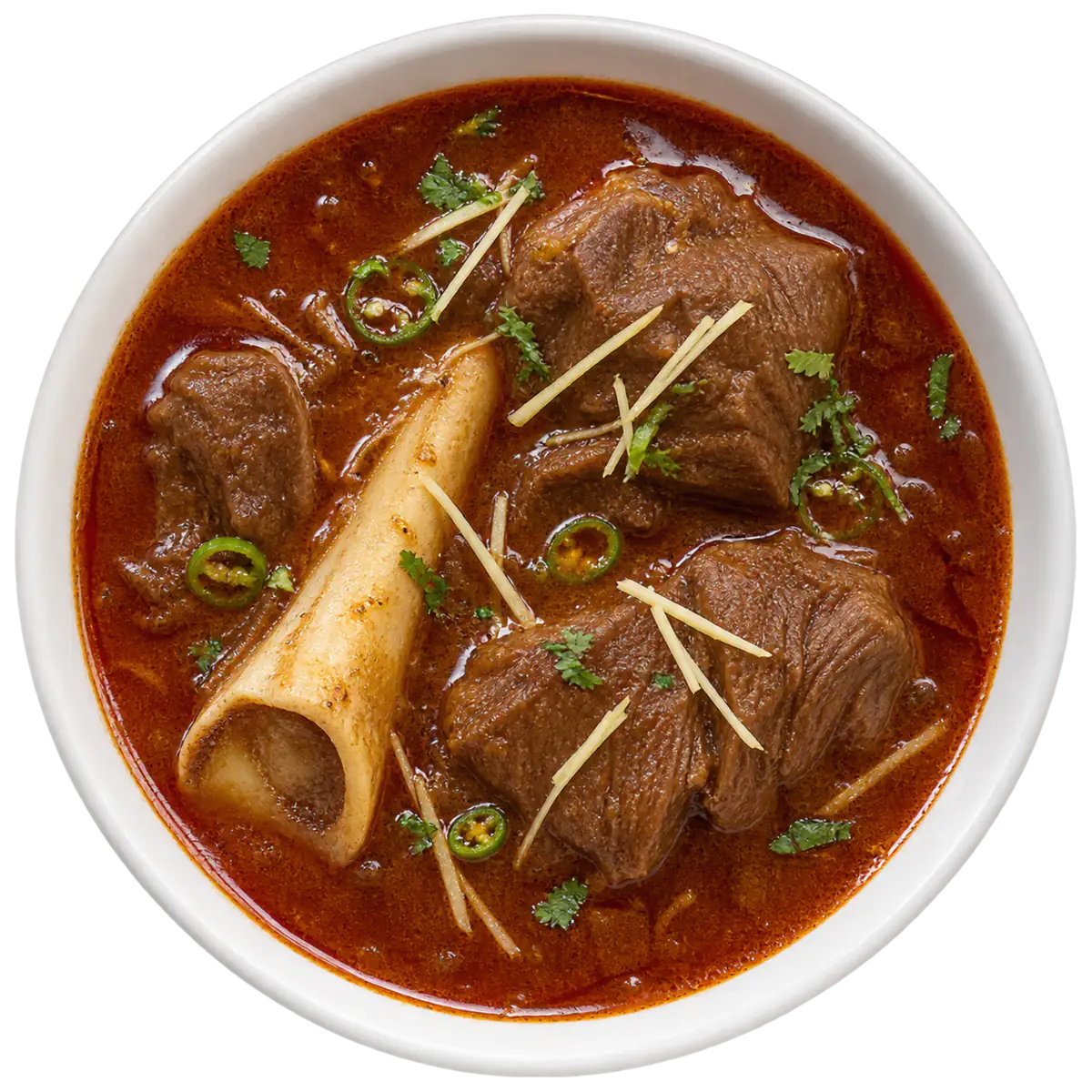
Nihari recipe
- Total time
- 3 h
- Hands-on
- 1 h
- Makes
- 4 servings
Nihari ingredients
- 1 kg2.2 lb beef shin (shank), bone-in if you can, cut in large pieces
- 1.25 L5 cups water
- 20 ml4 tsp ground turmeric
- 3 bay leaves
- 1 cinnamon stick
- 250 ml1 cup neutral oil, such as canola
- 40 ml2 1/2 tbsp ghee
- 1 large onion, finely chopped
- 20 ml4 tsp ginger paste
- 20 ml4 tsp garlic paste
- 80 ml1/3 cup nihari masala, from the batch below
- 20 ml4 tsp garam masala
- 62.5 ml1/4 cup atta (whole wheat flour)
- salt, to taste
- nihari masala (a batch; use 80 ml / 1/3 cup, keep the rest): 160 ml (2/3 cup) coriander seeds, 40 ml (2 1/2 tbsp) green cardamom pods, 40 ml (2 1/2 tbsp) cloves, 4 black cardamom pods, 2.5 ml (1/2 tsp) black peppercorns, 40 ml (2 1/2 tbsp) red chilli powder, 40 ml (2 1/2 tbsp) ginger powder, 2.5 ml (1/2 tsp) each ground nutmeg and mace, 40 ml (2 1/2 tbsp) Kashmiri chilli powder, 80 ml (1/3 cup) ground cumin, 40 ml (2 1/2 tbsp) salt
- 2.5 cm1 in fresh ginger, cut into fine matchsticks, to serve
- 1 lemon, sliced, to serve
- 1/4 bunch fresh coriander, chopped, to serve
- 1 to 2 green chillies, thinly sliced, to serve
- naan or khamiri roti, to serve
How to make nihari
-
1. Toast the whole spices of the nihari masala (coriander seeds, green and black cardamom, cloves, peppercorns) in a dry pan until fragrant, then grind them to a powder.
-
2. Mix the ground spices with the other powdered spices and the salt of the masala batch, and set aside.
-
3. Put the beef in a large pot with the water, turmeric, bay leaves, cinnamon stick and a little salt.
-
4. Cover and simmer until the meat is tender, about 2 hours.
-
5. Meanwhile, heat the oil and ghee in a separate pan over medium heat and fry the onion until golden brown.
-
6. Stir in the ginger and garlic pastes, the 80 ml (1/3 cup) of nihari masala and the garam masala, and cook until well combined.
-
7. Add this spiced paste to the beef as soon as the meat is tender.
-
8. Stir the atta with a cup of the hot cooking liquid, adding it gradually, to make a smooth slurry.
-
9. Stir the slurry back into the pot and cook for another 30 minutes, until the gravy thickens and oil rises to the top.
-
10. Serve hot in bowls, topped with ginger, coriander, green chilli and a squeeze of lemon, with naan on the side.
Notes
- Quantities follow SBS Food's recipe (Sumaiya Jawedan), which makes more masala than the stew needs; the rest keeps in a sealed jar for up to four weeks. The recipe is richer in oil than most; spoon off some of the red oil if you prefer.
- Traditionally nihari is cooked overnight, 6 to 8 hours, so that it is ready for breakfast after the dawn prayer (Dawn); the 2-hour recipe here is a home version. In older kitchens the pot's lid was sealed with flour dough.
- Delhi nihari is thicker, redder and uses wheat flour as thickener; Lucknow's is thinner, milder and golden (Scroll). In Old Delhi, a mutton yakhni stock is made first from the bones, and the nihari masala adds long pepper (pipli) and rose petals; the meat simmers 3 to 4 hours (Gulf News).
- Beef or veal shank is the classic; mutton and chicken are popular too, and nalli (marrow bones) and maghaz (brain) are added by some shops (Dawn).
- Atta can be replaced by brown rice flour for a gluten-free version (SBS). The garnish of ginger, chilli, coriander and lemon matters.
- Serve with khamiri roti, kulcha, naan or sheermal; Dawn describes it as eaten for breakfast, lunch and dinner.
- Scroll says Lucknow's khansamas added shanks (nalli) and trotters (paya) to nihari for a sticky texture; the paya soup on its own has a page here.
Adapted from SBS Food, Sumaiya Jawedan: Nihari, Dawn, Food Stories: Nihari, and Gulf News, Chef Faizan Ali: Purani Dilli (Jama Masjid) nihari.
Nihari origin and history
Dawn says nihari is rumoured to have begun in the lanes behind Delhi's Jama Masjid or in the kitchens of the Nawabs of Awadh in late 18th-century Lucknow, and its name is traced to the Arabic for morning. It was a breakfast eaten after the dawn prayer, simmered overnight. In Pakistan it is sold in dedicated shops in Karachi and Lahore (Waris Nihari in Lahore dates to 1960), and it later reached Dhaka. Delhi and Lucknow still keep distinct styles.
Nihari at soup festivals
No festival we list has printed it on a menu yet.