
🇫🇷 France · Gascony, Béarn, Landes, Pyrenees
GarbureFrench cabbage and bean soup
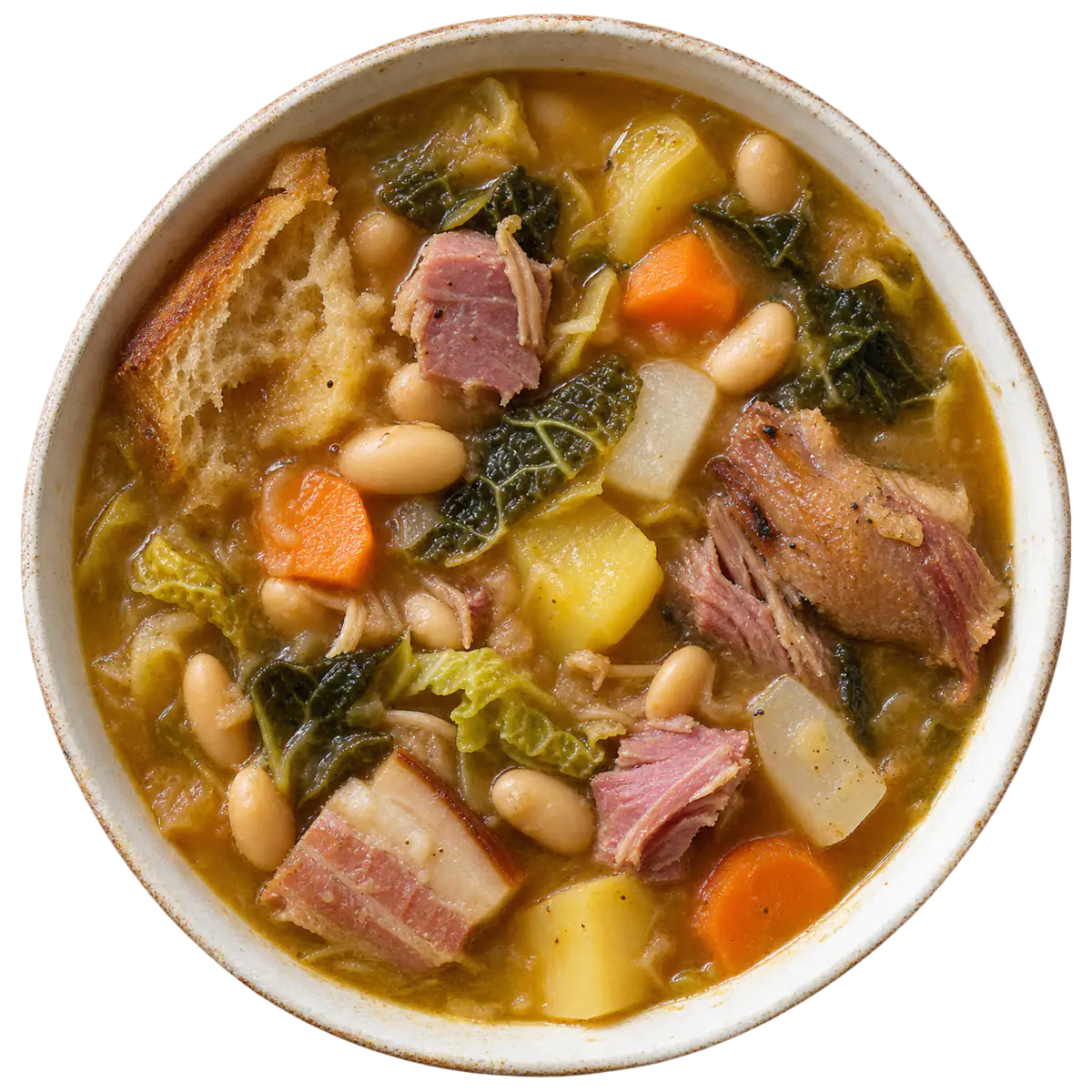
A slow-cooked south-western French soup-stew of cabbage and other vegetables, beans, and preserved pork or duck/goose confit, often with bread.
Origin and history
Garbure is the peasant cabbage soup of Béarn and Bigorre, spread across Gascony and the Landes. The word comes from Gascon garbura, attested in the 16th century, and reached French in the 18th; its origin is uncertain. Gautier's Le Capitaine Fracasse (1863) calls it a cheap soup still eaten in Gascony, and Dumas's Grand dictionnaire de cuisine (1873) gives recipes. Oloron-Sainte-Marie holds a garbure championship, the Garburade, every September.
Make it at home
- Makes
- 6 servings
- Total time
- 3 h
- Hands-on
- 40 min
Ingredients
- 250 g9 oz (1 1/3 cups) dried white beans: haricots tarbais, lingots or coco, soaked overnight in cold water
- 1 (about 600 g)1 (about 1.3 lb) jambonneau or crosse de jambon (ham hock or the knuckle end of a Bayonne-style ham)
- 250 g9 oz ventrèche (cured pork belly) or unsmoked pancetta, in one piece
- 3 L3 qt water
- 2 onions, one studded with a clove, one chopped
- 4 cloves garlic, peeled
- 2 leeks, sliced
- 3 carrots, in chunks
- 2 turnips, peeled, in chunks
- 1 bouquet garni (thyme, bay leaf, parsley, a celery stalk)
- 1 pinch piment d'Espelette, or 1 small dried chilli
- 10 black peppercorns
- 500 g1.1 lb waxy or all-purpose potatoes, peeled, in large chunks
- 1 (about 1 kg)1 (about 2.2 lb) green or savoy cabbage, cored, cut in wide strips
- 3 confit duck legs (or 2 pieces of confit goose), with a spoonful of their fat
- 6 slices stale country bread (pain de campagne), thinly sliced or toasted
- salt, to taste, at the end
Method
-
1. The day before, put the beans to soak in plenty of cold water.
-
2. Put the ham hock and the ventrèche in a large pot of cold water, bring to the boil, drain and rinse them; this removes excess salt and scum.
-
3. Return the meats to the clean pot (ideally earthenware or cast iron) with the 3 L (3 qt) of water and bring to a simmer; cook very gently, covered, for 1 hour.
-
4. Add the drained beans, both onions, the garlic, leeks, carrots, turnips, bouquet garni, piment d'Espelette and peppercorns. Do not salt yet.
-
5. Bring back to a simmer and cook gently, covered, for 45 minutes to 1 hour, until the beans are just tender.
-
6. Meanwhile, blanch the cabbage strips in boiling water for 5 minutes and drain them; this softens their sharp taste.
-
7. Add the potatoes and cabbage to the pot and simmer for 30–40 minutes more, until the cabbage is meltingly soft and the potatoes are cooked through.
-
8. Add the confit legs with a spoonful of their fat and simmer for 15 minutes, just until heated through.
-
9. Remove the bouquet garni and the clove-studded onion. Lift out the meats, take the ham off the bone and cut all the meats into serving pieces.
-
10. Taste the broth and add salt only if needed. The garbure should be thick enough for a ladle to almost stand in it.
-
11. Put a slice of bread in each deep bowl and ladle the broth and vegetables over it; serve the meats on a separate platter, or in the bowls if you prefer.
Notes
- Total time: 3 h, plus overnight soaking.
- Garbure has no single recipe: it is cooked with what the garden and larder hold, so the vegetables change with the season (fresh broad beans and peas in spring, green beans in summer, winter roots and cabbage in the cold months). Cabbage is the constant.
- Regional forms: Béarn and Bigorre, its homeland, use tarbais beans and ham or confit; in the Landes it is made with chou cavalier (a slightly bitter loose-leafed cabbage) cut in fine strips; in the Gers it has become richer, sometimes with a duck magret as well as the confit leg. Confit only became standard in the mid-20th century; older garbures relied on salt pork and a ham bone.
- Chabrot: at the end, Béarnais and Gascons pour a splash of red wine into the last of the broth in the bowl and drink it straight from the bowl (goudale in Gascon). The traditional measure is enough to hide the spoon.
- Substitutions: any large white beans work; without confit, use more cured pork (ventrèche, a smoked sausage or a piece of salt pork); the soup is leaner and less rich but still a garbure.
- Garbure is better reheated the next day, when it thickens further. It keeps 3 days in the refrigerator.
Adapted from Lourdes Tourisme / Tourisme Occitanie: La recette de la garbure, Kate Hill: Garbure from the bottom of my heart, and Hachette Vins: Garbure d'hiver au confit.
At the festivals
Served at 4 festivals in France.
Earlier editions
- September 26, 2026
-
September 05, 2026
🇫🇷 Oloron-Sainte-Marie, France
32nd World Garbure Championship (as headed on the site)
By Competing teams
- February 21, 2026
- January 25, 2025
- November 17, 2012