
🇯🇵 Japan · Yamanashi Prefecture
HōtōYamanashi flat noodle soup
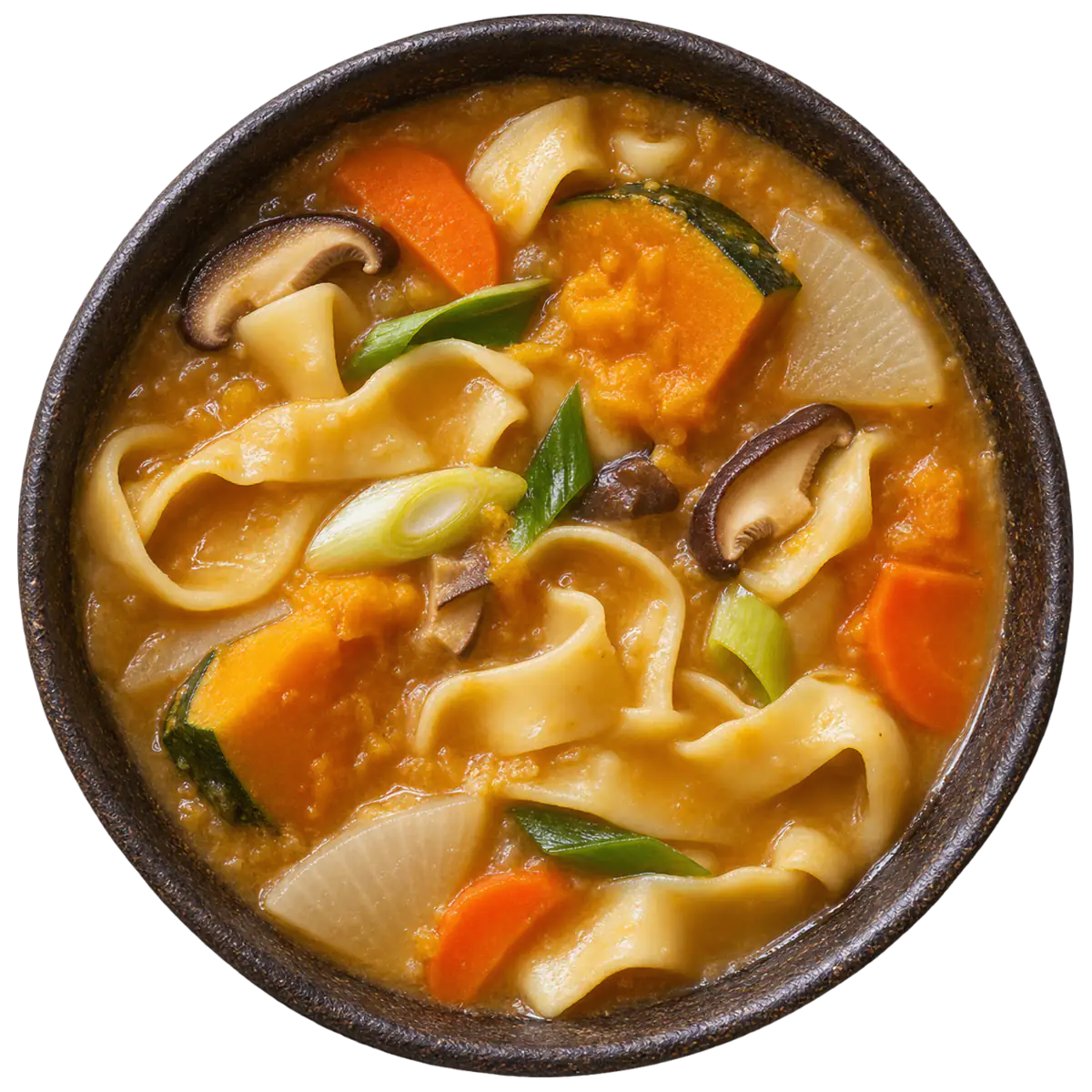
Wide, flat wheat noodles made with little or no salt, simmered directly in a miso broth with pumpkin, other vegetables and often meat.
Origin and history
Yamanashi's prefectural sources call hoto a representative local dish eaten across the prefecture. Japan's Ministry of Agriculture says it is said to have come from China in the Heian period, written 'hakutaku' in old documents, and survived mainly in Yamanashi, where mountains and lava soil make rice hard to grow but wheat does well. Written references to it as a local specialty appear mostly from the Edo period; the story that Takeda Shingen made it a field ration is only a theory.
Make it at home
- Makes
- 4 servings
- Total time
- 1 h 30 min
- Hands-on
- 45 min
Ingredients
- 400 g3 1/4 cups medium-gluten wheat flour (chuuriki-ko), plus extra flour for dusting; all-purpose flour will do; no salt in the dough
- 170 g3/4 cup lukewarm water, for the dough
- 1.6 L6 1/2 cups niboshi (dried sardine) dashi, ready made, strained
- 200 g7 oz kabocha (Japanese pumpkin), seeds removed, skin left on, bite-sized pieces
- 320 g11 oz daikon, cut in thin matchsticks
- 60 g2 oz carrot, bite-sized pieces
- 60 g2 oz burdock root (gobo), scrubbed, cut in thin slivers
- 4 shiitake mushrooms, thinly sliced
- 20 g3/4 oz abura-age (fried tofu), cut in small strips
- 200 g7 oz thinly sliced pork, optional
- 100 g3 1/2 oz miso, Koshu miso or another full-flavored miso; adjust to your brand
- 2 green onions (negi), chopped, to finish
Method
-
1. Put the flour in a bowl and rub in the lukewarm water with your fingertips until it forms crumbs. Press the crumbs together and knead for about 10 minutes until the dough is smooth and soft, like an earlobe. Cover with a damp cloth and rest for 30 minutes.
-
2. Dust the board with flour and roll the dough out to about 2 mm (1/12 in) thick, turning it 90 degrees every few passes so it stays even. Fold it loosely and cut it into strips about 1 cm (3/8 in) wide and roughly 3 cm (1 1/4 in) long. Toss the strips in a little flour. Hoto noodles are wider than udon, and the flour that clings to them thickens the broth.
-
3. Bring the dashi to a boil in a wide, heavy pot. Add the burdock, daikon and carrot and simmer for about 10 minutes.
-
4. Drop the raw noodles into the pot one by one, shaking off extra flour, then add the pumpkin. The noodles cook in the broth, not separately.
-
5. After a few minutes add the shiitake, abura-age and the pork, if using. Simmer for about 7 minutes, stirring from the bottom now and then, until the noodles are tender and the pumpkin starts to fall apart into the broth. The stew thickens and scorches easily, so add a little hot water if it gets too thick.
-
6. Turn the heat to low and dissolve the miso into the broth. Serve straight away in deep bowls, with the green onion on top.
Notes
- Hoto is made with little or no salt in the dough: the ministry says the low salt keeps the noodles soft and lets them absorb the broth. That is the main thing that separates it from udon, whose dough contains salt.
- Pumpkin is so central that the dish is promoted as pumpkin hoto; potato and pork are other common additions, and the amount of pumpkin is a matter of taste. Seasonal vegetables are a feature, so use what is good.
- The broth here is niboshi dashi with miso (as in the HugKum recipe); a home recipe on JeePe uses kombu and bonito dashi instead, with a little soy sauce and mirin.
- In Kyonan the dish is also called noshi-ire or noshi-komi. There is also a sweet azuki hoto, wide noodles in a sweetened red-bean soup.
- Store-bought fresh hoto noodles or wide dried udon are acceptable shortcuts; add the dried noodles a few minutes earlier.
Adapted from Ministry of Agriculture, Forestry and Fisheries, Our regional cuisine: Hoto (Yamanashi), HugKum (Shogakukan), Hoto recipe with handmade noodles, and JeePe, Hoto recipe.
At the festivals
No festival we list has printed it on a menu yet.