
🇨🇿 Czechia · Krkonoše (Giant Mountains)
KyseloCzech sour rye soup
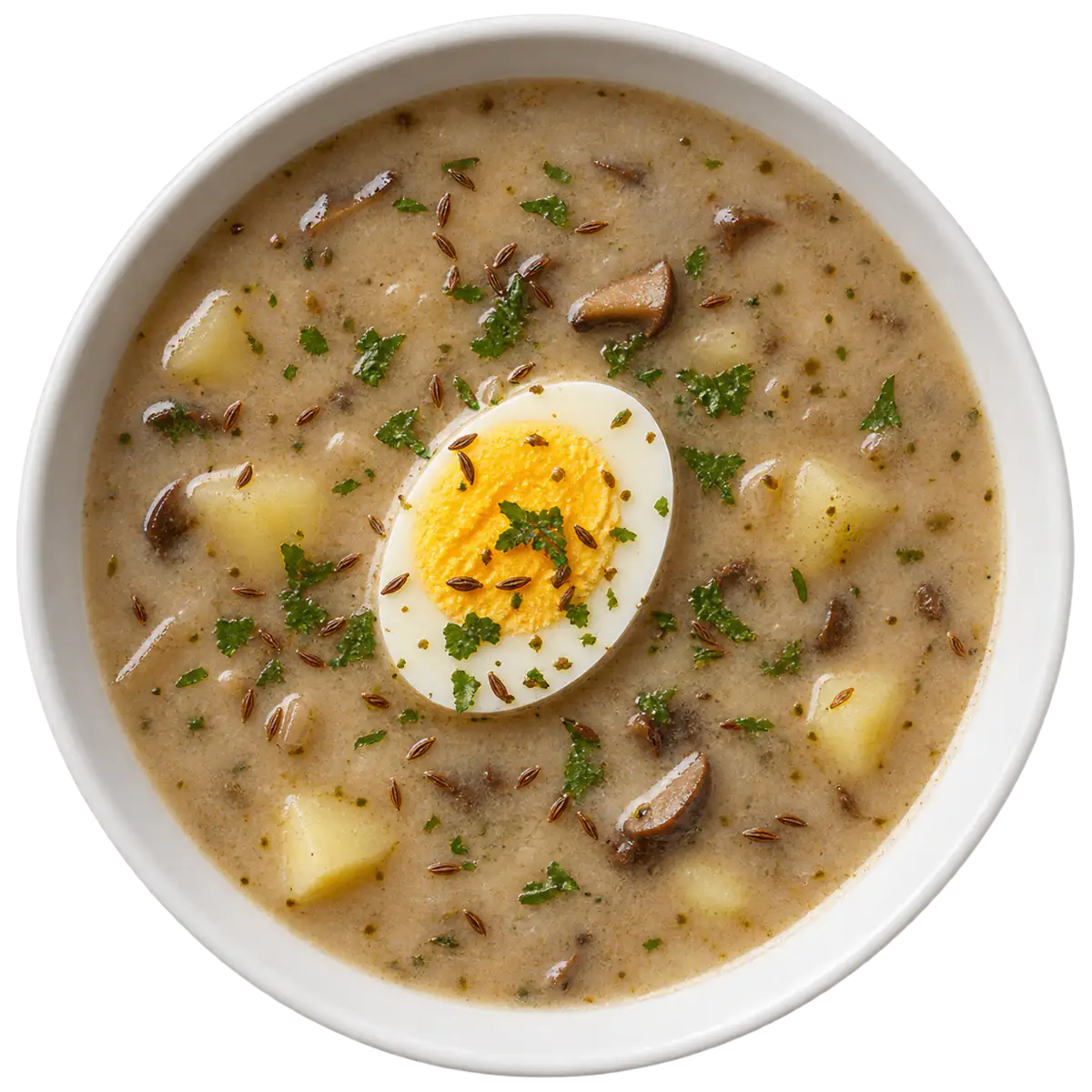
A sour soup from the Giant Mountains built on rye bread starter, with dried mushrooms, caraway and onion fried in butter; the modern form adds potatoes (cooked in it or served with it) and egg.
Origin and history
Kyselo is the signature soup of the Krkonoše (Giant Mountains) and their foothills in north-east Bohemia, where it was known in German as Kübelsauer. It began as a Lenten dish and became everyday food for poor mountain households, eaten so often that a local saying has people rising and going to bed with kyselo. Bread leaven for it was bought from bakers; when the starter disappeared from shops, people in Jilemnice campaigned in the 1960s to get it back. Jankó-Sandtnerová's 1941 cookbook already describes it as a Podkrkonoší speciality.
Make it at home
- Makes
- 6 servings
- Total time
- 1 h
- Hands-on
- 30 min
Ingredients
- 300 g1 1/4 cups rye sourdough starter (chlebový kvas), an active bread starter, or one bought from a baker
- 250 ml1 cup lukewarm water, for loosening the starter the night before
- 20 g3/4 oz dried mushrooms, ideally porcini (sušené hřiby)
- 250 ml1 cup water, for soaking the mushrooms
- 1.25 l5 1/4 cups water, for the soup
- 1 tsp caraway seeds (kmín)
- 1 1/2 tsp salt, plus more to taste
- 800 g1.75 lb floury potatoes, scrubbed, left whole in their skins
- 40 g3 tbsp butter or lard
- 1 onion (about 120 g / 4 oz), finely chopped
- 4 eggs
- chopped chives, optional, to serve
Method
-
1. The evening before, whisk the sourdough starter into the lukewarm water in a bowl, cover it with a cloth and leave it at room temperature overnight. By morning it will smell pleasantly sour and show small bubbles.
-
2. At the same time, put the dried mushrooms in a small pan with the soaking water and leave them to soak overnight.
-
3. Next day, boil the potatoes in their skins in salted water for 20-25 minutes, until a knife slides into the largest one without resistance. Drain, peel and keep them warm.
-
4. Bring the mushrooms and their soaking liquid to the boil and simmer for 15 minutes.
-
5. Add the 1.25 litres of water, the caraway and the salt to the mushrooms and bring back to the boil.
-
6. Stir the fermented starter well, then pour it into the pot in a thin stream, whisking all the time so no lumps form.
-
7. Simmer over low heat for 20 minutes, scraping the bottom of the pot every few minutes because the flour in the starter settles and catches easily. The soup is ready when it has thickened slightly and no longer tastes of raw dough.
-
8. Meanwhile, melt the butter or lard in a frying pan and fry the onion over medium heat for 8-10 minutes, until golden.
-
9. Crack the eggs into the pan with the onion and stir gently until they set into soft curds.
-
10. Tip the eggs and onion, with all the fat, into the soup. Taste and add salt; if it is sharper than you like, thin it with a little hot water.
-
11. Put the peeled potatoes in deep bowls, whole, cubed or roughly mashed, and ladle the hot kyselo over them. Scatter with chives if you like.
Notes
- Total time: 1 h, plus fermenting the starter overnight.
- The starter is the soup: its rye flour thickens the broth and its acidity gives the taste. Bakers' starter used to be the norm for households without their own bread oven. If you keep a rye starter for baking, use that. A dried starter must be rehydrated at least an hour ahead, better the day before. Bottled Polish żur starter (zakwas na żur) is the nearest shop-bought substitute; it is usually sharper and often already flavoured with garlic and bay, so dilute it more and taste as you go.
- Potatoes are served with kyselo, not always cooked in it. In some Krkonoše villages they are boiled whole in their skins and peeled and mashed at the table; elsewhere they are cooked separately and added in cubes. Some cooks simply simmer diced potatoes in the soup with the mushrooms.
- Eggs: households fry them hard with the onion, scramble them softly, poach them in the bowls, or beat them raw into the hot onion so they finish setting in the soup. The oldest forms of the soup were made without eggs.
- Dairy: kyselo is normally made without cream. A 1941 Czech cookbook allows milk but says cream does not belong in it; some modern recipes nevertheless add a splash of milk or cream at the end. Browned butter spooned over the bowl is a richer finish.
- Not to be confused with kulajda, the South Bohemian soup of potatoes, mushrooms, dill, cream and vinegar, or with Polish żurek, which shares the fermented-grain base but is usually made with meat stock and sausage.
- Make-ahead: the soup thickens as it stands and reheats well. Loosen it with water and stir from the bottom while it warms.
Adapted from Jiří Švestka (Hotel Horizont, Pec pod Sněžkou), "Krkonošské kyselo", in Právo / Novinky.cz, Kudy z nudy (CzechTourism), "Ochutnejte tradiční krkonošské pokrmy", Cook Like Czechs, "Kyselo: Czech Sourdough Soup", and Marie Jankó-Sandtnerová, Kniha rozpočtů a kuchařských předpisů (1941).
At the festivals
Served at 1 festival in Czechia.
Earlier editions
- September 04, 2016