
🇵🇱 Poland · Kujawy (Kuyavia)
Żur kujawskiKuyavian sour rye soup
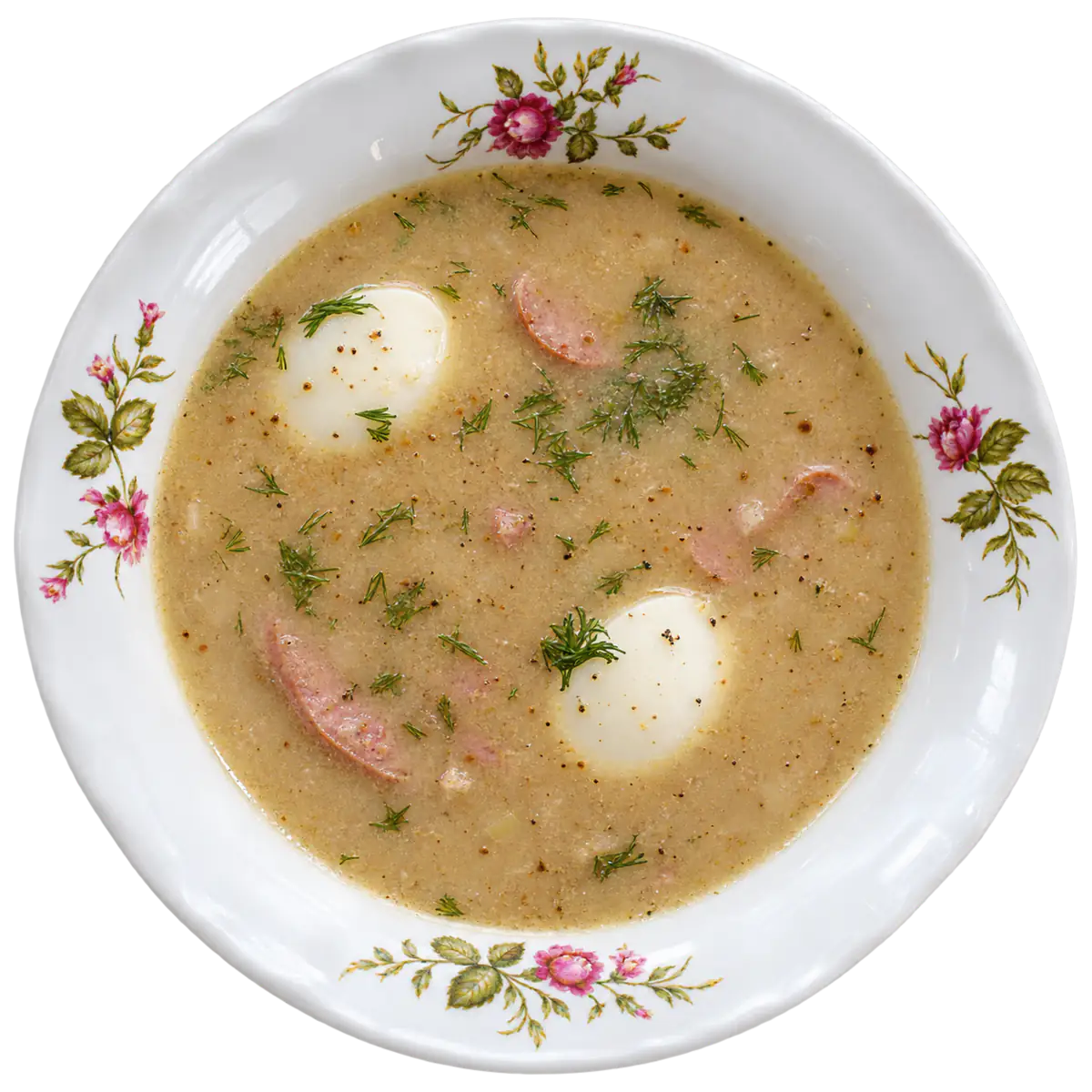
The regional form of żur from Kuyavia, an aromatic soup on a sourdough starter of flour and water, listed as a traditional product of the Kuyavian-Pomeranian voivodeship.
Origin and history
Kuyavian żur is the regional żur of Kujawy, on Poland's List of Traditional Products since 9 May 2008 (Kuyavian-Pomeranian voivodeship). The 19th-century ethnographer Oskar Kolberg described it in his volume on Kujawy. For centuries it was the daily breakfast in the countryside, eaten from mid-September to mid-April by rich and poor alike, the richer adding more cream and meat. Today it is made mainly for Easter breakfast.
Make it at home
- Makes
- 4-6 servings
- Total time
- 1 h
- Hands-on
- 35 min
Ingredients
- 100 g3/4 cup rye flour (mąka żytnia), wholemeal or light, for the Kuyavian starter (zakwas kujawski)
- 750 ml3 cups lukewarm boiled water, for the starter
- 3 garlic cloves, for the starter, halved
- 1 crust of rye bread, for the starter, to speed fermentation
- 1.2 l5 cups water, or, for a holiday żur, the broth from cooking a smoked ham
- 300 g10 oz Polish sausage, smoked or white (biała kiełbasa), whole; optional, see notes
- 100 g3.5 oz smoked bacon (boczek) or pork fat (słonina), finely diced; or 2 tbsp lard (smalec)
- 1 onion, finely chopped
- 150 ml2/3 cup sour cream (śmietana) or creamy whole milk
- 1 tsp dried marjoram
- salt and black pepper, to taste
- 800 g1.8 lb potatoes, peeled, boiled in salted water, to serve
- 4 eggs, hard-boiled, halved; for the Easter version
Method
-
1. Three to five days ahead, whisk the rye flour into the lukewarm water in an earthenware crock or a large jar, add the garlic and the bread crust, and cover with a cloth.
-
2. Leave it in a warm place, stirring once a day with a wooden spoon, until it smells sharply sour and separates into a clear top layer over a thick, grey flour layer; it is then ready, and keeps in the fridge for a week.
-
3. Bring the water or ham broth to the boil in a pot; if using sausage, put it in whole and simmer for 20 minutes, then lift it out and slice it.
-
4. Fry the bacon or pork fat in a pan over medium heat until the fat runs and the pieces turn golden, then add the onion and fry until golden brown, about 8 minutes. This is the okrasa (fat garnish).
-
5. Remove the bread crust and garlic from the starter and stir it well so the flour layer is fully mixed in.
-
6. Pour the starter into the boiling liquid in a thin stream, whisking constantly so no lumps form.
-
7. Simmer, stirring often, for 10 to 15 minutes, until the soup is thick, creamy-grey and opaque and no longer tastes of raw flour.
-
8. Stir in the okrasa of bacon and onion with all its fat, the marjoram, pepper and salt to taste.
-
9. Temper the sour cream or milk by mixing it with a ladle of hot soup, then stir it into the pot and heat without boiling.
-
10. Return the sliced sausage to the soup.
-
11. Serve hot, ladled over boiled potatoes in deep plates or with the potatoes alongside; at Easter add halved hard-boiled eggs.
Notes
- Total time: 1 h, plus 3-5 days for the starter.
- How it differs from the parent: the everyday żurek is a meat-stock soup with white sausage and egg. Kuyavian żur is built on water (or ham broth on feast days) and a thick flour-and-water starter. It is enriched at the end with cream or milk, or with fried bacon and onion, and eaten with potatoes or dumplings. The sausage is optional.
- The starter: Kujawy cooks soured rye flour (once wholemeal, now usually the finer sifted flour) in water in an earthenware crock called a żurownik, often with garlic and a crust of bread. Zakwas kujawski has been a listed traditional product in its own right since 2025.
- Everyday and festive: as a weekday breakfast it was made plain, on water, with cream or with lard and onion and potatoes. For Easter and other feasts it was cooked in smoked-ham broth and served with sausage, eggs or mushrooms.
- Bran: in some Kuyavian villages, such as Świątkowice, rye bran was used for the starter instead of flour.
- Substitutions: a bought rye zakwas can stand in for the home starter. Use about 500 ml (2 cups) and taste as you go, since it is often sharper.
- Make ahead: the soup thickens as it stands; loosen it with hot water when reheating, and add the cream only after reheating.
Adapted from Ministry of Agriculture and Rural Development (Poland), List of Traditional Products: Żur kujawski and Ministry of Agriculture and Rural Development (Poland), List of Traditional Products: Zakwas kujawski.
At the festivals
Served at 1 festival in Poland.
Earlier editions
-
June 18, 2022
🇵🇱 Brześć Kujawski, Poland
Święto Żuru Kujawskiego
By Competing teams, mainly residents of nearby villages
-
July 17, 2021
🇵🇱 Brześć Kujawski, Poland
Święto Żuru Kujawskiego
By teams, mainly residents of surrounding localities
-
June 16, 2018
🇵🇱 Brześć Kujawski, Poland
Święto Żuru Kujawskiego
By Competing teams, mainly residents of nearby localities
-
June 17, 2017
🇵🇱 Brześć Kujawski, Poland
Święto Żuru Kujawskiego
By teams, mostly residents of surrounding villages
-
June 18, 2016
🇵🇱 Brześć Kujawski, Poland
Święto Żuru Kujawskiego
By Competing teams, mainly residents of nearby towns
- June 26, 2015 – June 27, 2015
-
June 28, 2014
🇵🇱 Brześć Kujawski, Poland
Święto Żuru Kujawskiego
On the menu as Żurek kujawski
By Competing teams, mainly residents of nearby localities
-
June 22, 2013
🇵🇱 Brześć Kujawski, Poland
Święto Żuru Kujawskiego
By Competing teams, mainly residents of surrounding towns
-
June 25, 2011
🇵🇱 Brześć Kujawski, Poland
Święto Żuru Kujawskiego