
🇵🇱 Poland
ŻurekPolish sour rye soup
A sour soup built on a fermented rye-flour starter (zakwas) stirred into meat or vegetable stock, usually served with sausage and egg and seasoned with marjoram and garlic. Traditionally eaten at Easter.
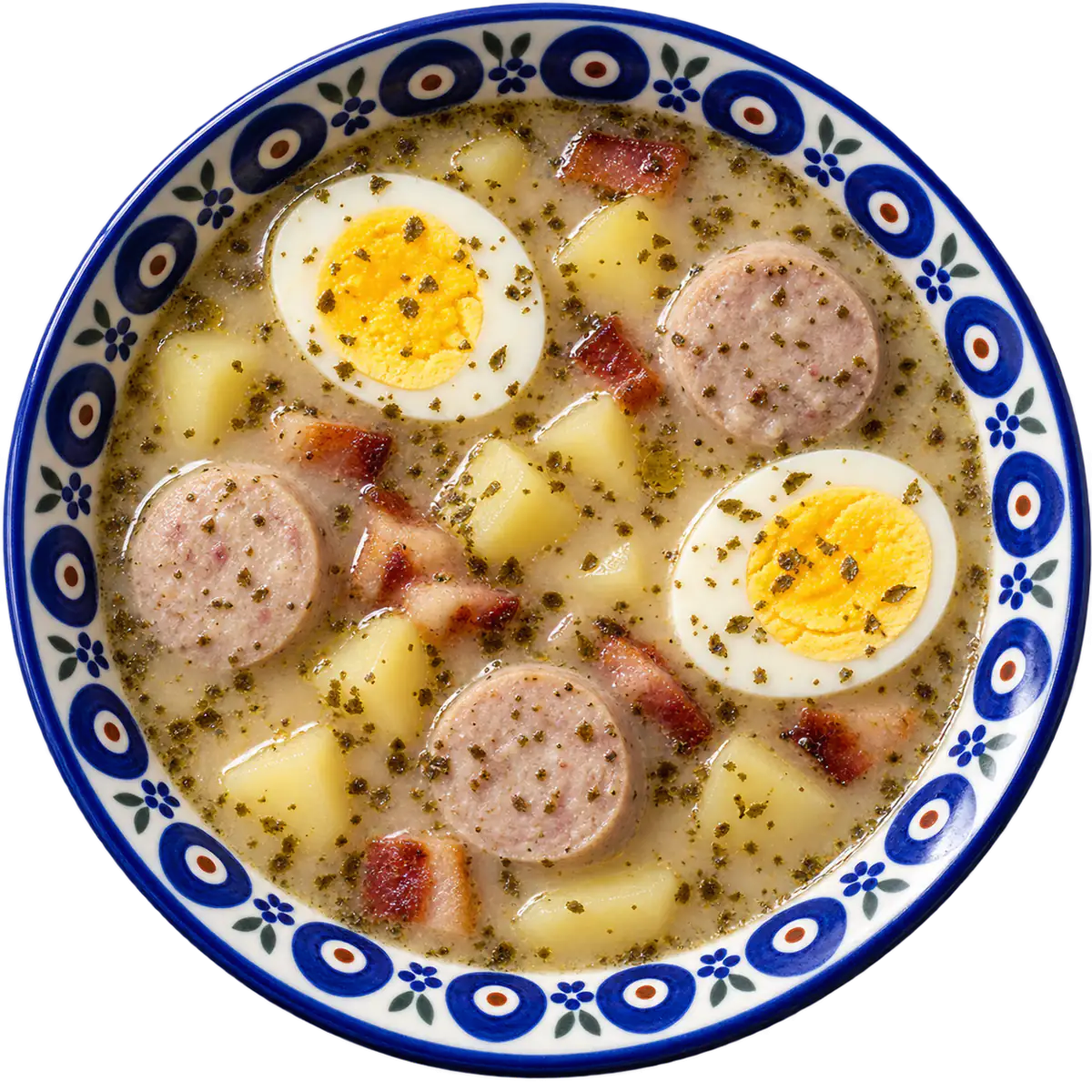
Origin and history
Żur takes its name from Middle High German sūr, 'sour'; żurek is its diminutive, and it is also called barszcz biały, white borscht. Soups on fermented rye have been made in Małopolska since at least the 13th century. For centuries żur was a cheap Lenten soup, eaten with herring; only later did it become the Easter soup with sausage and egg. Żurek po krakowsku joined Poland's list of traditional products in 2007, Kuyavian żur in 2008.
Make it at home
- Makes
- 6 servings
- Total time
- 1 h 15 min
- Hands-on
- 35 min
Ingredients
- 60 g1/2 cup wholemeal rye flour (mąka żytnia razowa), for the starter (zakwas)
- 600 ml2 1/2 cups lukewarm boiled water, for the starter
- 3 garlic cloves, for the starter, halved
- 1 crust of sourdough rye bread, for the starter, to speed fermentation; optional
- 1 bay leaf and 3 allspice berries, for the starter; optional
- 2 l8 1/2 cups water or light meat stock, stock left from cooking a ham or smoked meat is ideal
- 500 g1.1 lb raw white sausage (biała kiełbasa), whole links; or a lightly smoked Polish sausage
- 150 g5 oz smoked bacon (boczek wędzony) or smoked pork (wędzonka), in small dice
- 1 onion, finely chopped
- 1 + 1 carrot and parsley root, peeled, whole; optional
- 2 + 4 bay leaves and allspice berries
- 2 garlic cloves, crushed with a little salt
- 1 tbsp dried marjoram (majeranek), rubbed between the palms
- 100 mlscant 1/2 cup sour cream (śmietana, 18%), optional
- 1 tbsp grated horseradish, optional
- salt and black pepper, to taste
- 6 eggs, hard-boiled, halved, to serve
- rye bread, to serve
Method
-
1. Four or five days ahead, make the starter: stir the rye flour into the lukewarm water in a clean jar or crock, add the garlic, the bread crust and the spices if using.
-
2. Cover with a cloth and leave in a warm spot, stirring once a day, for 4 to 5 days, until it smells pleasantly sour and a clear liquid has formed over the flour; then keep it in the fridge.
-
3. Put the water or stock in a large pot with the whole sausages, the carrot and parsley root if using, bay leaves and allspice, bring to the boil and simmer gently for 25 to 30 minutes.
-
4. Meanwhile fry the bacon in a dry pan over medium heat until its fat runs and it browns, then add the onion and cook until golden, about 8 minutes.
-
5. Lift the sausages and root vegetables out of the pot; slice the sausages and dice the vegetables, or discard them.
-
6. Add the bacon and onion with their fat to the stock.
-
7. Stir the starter well (the flour settles at the bottom), then pour about 500 ml (2 cups) into the simmering stock in a thin stream, stirring all the time; use less if you prefer a milder soup.
-
8. Simmer for 5 to 10 minutes, stirring, until the soup thickens slightly and loses its raw-flour taste.
-
9. Add the crushed garlic and marjoram, return the sliced sausage and vegetables, and season with salt and pepper.
-
10. If using sour cream, mix it with a ladle of hot soup in a bowl, then stir it back into the pot without letting the soup boil again.
-
11. Stir in the horseradish if you like, and serve with halved hard-boiled eggs in each bowl and rye bread.
Notes
- Total time: 1 h 15 min, plus 4-5 days for the starter.
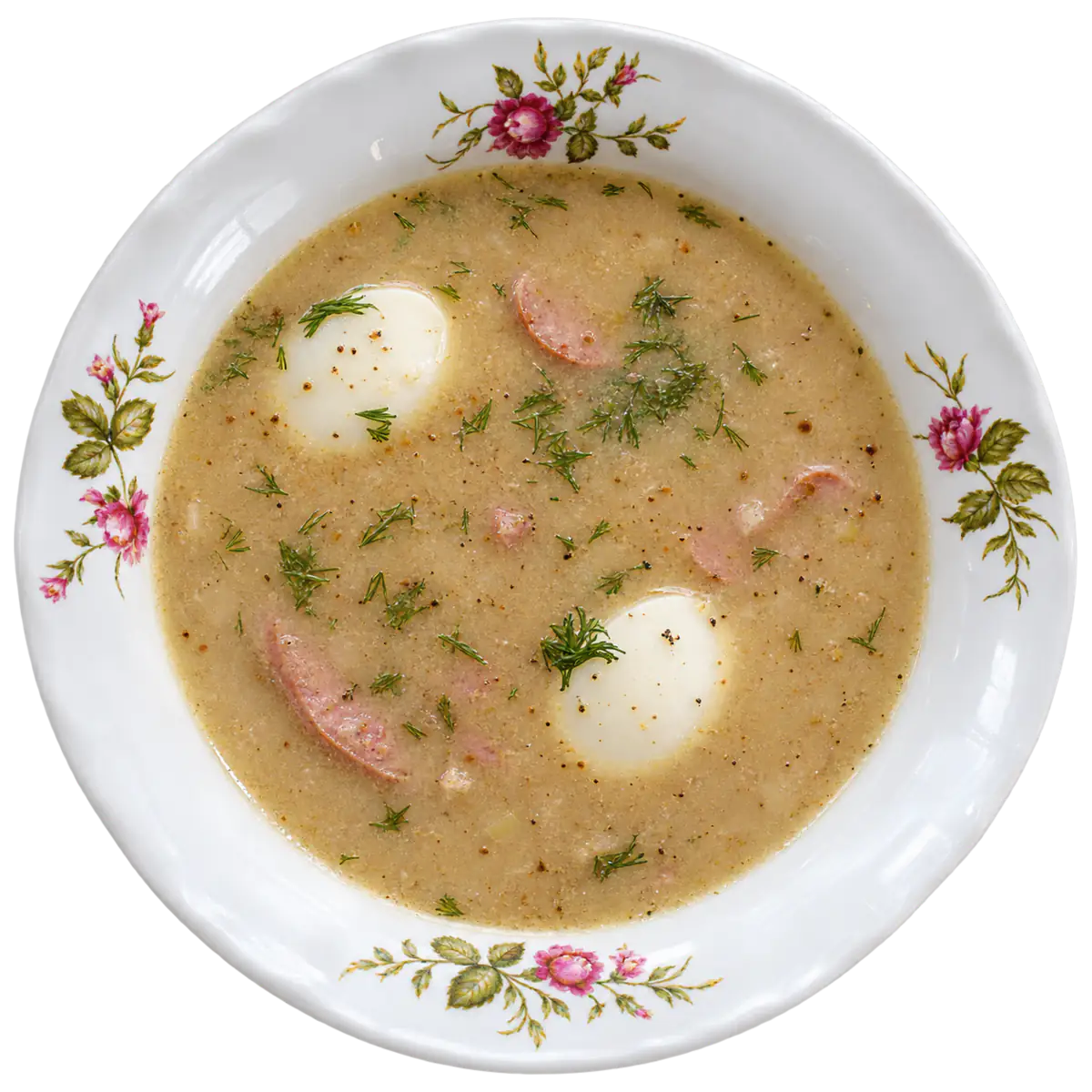
- This is the everyday żurek of most of Poland: a meat or smoked-meat stock soured with rye starter, with white sausage, egg, marjoram and garlic. The Kuyavian żur, made on water with a thick flour-and-water starter and finished with cream or lard, has its own page (zurek/kujawski).
- Starter: shop-bought bottled zakwas, often sold as 'barszcz biały' or 'żur', works well. Add it gradually and taste, since brands differ in sourness. A tablespoon of pickled-cucumber brine can speed up a home starter.
- Names: żur and żurek are the same soup (żurek is the diminutive). In some regions 'barszcz biały' (white borscht) is the name for the version with diced potatoes and sausage or bacon, while plain żur is the soup without additions.
- Additions by region and household: diced or mashed potatoes, dried porcini, smoked sausage instead of white, or more horseradish at Easter. In Silesia żur is poured over mashed potatoes. Zalewajka from the Świętokrzyskie region is a related potato soup made on żur.
- Serving: at Easter breakfast żurek comes with hard-boiled eggs and white sausage; some restaurants serve it in a hollowed-out loaf of bread.
- Fasting version: long before it became an Easter soup, żur was a Lenten dish made on water, without meat, eaten with herring or potatoes.
- Make ahead: the soup keeps 2 days in the fridge (one more without the cream). Reheat slowly; add the eggs when serving.
Adapted from Narodowe Centrum Kultury, Ojczysty, 'Żurek, znaczy się biały barszcz', Ministry of Agriculture (Poland), List of Traditional Products: Żur kujawski, and Polonist, Żurek na zakwasie.
Variants
At the festivals
Served at 3 festivals in United States and Poland.
Earlier editions
-
November 19, 2023
🇺🇸 Minneapolis, Minnesota, United States
PACIM Soup Festival
-
June 18, 2022
🇵🇱 Brześć Kujawski, Poland
Święto Żuru Kujawskiego
On the menu as żur kujawski
By Competing teams, mainly residents of nearby villages
-
October 24, 2021
🇺🇸 Minneapolis, Minnesota, United States
PACIM Soup Festival
-
July 17, 2021
🇵🇱 Brześć Kujawski, Poland
Święto Żuru Kujawskiego
On the menu as Żur kujawski
By teams, mainly residents of surrounding localities
-
June 16, 2018
🇵🇱 Brześć Kujawski, Poland
Święto Żuru Kujawskiego
On the menu as żur kujawski
By Competing teams, mainly residents of nearby localities
-
June 17, 2017
🇵🇱 Brześć Kujawski, Poland
Święto Żuru Kujawskiego
On the menu as żur kujawski
By teams, mostly residents of surrounding villages
-
July 31, 2016
🇵🇱 Stanica, Poland
Festiwal Żuru Stanica
On the menu as Żur łod starki and Żur z maślonki (żur od ciotki Hildy)
By Koło Gospodyń Wiejskich ze Stanicy
-
June 18, 2016
🇵🇱 Brześć Kujawski, Poland
Święto Żuru Kujawskiego
On the menu as żur kujawski
By Competing teams, mainly residents of nearby towns
-
June 26, 2015 – June 27, 2015
🇵🇱 Brześć Kujawski, Poland
Święto Żuru Kujawskiego
On the menu as żur kujawski
By Competing teams, cooked on an open hearth
-
June 28, 2014
🇵🇱 Brześć Kujawski, Poland
Święto Żuru Kujawskiego
On the menu as Żurek kujawski
By Competing teams, mainly residents of nearby localities
Show all 12
-
June 22, 2013
🇵🇱 Brześć Kujawski, Poland
Święto Żuru Kujawskiego
On the menu as żur kujawski
By Competing teams, mainly residents of surrounding towns
- June 25, 2011