
🇯🇵 Japan · Okinawa
Okinawa sobaOkinawan wheat noodle soup
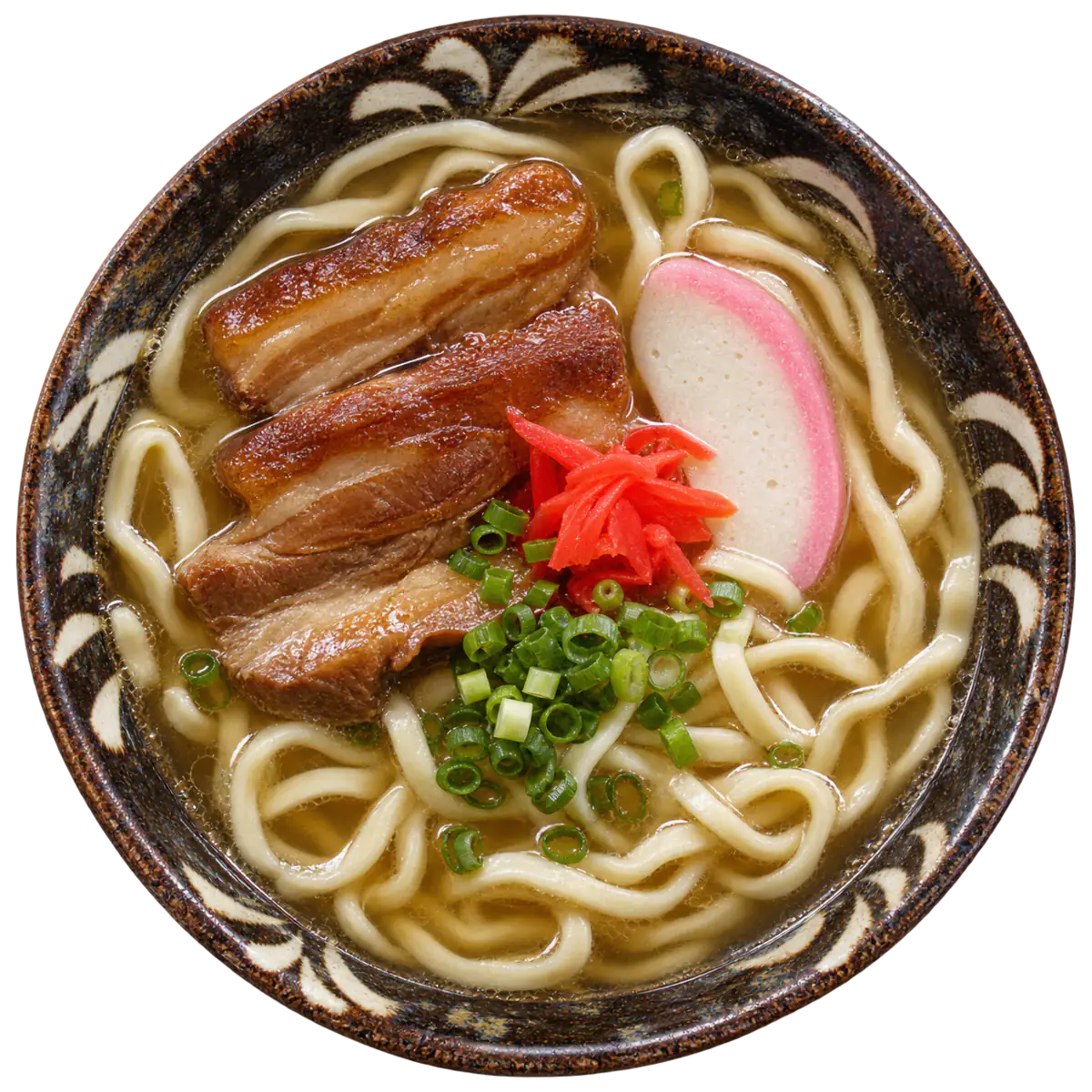
Alkaline wheat noodles (no buckwheat) in a pork and bonito broth, topped with simmered pork belly, kamaboko, scallion and pickled ginger.
Origin and history
The prefecture's archives place the dish's beginning in the mid-Meiji period, at a Chinese-run shop in Naha. Early names were plain 'suba' and 'Shina suba'; 'Okinawa soba' became common after the war. In 1976 the Fair Trade Commission ruled that noodles without at least 30 percent buckwheat could not be sold as 'soba'; after a campaign by the noodle cooperative, the label 'honba Okinawa soba' was approved on 17 October 1978, and in 1997 the cooperative made 17 October Okinawa Soba Day.
Make it at home
- Makes
- 4 servings
- Total time
- 1 h 15 min
- Hands-on
- 35 min
Ingredients
- 800 g1.75 lb fresh Okinawa soba noodles (wheat noodles made with kansui, no buckwheat), about 200 g per bowl; Chinese-style fresh wheat noodles are the closest substitute
- 400 g14 oz pork belly (sanmainiku), in one piece, boiled whole, then sliced about 5 mm thick
- 4 tbsp sake or awamori, for the pork glaze
- 4 tbsp mirin, for the pork glaze
- 2 tsp sugar, for the pork glaze
- 4 tbsp soy sauce, for the pork glaze
- 2 L2 qt water, includes the liquid the pork is boiled in
- 10 cm4 in dashi kombu, one piece
- 30 g1 oz (about 1 cup, loosely packed) katsuobushi (dried bonito flakes)
- 2 tsp salt, for the broth, adjust to taste
- 1 tbsp soy sauce, for the broth
- 4 kamaboko (fish cake) slices, or one log, sliced diagonally
- 3 scallions, thinly sliced
- red pickled ginger (beni shoga) and koregusu (chili steeped in awamori), to serve
Method
-
1. Put the pork belly in a pot with the water, bring it to a boil and simmer at about 95 C (200 F) until a skewer slides in easily, about 40 minutes.
-
2. Lift the pork out and set it aside. Measure the cooking liquid, skim the fat from the top and make it up to 2 L (2 qt) with fresh water.
-
3. Add the kombu to the liquid and warm it over medium heat for about 15 minutes. Take the kombu out just before the liquid boils.
-
4. Add the katsuobushi, let it steep for a minute or two, then strain the broth through a fine sieve.
-
5. Season the strained broth with the salt and 1 tbsp soy sauce, keep it just under a simmer and taste it: it should be light and savoury, not heavy.
-
6. Slice the pork into pieces about 5 cm (2 in) wide and 5 mm (1/4 in) thick. Simmer them in a small pan with the sake, mirin, sugar and 4 tbsp soy sauce over medium heat until the glaze thickens and coats them.
-
7. Boil the noodles in plenty of water as the package says, or until they float and then another 10 to 20 seconds. Drain well; rinsing in hot water removes surface oil.
-
8. Divide the noodles among four bowls, ladle in the hot broth, and top with the glazed pork, kamaboko, scallions and a little pickled ginger.
-
9. Serve at once, with koregusu on the table for each person to add.
Notes
- The noodles are a wheat flour, salt and kansui (alkaline water) noodle with no buckwheat, so 'soba' here is a name and not the buckwheat noodle. Ready-made fresh or frozen Okinawa soba is what most home cooks use; the agricultural ministry's page also gives a from-scratch dough (360 g cake flour, 180 g bread flour, a kansui solution, rested 2 to 3 hours, rolled 1.5 to 2 mm thick).
- Restaurant broths are built on pork bones as well as bonito and are skimmed carefully to stay clear; the ministry describes the stock as a pork and bonito one, and some cooks use pork stock alone. Here the pork belly's own cooking liquid carries the pork flavour, so no bones are needed.
- Soki soba is the same bowl topped with simmered spare ribs (soki) instead of pork belly; vegetable soba and the Miyako and Yaeyama island styles also exist and are treated as styles of the same dish on this site.
- Without awamori, use sake. A home shortcut is a plain bonito dashi, with chicken stock granules, salt and soy sauce, over store-bought noodles.
- Koregusu is chili peppers steeped in awamori; a drop sharpens the broth. Pickled ginger is the traditional garnish.
Adapted from Ministry of Agriculture, Forestry and Fisheries (Japan), Uchi no kyodo ryori: Okinawa soba (recipe by Junko Azato), Kyodo ryori (Okinawa Prefecture agriculture department data): Okinawa soba, and Delish Kitchen: seasoned pork belly with Okinawa soba (glaze proportions).
At the festivals
No festival we list has printed it on a menu yet.