
🇵🇱 Poland
Barszcz (Polish red borscht)Polish red borscht
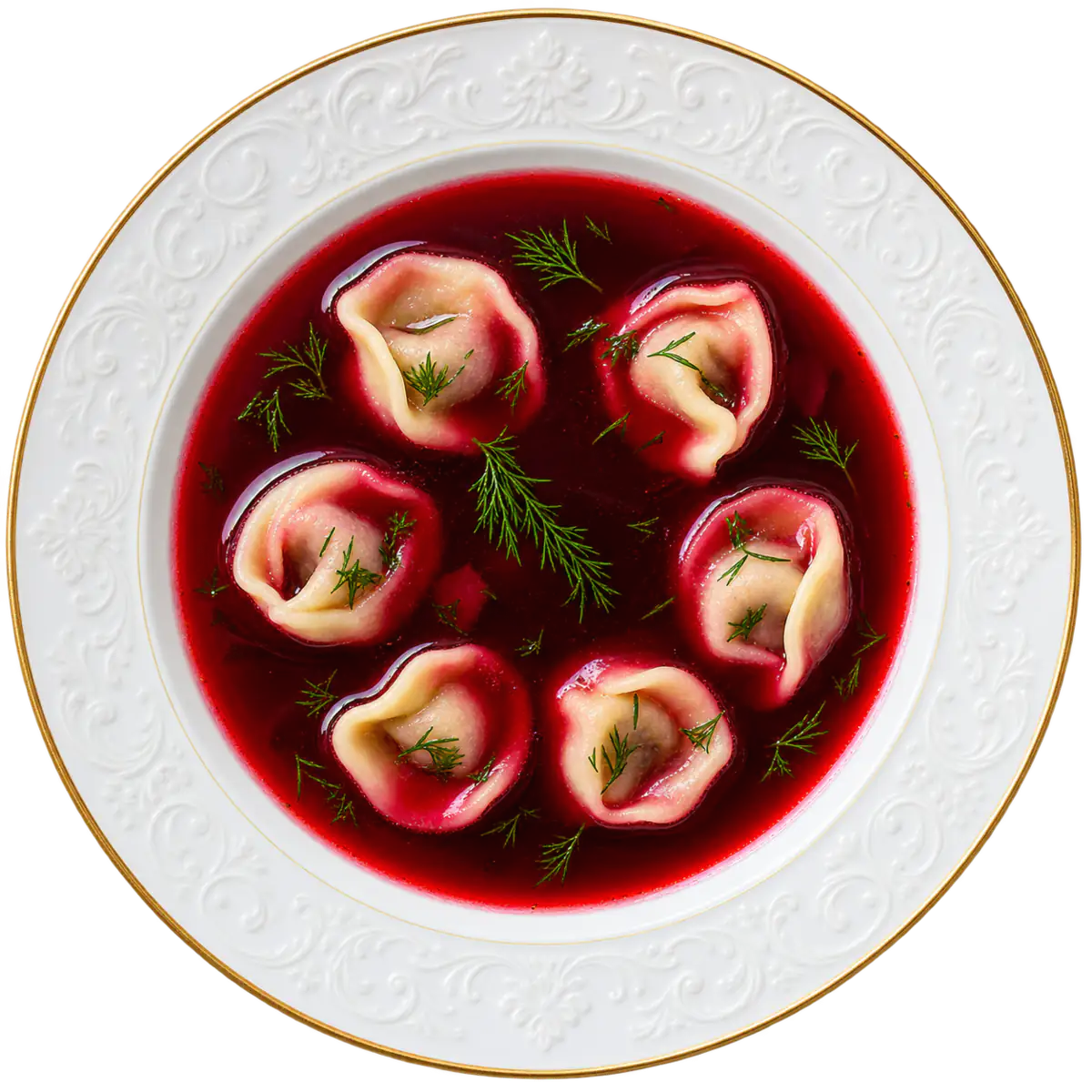
Polish clear red beet broth soured with beet zakwas, served as a drink-like broth or with uszka (small mushroom dumplings), the meatless mushroom-flavoured form being the Christmas Eve soup.
Origin and history
The name barszcz first belonged to the common hogweed (barszcz zwyczajny), whose fermented leaves gave an old sour soup; by around the 17th century the word covered many sour soups, and fermented beetroot became the base of the red one. In the 1770s King Stanisław August's chef Paul Tremo served red barszcz with mushroom uszka at the royal Thursday dinners, and by the 19th century cookbooks placed barszcz with uszka at the Christmas Eve supper.
Make it at home
- Makes
- 6 servings
- Total time
- 1 h 45 min
- Hands-on
- 45 min
Ingredients
- 1 kg2.2 lb beetroots, for the zakwas (beet sour), peeled, thinly sliced
- 4 garlic cloves, for the zakwas, halved
- 2 bay leaves, for the zakwas
- 4 allspice berries, for the zakwas
- 1 tsp salt, for the zakwas
- 1 crust of rye or wholemeal bread, for the zakwas, speeds up fermentation
- 1.2 l5 cups water, boiled and cooled to lukewarm, for the zakwas
- 25 g1 oz dried wild mushrooms, ideally borowiki (porcini), soaked overnight in 500 ml (2 cups) cold water
- 500 g1.1 lb beetroots, for the broth, peeled, sliced
- 2 carrots, peeled, cut in chunks
- 1 parsley root (pietruszka) or small parsnip, peeled, cut in chunks
- 100 g3.5 oz celeriac (celery root), peeled, cut in chunks
- 1 leek, white part, cleaned, sliced
- 1 onion, halved
- 2 garlic cloves, for the broth
- 2 bay leaves and 4 allspice berries, for the broth
- 1.5 l6 1/3 cups water, for the broth
- 500-600 ml2-2 1/2 cups strained beet zakwas, from the batch above; about a quarter to a third of the finished soup
- 1/2 tsp dried marjoram
- salt, black pepper and a pinch of sugar, to taste
- uszka (small mushroom-filled dumplings), to serve; about 6-8 per person
Method
-
1. Make the zakwas 4-5 days ahead. Pack the sliced beetroots into a 2-litre (2-quart) jar with the garlic, bay leaves, allspice and salt, pour over the lukewarm boiled water so the beets are covered, and lay the bread crust on top.
-
2. Cover the jar with a cloth and leave it somewhere warm, around 20-24 °C (68-75 °F), for 4-5 days. Skim off any foam every day. It is ready when the liquid is a clear, deep ruby red and tastes pleasantly sour.
-
3. Remove the bread, strain the zakwas through a cloth-lined sieve, bottle it and keep it in the fridge until needed.
-
4. On the day: lift the soaked mushrooms out of their water and put them in a small pan. Pour in the soaking water, leaving the grit at the bottom of the bowl behind, and simmer gently, covered, for about 40 minutes until tender. Strain and keep this dark mushroom broth; set the mushrooms aside for the uszka filling.
-
5. In a large pot, put the beetroots for the broth, carrots, parsley root, celeriac, leek, onion, garlic, bay leaves and allspice with the 1.5 l (6 1/3 cups) water. Bring to the boil, then lower the heat and simmer gently for 45 minutes.
-
6. Strain the vegetable broth through a fine sieve lined with a cloth, without pressing hard, so it stays clear. Discard the vegetables or keep them for a salad. Pour in the mushroom broth.
-
7. Add 500 ml (2 cups) of the zakwas and the marjoram and warm the soup over low heat until it steams. Do not let it boil: boiling dulls the colour and the fresh sour taste.
-
8. Taste, and add more zakwas if you want it sharper. Season with salt and pepper and, if it is too sour, a pinch of sugar.
-
9. Serve hot in bowls with a few uszka in each, or in cups to drink alongside a croquette or a pasztecik (yeast pastry).
Notes
- Total time: 1 h 45 min, plus 4-5 days to ferment the zakwas and an overnight mushroom soak.
- Christmas Eve: this is the meatless, dairy-free barszcz wigilijny (also barszcz czysty or barszcz postny), one of the dishes of the Wigilia supper, served with uszka filled with dried mushrooms and fried onion. On other days it is often made on a beef or poultry broth instead of vegetables.
- Zakwas: ready-made beet sour is sold in Polish shops in bottles. Without it, lemon juice is the usual stopgap; the soup is then sharper and lacks the rounded, earthy sourness of fermented beets. Vinegar gives the harshest result.
- Some cooks add a few smoked prunes, a piece of dried apple or roasted vegetables to the broth for more depth.
- Barszcz zabielany is an everyday creamy form: beetroot cooked in broth, soured, then thickened with sour cream and a spoonful of flour, served with potatoes and dill.
- Barszcz czerwony is not the same soup as Ukrainian-style borscht (barszcz ukraiński), which keeps the vegetables, beans and cabbage in the bowl; it is also different from barszcz biały, the white soup that is close to żurek.
- Make-ahead: the zakwas keeps for weeks in the fridge, and the finished barszcz keeps several days. Reheat gently and never boil it.
Adapted from Polonist, "Barszcz czerwony wigilijny, na zakwasie" and RMF24, "Wigilijna opowieść o barszczu" (zakwas and barszcz recipes).
At the festivals
Served at 2 festivals in Poland and United States.
Earlier editions
- July 05, 2026
-
November 16, 2025
🇺🇸 Minneapolis, Minnesota, United States
PACIM Soup Festival
On the menu as Borscht (Barszcz, vegetarian)
By PACIM members and friends
- August 17, 2025
- November 19, 2023
- October 24, 2021