
🇰🇷 South Korea · Busan
Dwaeji-gukbapKorean pork and rice soup
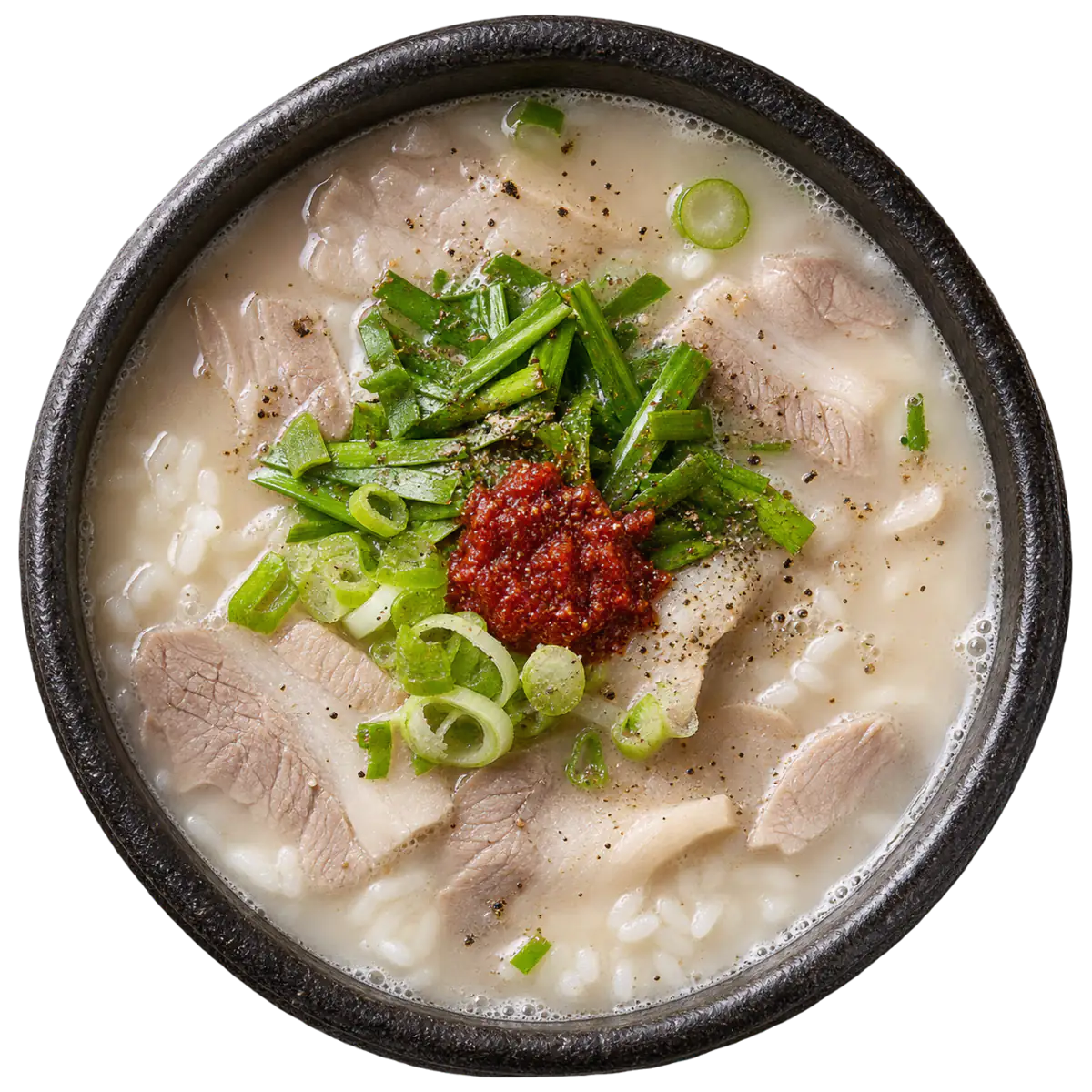
Korean soup of pork and pork bones simmered into a milky broth, served with rice added to the bowl (or on the side) and with sliced boiled pork; closely tied to Busan.
Origin and history
Dwaeji-gukbap is Busan's emblematic dish. The most widely told account ties it to the Korean War (1950–53), when refugees crowding into the wartime capital boiled cheap pork bones, including those from American military bases, into a milky broth poured over rice. It became the quick meal of market vendors and labourers, then of office workers and students; Busan today has well over a thousand gukbap restaurants.
Make it at home
- Makes
- 4 to 6 servings
- Total time
- 7 h
- Hands-on
- 45 min
Ingredients
- 2 kg4.4 lb pork bones (dwaeji sagol): leg bones and neck or back bones, cut in pieces by the butcher
- 700 g1.5 lb boneless pork front leg or shoulder (apdarisal or moksal), in one or two pieces
- about 6 Labout 6 qt water, plus extra to top up
- 1 onion, halved
- 2 green onions (daepa), white parts
- 6 garlic cloves, whole
- 1 thumb fresh ginger, sliced
- 2 + 1 tsp bay leaves and whole black peppercorns
- 4–6 bowls freshly cooked short-grain rice
- 3 tbsp saeujeot (salted fermented shrimp), for seasoning at the table
- For the dadaegi (chili seasoning):
- 3 tbsp gochugaru (Korean chili flakes)
- 1 tbsp minced garlic
- 2 tbsp soy sauce (guk-ganjang or regular)
- 1 tbsp saeujeot, finely chopped
- 2 tbsp hot broth or water
- For the jeongguji muchim (seasoned chives):
- 100 g3.5 oz buchu (Asian garlic chives), called jeongguji in Busan, cut in 3 cm (1 1/4 in) lengths
- 1 tbsp gochugaru
- 1 tsp + 1 tsp fish sauce and toasted sesame seeds
- To serve: chopped green onion, sliced raw onion, green chilies, ssamjang or doenjang, napa kimchi and kkakdugi (radish kimchi)
Method
-
1. Soak the bones in cold water for about 2 hours to draw out the blood, changing the water once.
-
2. Put the bones in a large pot, cover with fresh cold water, bring to the boil and boil hard for 10 minutes.
-
3. Drain, throw away this first water and rinse each bone under running water, rubbing off the dark bits; rinse the pot too.
-
4. Return the bones to the pot with about 6 L (6 qt) of fresh water, the onion, the green onion whites, the garlic, the ginger, the bay leaves and the peppercorns, and bring to the boil.
-
5. Add the piece of boneless pork and keep everything at a steady, lively boil for about 1 hour, skimming the foam, until a chopstick slides easily into the meat.
-
6. Lift out the pork, wrap it so it does not dry out and let it cool; fish out and discard the onion, green onion, ginger and bay leaves.
-
7. Keep the bones boiling briskly, lid ajar, for 5 to 6 hours more, topping up with boiling water whenever the level drops below the bones; the rolling boil is what turns the broth opaque and milky white.
-
8. Strain the broth; you should have about 3 L (3 qt). Let it settle a few minutes and spoon off the fat from the surface.
-
9. Mix the dadaegi ingredients into a thick red paste, and toss the chives with the gochugaru, fish sauce and sesame for the jeongguji muchim.
-
10. Slice the cooled pork thinly against the grain.
-
11. For each bowl, bring the broth back to a boil, put a portion of sliced pork in a heavy earthenware bowl (ttukbaegi) or deep bowl, pour boiling broth over it, drain it back into the pot and pour again so the meat is heated through.
-
12. Top with chopped green onion and serve at once, unseasoned, with a bowl of rice, the saeujeot, the dadaegi, the chives and the side dishes.
-
13. Each person salts the soup with saeujeot to taste, stirs in dadaegi and chives as they like, and adds the rice to the bowl or eats it alongside.
Notes
- Total time: 7 h, plus 2 h soaking the bones.
- The broth is served unsalted: seasoning is done at the table with saeujeot (or salt), and the dadaegi and chives turn it red and pungent. Taste it plain first.
- Busan's classic is the milky-white broth from long-boiled bones. Some celebrated Busan restaurants serve a clear broth instead, made mostly from meat at a gentler simmer, and a few use a largely vegetable broth; all are called dwaeji-gukbap.
- Many restaurants add offal (sundae blood sausage, intestines, liver) to the bowl; 'sundae gukbap' and 'naejang gukbap' name those versions. A side plate of sliced boiled pork (suyuk) eaten with ssamjang and onion is common.
- Rice can be put into the broth in the kitchen or brought in its own bowl (ttaro-gukbap, 'separate gukbap'); some places add thin somyeon noodles to the bowl.
- For a quicker version, a good unsalted pork or beef bone broth can replace the homemade one: simmer the pork shoulder in it and follow the serving steps. The flavour is lighter and less porky.
- The broth sets to a jelly when cold. It keeps 4 days in the refrigerator and freezes well in portions.
Adapted from Korean Culture and Information Service (KOCIS) webzine: Busan's dwaeji-gukbap, Busan Metropolitan City, Daily Busan: dwaeji gukbap, 10000recipe: 돼지국밥 (pork bone broth method), and Beyond Kimchee: Dwaeji gukbap (Busan pork rice soup).
At the festivals
Served at 1 festival in South Korea.
Earlier editions
- October 16, 2026