
🇰🇷 South Korea · Seoul, Korea
SeolleongtangKorean ox bone soup
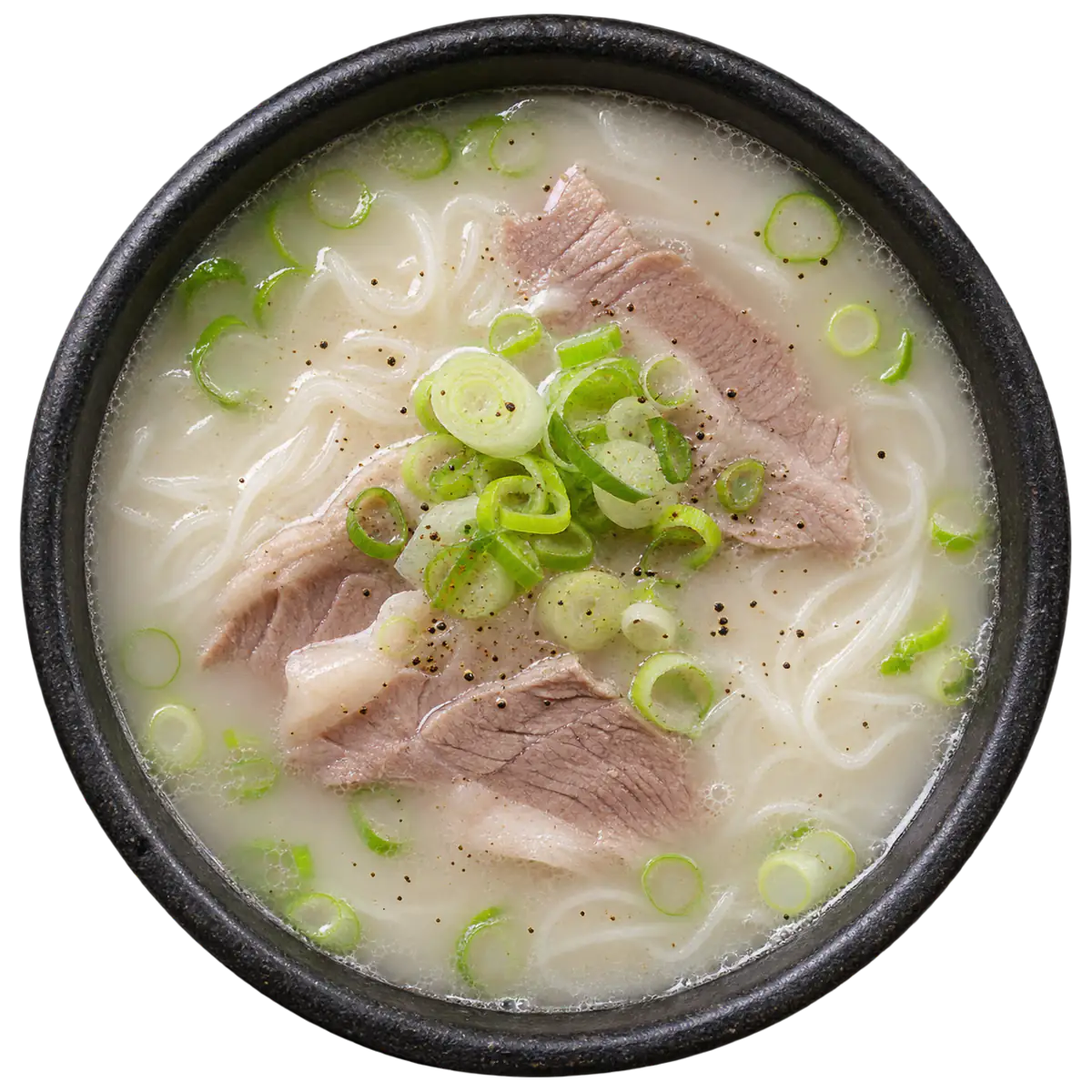
A milky white Korean soup of ox bones, head, feet and brisket simmered for many hours, seasoned at the table with salt, pepper and scallion and eaten with rice or noodles and kkakdugi.
Origin and history
The Encyclopedia of Korean Culture defines seolleongtang as a long-simmered white soup of ox head, shank, meat, bones and offal, and gives three explanations of its origin: the ox sacrificed at the Seonnongdan rite and boiled as soup for onlookers (the most popular, with the name said to have shifted from seonnongtang), a tale of King Sejong caught in the rain, and Mongolian influence. These are theories, not documented fact. It was an early popular food of Seoul, and Seoul Metropolitan Government placed it first on its Future Heritage list.
Make it at home
- Makes
- 6 servings
- Total time
- 9 h
- Hands-on
- 50 min
Ingredients
- 2 kg4.4 lb beef bones, a mix of knuckle, leg and marrow bones
- 700 g1.5 lb beef brisket, or shank
- 8 L8 qt water, for the soaking, blanching and the main pot, topped up as it cooks
- 1/2 onion, for cooking the meat
- 1 piece Korean radish, about 150 g (5 oz), for cooking the meat
- 4 scallions, chopped, for serving
- fine sea salt and ground black pepper, at the table
- 50 g2 oz thin wheat noodles (somyeon) or cooked glass noodles, optional
- steamed rice, to serve
- kkakdugi (cubed radish kimchi), to serve
Method
-
1. Soak the bones in cold water for at least 1 hour, changing it once, to draw out the blood.
-
2. Cover the bones with fresh water, boil hard for 15 minutes, drain, rinse the bones under running water and scrub the pot.
-
3. Return the bones to the pot, cover with about 4 L (4 qt) fresh water and boil briskly, partly covered, for 1 hour, skimming; add water so the bones stay covered.
-
4. Keep boiling and topping up with hot water, about 1 more hour, until the broth turns cloudy and starts to look milky.
-
5. Lower to a steady simmer and cook for 5 to 6 hours more, topping up with hot water as needed, until the broth is opaque white; this long time is what makes it milky.
-
6. Meanwhile, simmer the brisket separately with the onion and radish in about 2 L (2 qt) water for 1 1/2 hours until tender, then slice it thinly across the grain.
-
7. Strain the bone broth, combine with a ladle of the brisket broth if you like, and skim the surface fat; keep it hot.
-
8. Put rice, or noodles, in warm bowls, add the sliced brisket, ladle over the boiling-hot broth, and top with scallion. Serve with salt, pepper and kkakdugi at the table.
Notes
- The soup is served unseasoned: each diner adds salt, pepper and chopped scallion at the table, and some add red pepper powder. Rice goes into the bowl first, or noodles, and then the sliced meat and boiling broth. Kkakdugi is the standard side dish, and a spoonful of its brine can go into the soup.
- Traditional versions include ox head, feet and offal as well as bones; brisket and bones are the easy home version. The long boil is what turns the broth milky white.
- Gomtang, a clear long-simmered beef soup, and galbitang (clear short-rib soup) are separate dishes.
- Make ahead: it keeps 3 days, and the fat that sets on top can be lifted off. Freezes well.
Adapted from Encyclopedia of Korean Culture (한국민족문화대백과사전), 설렁탕, Korean Culture and Information Service, Seolleongtang feature, and Kimchimari, Seolleongtang.
At the festivals
No festival we list has printed it on a menu yet.