
🇹🇼 Taiwan
Red-braised beef noodle soup
The soy-braised style of Taiwanese beef noodle soup, one of its two classic schools (red-braised and clear-stewed): beef braised for hours with soy sauce, doubanjiang and spices, giving a dark reddish-brown broth.
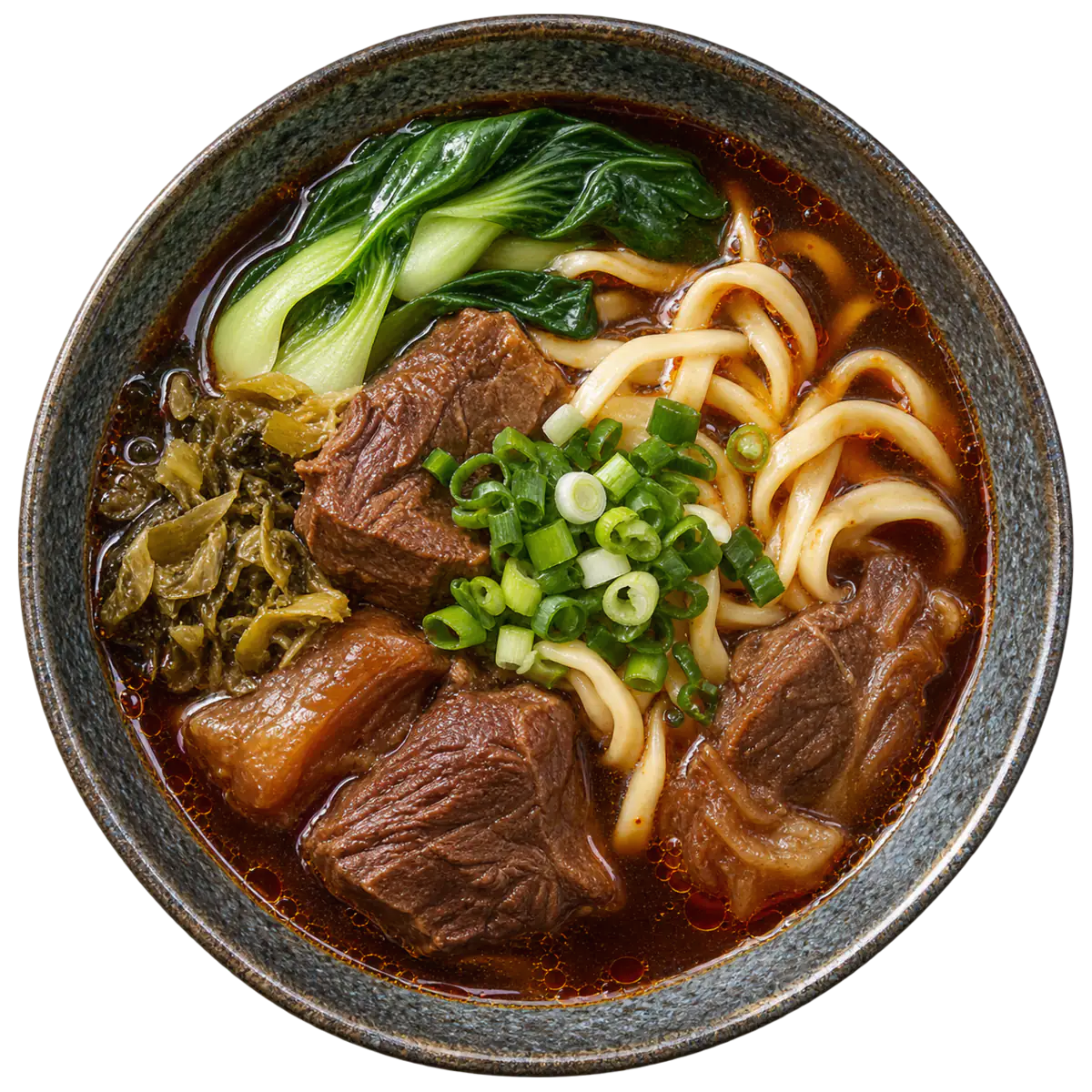
Origin and history
Red-braised beef noodle soup is the style most people mean by Taiwanese beef noodle soup. The historian Lu Yao-tung traced it to Sichuanese veterans at the Gangshan air base in Kaohsiung after 1949, who made a soybean version of Pixian chili bean paste; military-village wives braised beef in it, and the dish spread north to Taipei. Red-braised and clear-stewed have long been the two core styles judged at the Taipei beef noodle festival.
Make it at home
- Makes
- 6 servings
- Total time
- 5 h
- Hands-on
- 1 h
Ingredients
- 1.5 kg3.3 lb beef bones (marrow and knuckle), for the stock
- 4 l17 cups water, for the stock
- 1 onion, quartered, for the stock
- 1 carrot, in chunks, for the stock
- 1 kg2.2 lb beef shank (牛腱), in 4 to 5 cm (1 1/2 to 2 in) chunks
- 500 g1.1 lb beef tendon (牛筋), whole
- 3 tbsp vegetable oil
- 8 slices fresh ginger
- 8 cloves garlic, smashed
- 4 scallions, in 5 cm (2 in) lengths
- 2 ripe tomatoes, in wedges
- 2 to 3 dried red chiles, optional
- 3 tbsp doubanjiang (spicy fermented bean paste, ideally Taiwanese Gangshan style)
- 20 g1 1/2 tbsp rock sugar, crushed
- 150 ml2/3 cup Taiwanese rice wine (米酒) or Shaoxing wine
- 120 ml1/2 cup light soy sauce
- 2 tbsp dark soy sauce
- spice bag: 2 star anise, 1 tsp Sichuan peppercorns, 1/2 tsp fennel seeds, a 5 cm (2 in) piece of cassia bark, 1 cao guo (black cardamom), 2 bay leaves, tied in muslin
- 600 g1.3 lb fresh wheat noodles, wide or knife-cut, or 400 g / 14 oz dried
- 6 small heads baby bok choy, halved
- 200 g7 oz suan cai (Hakka pickled mustard greens, 酸菜), rinsed, chopped, stir-fried with 1 tbsp oil, 1 tsp sugar and a chopped chile
- 2 scallions, thinly sliced, to serve
- chili oil and salt, to taste
Method
-
1. Put the bones, shank and tendon in a large pot of cold water, bring to a boil and boil for 5 minutes. Drain and rinse everything under running water.
-
2. Return the bones to the clean pot with the 4 litres of water, the onion and carrot. Bring to a boil, skim, and simmer uncovered for 2 hours while you braise the beef. Strain; you need about 2.5 litres (10 1/2 cups) of stock.
-
3. In a wide, heavy pot, heat the oil over medium-low heat, add the doubanjiang and fry it, stirring, for 2 to 3 minutes, until the oil turns brick red and smells toasty.
-
4. Add the ginger, garlic, scallions and chiles and fry for 1 minute, then add the tomatoes and cook until they collapse, about 3 minutes.
-
5. Raise the heat, add the shank and tendon and stir-fry for 5 minutes so the meat is coated in the red paste.
-
6. Add the rock sugar, pour in the rice wine and let it bubble for 1 minute, then add both soy sauces and stir until the meat is glossy and dark.
-
7. Add the strained beef stock (or water, if you skipped the stock) and the spice bag. Bring to a boil, skim, cover and simmer very gently.
-
8. After about 2 hours, test the shank: when a chopstick slides in easily, lift it out. Keep simmering the tendon until it is soft and translucent, usually another 30 to 45 minutes, then lift it out too.
-
9. Discard the spice bag and skim the fat from the broth. Taste: it should be deep reddish-brown, savoury, a little sweet and gently spicy; adjust with salt or water.
-
10. Slice the shank and tendon across the grain into thick pieces and return them to the broth to stay warm. If you have time, let everything cool and rest overnight in the fridge, then reheat; the flavour rounds out.
-
11. Cook the noodles in plenty of unsalted boiling water until just tender, adding the bok choy for the last minute. Drain.
-
12. Divide noodles and greens among large bowls, top with shank and tendon, ladle over the hot broth and finish with scallions. Serve the suan cai and chili oil on the table.
Notes
- How it differs from the parent: this is the full shop-style hongshao bowl. The beef is braised in a beef-bone stock rather than water, the doubanjiang is fried until its oil turns red, a bag of whole spices goes in, and shank and tendon are cooked to their own doneness. The broth is darker, spicier and more layered than the everyday home pot.
- Doubanjiang: Taiwanese Gangshan-style paste is made from soybeans, where Sichuan Pixian paste uses broad beans. Either works; taste the broth before salting, as bean pastes vary a lot in saltiness.
- Shops guard their spice formulas; some use dozens of ingredients. Some cooks add a little tomato for sweetness and acidity, others none.
- Resting the broth overnight and reheating it is a trick of competition-winning Taipei cooks: it settles and the flavour becomes more refined.
- Cuts: order 'half tendon, half meat' (半筋半肉) in Taiwan and you get shank and tendon together, the most popular bowl.
- The other main style, qingdun (清燉, clear-stewed), has its own page: a clear beef broth with ginger and rice wine, no soy or bean paste.
Adapted from Cathy Erway, The Food of Taiwan: Recipes from the Beautiful Island (Taiwanese Beef Noodle Soup), 台灣牛肉麵兩大流派 一碗濃湯見證社會演變, HK01, and Michelin Guide Taiwan, 經典美味:牛肉麵.
At the festivals
Served at 1 festival in Taiwan.
Earlier editions
-
September 17, 2022 – September 18, 2022
🇹🇼 Taipei, Taiwan
2022 Taipei Beef Noodle International Prize (臺北市牛肉麵國際大賞, 'Wa-cow Carnival')
On the menu as 紅燒牛肉麵
By 桃園「金大方麵食館」, 台北老爺 (Taipei Howard), chef 林繼正, 台北晶華 (Regent Taipei), chef 林承翰 of 晶華軒, 六福萬怡酒店大廳酒吧The Lounge, 台北凱達大飯店 「98酒吧」, Gold: 金大方麵食館, 老爺大酒店, 兩支北方麵食館, Suage (Hokkaido), Winners: 金大方麵食館, 老爺大酒店, 兩支北方麵食館 (gold), Winner: 基隆翹腳牛肉麵 (gold), Competing shops, fresh-food group, and Ready-to-cook pack group
-
September 24, 2019
🇹🇼 Taipei, Taiwan
2019 Taipei Beef Noodle Xiangwei International Grand Evaluation (臺北市牛肉麵饗味國際大評比)
On the menu as 紅燒牛肉麵 (2012紅燒冠軍牛肉麵)
By 皇家傳承
-
November 21, 2009 – November 22, 2009
🇹🇼 Taipei, Taiwan
5th Taipei Beef Noodle Festival
On the menu as 紅燒牛肉麵 (red-braised beef noodles, knife-cut noodles)
By 王鴻庚, 高雄左營東北劉家酸白菜火鍋店
-
November 03, 2007
🇹🇼 Taipei, Taiwan
2007 Taipei International Beef Noodle Festival (牛轉世界 獨當一麵)
On the menu as 紅燒 (red-braised) beef noodles and 紅燒牛肉麵
By 洪師父牛肉麵, 洪師父麵食棧 owner brothers, and 洪金龍 (洪師傅 / Chef Hung)