
🇫🇷 France · Marseille, Provence
BouillabaisseMarseille fish stew
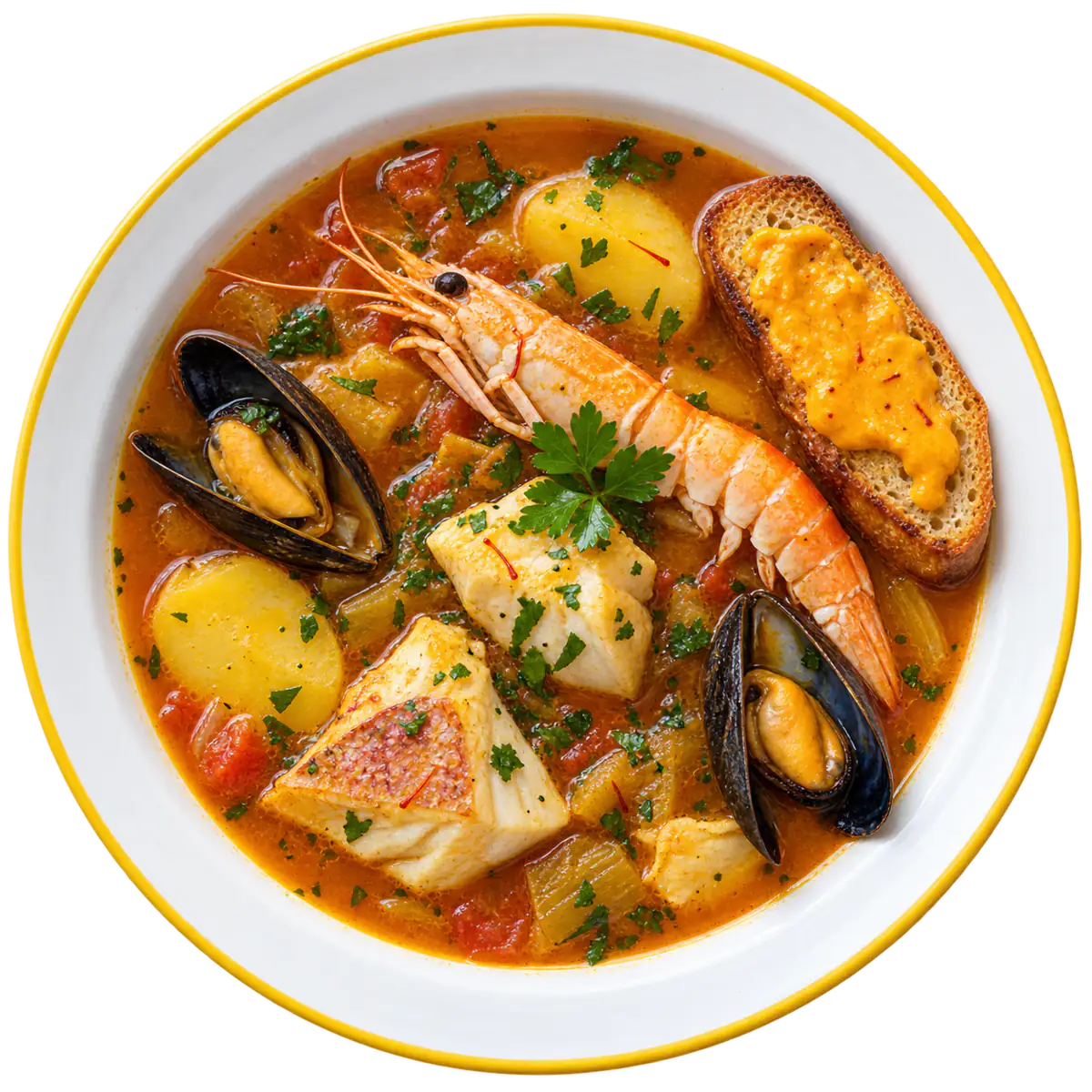
A Provençal fish soup from Marseille made with several bony Mediterranean rockfish (the 1980 charter asks for at least four species from a list led by rascasse), vegetables, olive oil and saffron, served with rouille and bread.
Origin and history
Bouillabaisse began as a Marseille fishermen's meal, made from the bony rockfish set aside as unsaleable when the catch was sorted. Its name is usually explained as 'when it boils, lower the heat'. Restaurants later refined it, and in 1980 a group of Marseille restaurateurs drew up the Charte de la bouillabaisse, setting out the fish (at least four kinds, rascasse first), the method and the service, because any fish soup was being sold under the name. The charter is a voluntary commitment, not a legal protection.
Make it at home
- Makes
- 6 servings
- Total time
- 2 h 30 min
- Hands-on
- 1 h 15 min
Ingredients
- 1 kg2.2 lb small rockfish for the soup base (poissons de roche: girelle, serran, small scorpionfish, small gurnard), scaled and gutted; or white-fish heads and frames, gills removed
- 200 g7 oz small green shore crabs (favouilles), optional, rinsed
- 6 tbsp olive oil
- 2 onions, sliced
- 1 leek, white part, washed and sliced
- 4 garlic cloves, crushed
- 500 g1.1 lb ripe tomatoes, chopped
- 1 small bulb fennel, sliced; or a few stalks of wild fennel
- 1 bouquet garni (bay leaf, thyme, parsley stalks)
- 1 strip orange peel, untreated, white pith removed
- 2.5 l10½ cups water, boiling
- 2 generous pinches (about 0.3 g)2 generous pinches saffron threads, plus a pinch for the rouille
- salt, black pepper and a pinch of cayenne, to taste
- 2–2.5 kg4.4–5.5 lb whole Mediterranean fish, at least four kinds: rascasse (scorpionfish), saint-pierre (John Dory), grondin (gurnard), vive (weever), baudroie (monkfish), congre (conger), scaled and gutted, cut into thick pieces on the bone; heads kept on the small ones
- 800 g1.75 lb firm waxy potatoes, optional (see notes); peeled, cut in 1.5 cm (½ in) slices
- 40 g1.5 oz stale white bread, crumb only, for the rouille
- 3 garlic cloves, for the rouille
- 1–2 small fresh red chillies, seeded; or a good pinch of cayenne
- 200 ml¾ cup + 1 tbsp olive oil, for the rouille
- 1 baguette, sliced, dried in the oven and rubbed with garlic
Method
-
1. Heat the 6 tbsp olive oil in a large pot over high heat and cook the onions, leek and garlic for 5 minutes, until soft.
-
2. Add the tomatoes and fennel and cook for 5 minutes more, until the tomatoes break down.
-
3. Add the soup rockfish, the crabs if using, the bouquet garni and the orange peel. Stir over high heat for 10–15 minutes, crushing the fish with a wooden spoon, until it falls apart into a thick paste.
-
4. Pour in the boiling water, bring back to a rolling boil and boil hard for 10 minutes, then lower the heat and simmer for 40 minutes.
-
5. Pass everything through a food mill, then press it through a fine sieve to extract all the juice; you should have about 2 l (8½ cups) of opaque orange broth. Discard the bones.
-
6. Make the rouille: moisten the bread with a ladle of broth and squeeze it dry. Pound the garlic, chillies, a pinch of saffron and a pinch of salt to a paste in a mortar, work in the bread, then add the 200 ml olive oil drop by drop at first, then in a thin stream, stirring all the time, until the sauce is thick and glossy.
-
7. Pour the broth into a wide clean pot, bring it to a boil and add the saffron; season with salt, pepper and cayenne.
-
8. Add the potato slices, if using, and the firm fish (rascasse, monkfish, conger, gurnard) and keep at a steady boil for 10 minutes.
-
9. Add the delicate fish (John Dory, weever) and cook for 5–8 minutes more, until all the flesh lifts easily from the bone.
-
10. Lift the fish and potatoes with a slotted spoon onto a warm platter and moisten them with a little broth; keep the rest of the broth hot.
-
11. Serve in two courses: first the broth, poured over the garlic croutons spread with rouille; then the fish, filleted at the table, with the potatoes and more broth and rouille.
Notes
- The 1980 Charte de la bouillabaisse, signed by a group of Marseille restaurateurs, asks for at least four species from a list of Mediterranean fish led by rascasse, together with baudroie, fielas (conger), chapon (large scorpionfish), vive, saint-pierre and galinette. Freshness is the first rule, and purists accept only fish from the Mediterranean.
- Potatoes divide cooks: Marseille's tourist office includes thick slices cooked in the broth, while Le Routard notes they are common in Toulon but less so in Marseille, where the soup, the fish and the rouille may be served alone.
- Rouille is made either on a bread base, as here, or on a garlic and saffron aioli with chilli; both are served on dried bread rubbed with garlic.
- Outside the Mediterranean, use a mix of firm white fish with bones and skin (gurnard, monkfish, John Dory, red mullet, rockfish or other scorpionfish), and fish frames plus a few small crabs for the base. Avoid oily fish such as mackerel or sardines. The soup will be good but lighter than a Marseille bouillabaisse.
- The name is traditionally explained as boil, then lower (bouiabaisso in Provençal): the broth is boiled hard to bind the oil into it, then the heat is lowered so the fish cook gently.
- Make the strained broth and the rouille up to a day ahead and keep them cold; cook the fish only at the last moment.
- Restaurants serve bouillabaisse for at least two people, and carving the fish in front of the guests is part of the ritual.
Adapted from Office de Tourisme de Marseille: La bouillabaisse and Le Routard: Recette de la bouillabaisse.
At the festivals
Served at 1 festival in Czechia.
Earlier editions
- October 17, 2026
-
October 19, 2019
🇨🇿 Prague, Czechia
Podzimní Polívkování